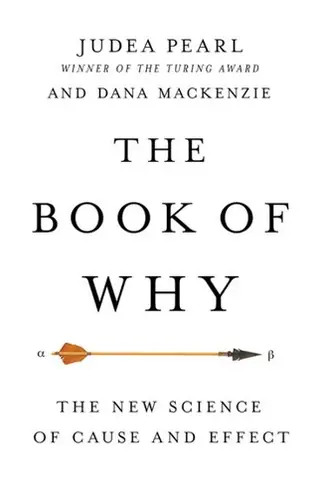
The Book of Why
The New Science of Cause and Effect
by Judea Pearl, Dana Mackenzie, Dana Mackenzie Judea Pearl, Mel Foster · first published 2018
57% recommend37% neutral7% critical
Why HN recommends it
Readable popular introduction to causal inference for laypeople and ML or stats folks: explains why correlation isn't causation, uses real-life examples and history, and argues causality belongs at the heart of ML.
Summarised by Claude from recommending comments
A Turing Award-winning computer scientist and statistician shows how understanding causality has revolutionized science and will revolutionize artificial intelligence “Correlation is not causation.” This mantra, chanted by scientists for more than a century, has led to a virtual prohibition on causal talk. Today, that taboo is dead. The causal revolution, instigated by Judea Pearl and his colleagues, has cut through a century of confusion and established causality–the study of cause and effect–on a firm scientific basis. His work explains how we can know easy things, like whether it was rai
Affiliate links. As an Amazon Associate I earn from qualifying purchases.
Mentions per year
What Hacker News says
Related books
 2016–2022
Causal Inference in Statistics
Judea Pearl, Nicholas P. Jewell
Recommended by 5 · mentioned by 75 recommend · 7 mention5 recommend · 75 recommend
 2016–2023
Counterfactuals and Causal Inference
Stephen L. Morgan
Recommended by 4 · mentioned by 54 recommend · 5 mention4 recommend · 54 recommend
 2009–2024
Probabilistic reasoning in intelligent systems
Judea Pearl
Recommended by 7 · mentioned by 117 recommend · 11 mention7 recommend · 117 recommend
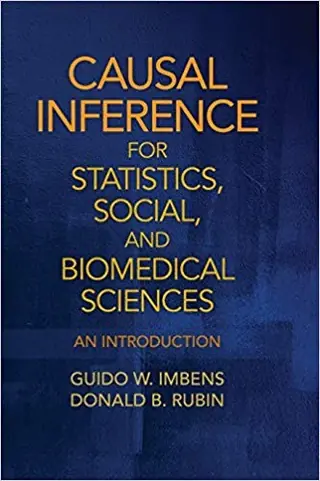 2016–2020
Causal Inference for Statistics, Social, and Biomedical Sciences
Guido W. Imbens, Donald B. Rubin
Recommended by 4 · mentioned by 64 recommend · 6 mention4 recommend · 64 recommend
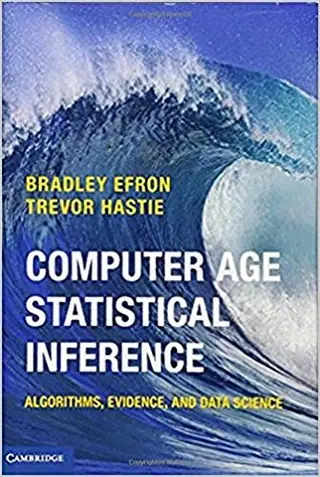 2016–2026
Computer Age Statistical Inference
Bradley Efron, Trevor Hastie
Recommended by 14 · mentioned by 1714 recommend · 17 mention14 recommend · 1714 recommend
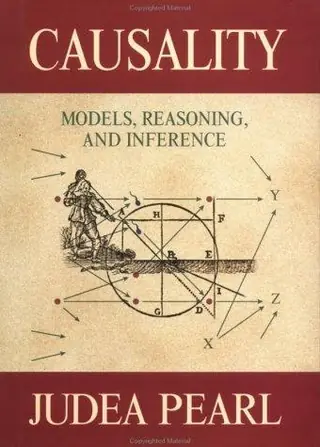 2009–2024
Causality
Judea Pearl
Recommended by 17 · mentioned by 3417 recommend · 34 mention17 recommend · 3417 recommend
 2012–2025
Models behaving badly
Emanuel Derman
Recommended by 5 · mentioned by 65 recommend · 6 mention5 recommend · 65 recommend
 2018–2025
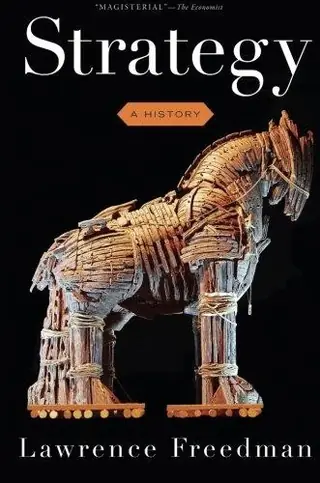
Strategy
Lawrence Freedman
Recommended by 6 · mentioned by 76 recommend · 7 mention6 recommend · 76 recommend
…The Soul of a New Machine, or if you like watching Halt and Catch Fire, you may well like Dreaming in Code. Inspired by Marty Cagan. Really solid overview of the essentials of product management. The Book of Why: The New Science of Cause and Effect by Judea Pearl. Judea Pearl is, of course, a giant in the worlds of statistics and AI, and this book distills his work on "causal inference" and lays it all out in…
on “Ask HN: Favorite nonfiction books of 2018?” ↗I presume this was heavily downvoted because of the Rand. While I'm not a fan of her either, that's unfair: 1. Dreaming in Code and The Book of Why are excellent (I haven't read the other two), and 2. Rand makes some points that some people need to learn, even if I don't buy her whole worldview.
on “Ask HN: Favorite nonfiction books of 2018?” ↗Sadly, social media is the new smoking. I encourage everyone to read "the book of why" by Judea Pearl. It illustrates how "research" and "studies" were used to sew doubt about the dangers of smoking. That's where we're at with social media, BUT, we have new tools like causal inference…
on “Teens, tech and mental health: Oxford study finds no link” ↗exactly, Judea Pearl's The Book of Why opened my eyes to the fact that most of what happens in machine learning is really just curve fitting It connected with what i've heard Chomsky say about trying to develop laws of physics by filming…
on “Time Series Prediction Using LSTM Deep Neural Networks” ↗…a clear path from where you are. For me Gelmans Data Analysis Using Regression and Multilevel/Hierarchical Models [0] drove home many, many points. More recently, I have a sense/hope that Pearl's The Book of Why [1] might take this to yet another level. [0] http://www.stat.columbia.edu/~gelman/arm/ [1] https://www.amazon.com/Book-Why-Science-Cause-Effect/dp/0465...
on “Ask HN: What are your favorite statistics and probability textbooks?” ↗…have a mental model to ponder 'what if' and can't use counter-factuals to ponder what would happen if it didn't do something. It's just glorified pattern matching currently. Reading Judea Pearl's The Book Of Why certainly sobered my outlook on AI.
on “Tesla has a self-driving strategy other companies abandoned years ago” ↗The Book of Why by Judea Pearl may be a good starting point for anyone interested in this.
on “Causal Inference and Data-Fusion in Econometrics (2019)” ↗…experience diminishing returns in performance because of this. For us to achieve AGI[0], the holy grail of AI, we will need to develop algorithms that can recognize causality somehow. Judea Pearl’s “The Book of Why”[1] does a great job articulating why this is important. Deep learning is a big leap forward and we’re only beginning to see its impacts, but it’s not sufficient to achieve AI’s most ambitious goals.…
on “The Computational Limits of Deep Learning” ↗I recommend "The Book of Why" by Judea Pearl as an introduction to the topic. It is targeted at a general (but educated) audience.
on “Understanding Causality Is the Next Challenge for Machine Learning” ↗…learn bayesianism on a bunch of problems that are easy with bayesianism and very hard or impossible to tackle with frequencies. You can try "Think Bayes"[1] if you like. Or to read Judea Pearl's "The Book of Why"[2]. He invented modern bayesianism, starting with ideas of Thomas Bayes. "The Book of Why" more of his next invention (Causation) but he talks there of bayesianism too. [1] https://greenteapress.com/wp/think-bayes/…
on “What Is Bayesian/Frequentist Inference? (2012)” ↗I bought Judea Pearl’s new book The Book of Why last night after reading this article. So far I love the book. I manage a machine learning team at work and I appreciate Pearl’s discussion of how deep learning and statistics won’t lead to strong AI.
on “How Judea Pearl Became One of AI's Sharpest Critics” ↗…Astonishing story. What Money Can't Buy: The Moral Limits of Markets by Michel Sandel The Attention Merchants by Tim Wu Who we are and how we got here by David Reich: ancient DNA and human history The Book of Why by Judea Pearl; liked it but I need to reread this one a few more times to comprehend completely or go to his textbooks Empire of Cotton: Sven Birckets; a history of the first global technology including…
on “Ask HN: Favorite nonfiction books of 2018?” ↗Reading Judea Pearl is recommended. You might begin with The Book of Why and then do a deep dive. Michael Neilson has a good blog post on the issue: http://www.michaelnielsen.org/ddi/if-correlation-doesnt-impl... with interesting comments by Judea Pearl at http://www.michaelnielsen.org/ddi/guest-post-judea-pearl-on-....…
on “Correlation Is Not Causation. How Often?” ↗Anything by Judea Pearl, but especially the Book of Why[1], is good. He comes at causality from a CS perspective, which I think would make sense for most people on here. Economists also have a big causality literature which might be less accessible for HN…
on “Actual Causality (2016)” ↗…listen for a long time. Instead of worshipping blindly at the altar of RCTs, we should pay attention to what actual statisticians have to say about actual results. Judea Pearl, in a recent book, "The Book of Why", provides a readable, in-depth exploration of statisticians' fundamental relationship with causuality, and the historical development of statisticians' decades-long loss of their ability to form conclusions…
on “Transport noise linked to increased risk of dementia, study finds” ↗