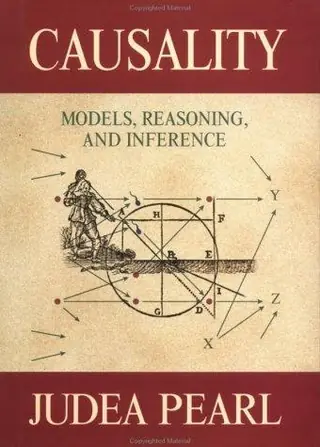
Causality
by Judea Pearl · first published 2000
50% recommend50% neutral
Why HN recommends it
Rigorous treatment of how causal concepts connect to statistical evidence, covering graphical models and instrumental variables. Suits readers who want to infer causation from observational data.
Summarised by Claude from recommending comments
Written by one of the preeminent researchers in the field, this book provides a comprehensive exposition of modern analysis of causation. It shows how causality has grown from a nebulous concept into a mathematical theory with significant applications in the fields of statistics, artificial intelligence, economics, philosophy, cognitive science, and the health and social sciences. Judea Pearl presents and unifies the probabilistic, manipulative, counterfactual, and structural approaches to causation and devises simple mathematical tools for studying the relationships between causal connecti
Affiliate links. As an Amazon Associate I earn from qualifying purchases.
Mentions per year
What Hacker News says
Related books
 2009–2024
Probabilistic reasoning in intelligent systems
Judea Pearl
Recommended by 7 · mentioned by 117 recommend · 11 mention7 recommend · 117 recommend
 2018–2026
The Book of Why
Judea Pearl, Dana Mackenzie, Dana Mackenzie Judea Pearl, Mel Foster
Recommended by 59 · mentioned by 10359 recommend · 103 mention59 recommend · 10359 recommend
 2010–2025
Probabilistic Graphical Models
Daphne Koller, Nir Friedman
Recommended by 16 · mentioned by 3716 recommend · 37 mention16 recommend · 3716 recommend
 2010–2026
The Old Man and the Sea
Ernest Hemingway
Recommended by 31 · mentioned by 8231 recommend · 82 mention31 recommend · 8231 recommend
 2008–2025
Good calories, bad calories
Gary Taubes
Recommended by 91 · mentioned by 13291 recommend · 132 mention91 recommend · 13291 recommend
 2007–2026
Fooled by randomness
Nassim Nicholas Taleb
Recommended by 195 · mentioned by 307195 recommend · 307 mention195 recommend · 307195 recommend
 2008–2026
Anathem
Neal Stephenson
Recommended by 207 · mentioned by 393207 recommend · 393 mention207 recommend · 393207 recommend
 2007–2026
Zen and the Art of Motorcycle Maintenance
Robert M. Pirsig
Recommended by 302 · mentioned by 508302 recommend · 508 mention302 recommend · 508302 recommend
Causality by Judea Pearl, Probability by Jaynes & Elements of Information Theory by Cover. The above will help you design trading strategies. For modelling derivatives and such, you'll have to check out books…
on “Good books for hackers interested in quant finance?” ↗…makes it feel as though some kind of "special" correlation implies causation. Really, correlation is just one part of a package of other things which all together imply causation. http://www.amazon.com/Causality-Reasoning-Inference-Judea-Pe...
on “Correlation does not even imply correlation” ↗The book Causality by Judea Pearl is kind of an extended answer to this question.
on “We know correlation does not imply causality. What does?” ↗I recommend Causality by Judea Pearl, he has a pretty good discussion of why science is the study of causal models: https://books.google.com/books?id=LLkhAwAAQBAJ Basically, if you do not have a notion of causality, you cannot…
on “Causal feedbacks in climate change” ↗Causality, i.e. Causal inference & Graphical Models, see the work by Judea Pearl, he pretty much singlehandedly pioneered the field. https://www.amazon.com/Causality-Reasoning-Inference-Judea-P... https://en.wikipedia.org/wiki/Causality#Theories…
on “What are the most important statistical ideas of the past 50 years? [pdf]” ↗…to, if the study is to be believed, increase the probability of pot use. Correlations and probabilities are interesting for themselves, and can in fact be used to imply causation. http://www.amazon.com/Causality-Reasoning-Inference-Judea-Pe...
on “High IQ linked to drug use” ↗And don't forget the later "Causality" (2nd edition): http://www.amazon.com/Causality-Reasoning-Inference-Judea-Pe...
on “Cigarettes, damn cigarettes and statistics” ↗…variables and lays out graphical configurations where you can measure the causal effect of a variable onto another variable, and how to compute that effect. A great reference: https://www.amazon.com/Causality-Reasoning-Inference-Judea-P... A nice introduction: https://www.youtube.com/watch?v=RPgvfSeQB8A
on “Causal inference in Python” ↗…were physics, one could come up with a predictive theory to put this to the test. In social studies, we just cannot control the parameters well enough. If you are interested in reading more on this, "Causality" by Judea Pearl is a good (but exhausting read).
on “Developers who use spaces make more money than those who use tabs” ↗…"Integration and Probability"[11] 11. Segal/Kunze's "Integrals and Operators"[12] Similarly, some normative focus on probability would be useful: 12. Jaynes' "Probability Theory"[13] 13. Pearl's "Causality"[14] --- [0] https://bartoszmilewski.com/2014/10/28/category-theory-for-p... [1] https://www.amazon.com/Topoi-Categorial-Analysis-Logic-Mathe... [2] http://www.cwru.edu/artsci/phil/UsesandAbuses%20HistoryTopos...…
on “Physics, Topology, Logic and Computation: A Rosetta Stone (2009) [pdf]” ↗…whether smoking is bad for you. Of course this would take away much of the reason why smoking is bad for you. You need a proper causal model informed by data - something that is hard to do. See Judea Pearl "Causality". 6. Note the heterogeneity of results. This suggests that things are going on that are not captured by the studies. Note also that the types of mushrooms don't seem to matter - a strange thing if there…
on “Higher mushroom consumption is associated with a lower risk of cancer” ↗…lungs: Men who smoke die of lung cancer at 23 times the rate of nonsmokers. Now, that may not be from a randomized trial. But nonetheless, I think that's an important explanandum. See Judea Pearl's Causality if you don't think it's possible to get important data off of mere observational studies. It just seems really unlikely that, you know, future lung cancer would cause people to start smoking now, or…
on “The Scientific Scandal of Antismoking” ↗Please don't use this quote as a way to shut down discussions. If you're genuinely ignorant about how causality and correlation interact, go learn about it. (Judea Pearl's Causality is pretty good.)
…that "correlation is not causation, but causation causes correlation." For a fully rigorous and enjoyable treatment of how causal concepts relate to statistical evidence I recommend Judea Pearl's book Causality, which elaborates the concepts for which he won the Turing prize. If you don't have time for the book, the epilog is up on the web a few different places and is a great summary.
on “Why 'The Daily' Failed” ↗I won't claim to have fully internalized all of it, but Judea Pearl's book Causality is incredible.
on “Simpson's Paradox” ↗