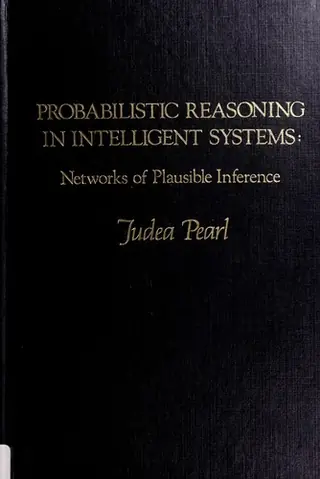
Probabilistic reasoning in intelligent systems
by Judea Pearl · first published 1988
11mentions
7recommended by
11HN commenters
2009–2024first – last mentioned
64% recommend36% neutral
Why HN recommends it
Foundational text on Bayesian networks and plausible inference. It offers clear, lasting insight into reasoning under uncertainty and serves as a starting point for probabilistic modeling.
Summarised by Claude from recommending comments
Affiliate links. As an Amazon Associate I earn from qualifying purchases.
Mentions per year
What Hacker News says
Related books
 2016–2022
Causal Inference in Statistics
Judea Pearl, Nicholas P. Jewell
Recommended by 5 · mentioned by 75 recommend · 7 mention5 recommend · 75 recommend
 2009–2024
Causality
Judea Pearl
Recommended by 17 · mentioned by 3417 recommend · 34 mention17 recommend · 3417 recommend
 2018–2026
The Book of Why
Judea Pearl, Dana Mackenzie, Dana Mackenzie Judea Pearl, Mel Foster
Recommended by 59 · mentioned by 10359 recommend · 103 mention59 recommend · 10359 recommend
Judea Pearl's Probabilistic Reasoning in Intelligent Systems: Networks of Plausible Inference. I'm not finished with it yet, though. (It might be superceded by his Causality which I'd also like to read.) It's provided some "aha", scales falling from eyes moments.…
on “Ask HN: Great books you read in 2009?” ↗…though I haven't gotten to the point where I could direct you to the best place to start, it would probably be in one of these books: E.T. Jaynes, "Probability Theory: The Logic of Science" Judea Pearl, "Probabilistic Reasoning in Intelligent Systems" Bayesian Data Analysis, 2nd ed by Gelman et. al
on “What's luck got to do with it? The math of gambling” ↗Seconded hard. If you have to read only one of these, read Probabilistic Reasoning in Intelligent Systems.
on “Ask HN: Great books you read in 2009?” ↗Pearl's "Probabilistic Reasoning in Intelligent Systems" was one of the most lauded books during my time in the university. I remember when Pearl gave a talk about his upcoming book Causality, my professor said that it might become one of the most important…
on “Engines of Evidence – A Conversation with Judea Pearl” ↗…them constructively. For those who want more he has a more technical book "Causality: Models, Reasoning and Inference" which is also excellent. Pearl is a legend in the field, who wrote the seminal "Probabilistic Reasoning in Intelligent Systems: Networks of Plausible Inference". There is a school of thought that there is nothing new here. Pearl is very honest and open about who invented what and of the mistakes in his earlier work. While no…
on “The Book of Why: The New Science of Cause and Effect [pdf]” ↗Just an interesting note, his son was Daniel Pearl, who was tragically murdered in Pakistan. I enjoyed Probabilistic Reasoning in Intelligent systems. I was unaware of Causality.
on “Engines of Evidence – A Conversation with Judea Pearl” ↗I think "Probabilistic Reasoning in Intelligent Systems" is a better starting point for Pearl. Not much easier but more familiar ground if you're coming from today's ML mindset. As an aside, once while reading through Wasserman's "All of Statistics", he somehow…
on “Causal Inference and Data-Fusion in Econometrics (2019)” ↗…very short: "AI" isn't the same as blockchain because some people on forums sound similar when talking about it, it's the culmination of decades of research that started in earnest w/ Judea Pearl's 1984 Probabilistic Reasoning in Intelligent Systems, or even the hubbub around Marvin Minsky's 1969 Perceptrons. It's an academic discipline, not a buzzword, and any professional or serious critique should engage with such work, not just quote-dunk the…
on “The Continued Trajectory of Idiocy in the Tech Industry” ↗…published "Causality: Models, Reasoning and Inference", which gives mathematical tools to track causes and effects. This book is full of "beliefs". Less so then the previous book of the same author ("Probabilistic Reasoning in Intelligent Systems"), but nevertheless. I believe, that the use of word "believe" or "feel" is not a sign of rejecting rationality. In this case it is about accepting the idea that we do not know the absolute truth and…
on “'We conclude' or 'I believe?' Study finds rationality declined decades ago” ↗…good design. This claim about Tdap is not like smoking...we don't have the same understanding of the underlying biology nor the massive effect sizes from other studies. I have read the Book of Why and Probabilistic Reasoning in Intelligent Systems. There is nothing within those books to indicate animus against well designed RCTs. Rather he advocates, as I already did, for intelligent combination of sometimes sparse RCTs with the large N of observational…
on “Transport noise linked to increased risk of dementia, study finds” ↗…several topics: - the retreat of AI to statistics, - Brooks subsumption architecture and some pitfalls, - the limited efficacy of neural networks and - even a brief discussion of Pearl's previous book("Probabilistic Reasoning in Intelligent Systems") and work, which provided just enough information to send me in a new direction!
on ““The next 50 years: A personal view” [of AI] by Patrick Henry Winston” ↗