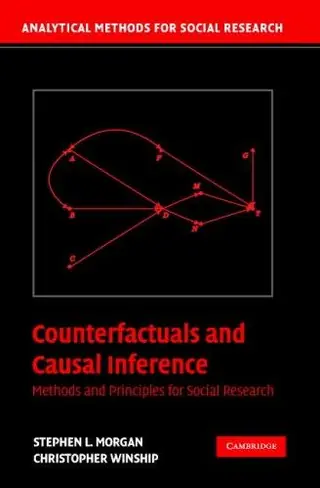
Counterfactuals and Causal Inference
Methods and Principles for Social Research (Analytical Methods for Social Research)
by Stephen L. Morgan · first published 2007
80% recommend20% neutral
"In this second edition of Counterfactuals and Causal Inference, completely revised and expanded, the essential features of the counterfactual approach to observational data analysis are presented with examples from the social, demographic, and health sciences. Alternative estimation techniques are first introduced using both the potential outcome model and causal graphs; after which, conditioning techniques, such as matching and regression, are presented from a potential outcomes perspective. For research scenarios in which important determinants of causal exposure are unobserved, alternative
Affiliate links. As an Amazon Associate I earn from qualifying purchases.
Mentions per year
What Hacker News says
Related books
 2016–2020
Causal Inference for Statistics, Social, and Biomedical Sciences
Guido W. Imbens, Donald B. Rubin
Recommended by 4 · mentioned by 64 recommend · 6 mention4 recommend · 64 recommend
 2018–2026
The Book of Why
Judea Pearl, Dana Mackenzie, Dana Mackenzie Judea Pearl, Mel Foster
Recommended by 59 · mentioned by 10359 recommend · 103 mention59 recommend · 10359 recommend
Someone posted this flowchart in a previous HN thread on Causal Inference frameworks: https://www.bradyneal.com/which-causal-inference-book (I picked up Counterfactuals and Causal Inference and Elements of Causal Inference, and would recommend both).
on “The Case for Causal AI” ↗Gelman's own book (with Jennifer Hill) also has some good, practical techniques on causal inference. [0] Morgan and Winship's Counterfactuals and Causal Inference: Methods and Principles for Social Research [1] is also really good. Be sure to get the second edition; it's much better than the first. [0] http://www.amazon.com/Analysis-Regression-Multilevel-Hierarc...…
on “Causal Inference in Statistics: A Primer” ↗…The set of questions it answers are about 80% overlapping (although both Pearl and POs have their own 20%), but I find the vocabulary a little more intuitive. Canonical books include Morgan and Winship "Counterfactuals and Causal Inference" or Imbens and Rubin "Causal Inference for Social Scientists". As to the blog post, Pearl is correct that causality requires qualitative assumptions about design to justify assumptions required to do…
on ““The Book of Why” by Pearl and Mackenzie” ↗Thank you, I was not aware of this book. I am currently working my way through the Counterfactuals and Causal Inference (2nd), and I would definitely recommend this book (arguably over JP's Causality) to those who are looking for a comprehensive, introductory text.
on “Causal Inference Book” ↗…analysis eventually succumbs to a more thorough analysis that uncovers serious issues in the assumptions. Take for instance the running example of catholic schoolings effect on test scores used by the boook Counterfactuals and Causal Inference. Subsequent chapter re-treat this example with increasingly sophisticated techniques and more complex assumptions about causal mechanisms, and each time they uncover a flaw in the analysis using techniques…
on “Causal inference as a blind spot of data scientists” ↗