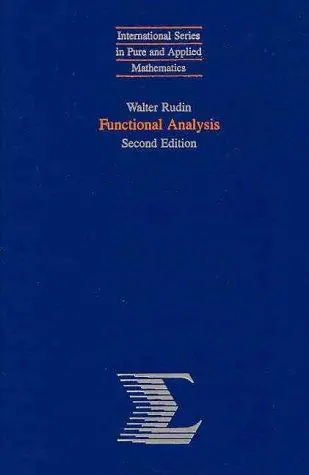
Functional Analysis
by Walter Rudin · first published 1973
100% recommend
Written for undergraduate courses, this new edition includes coverage of current topics of research and contains more exercises and examples. New topics covered include: Kakutani's fixed point theorem; Lomonosov's invariant subspace theorem; and an ergodic theorem
Affiliate links. As an Amazon Associate I earn from qualifying purchases.
Mentions per year
What Hacker News says
Related books
 2009–2025
Real and complex analysis
Walter Rudin
Recommended by 25 · mentioned by 4025 recommend · 40 mention25 recommend · 4025 recommend
 2015–2021
Linear Algebra
Kenneth Hoffman, Ray Kunze
Recommended by 2 · mentioned by 42 recommend · 4 mention2 recommend · 42 recommend
 2011–2024
Real Analysis
H. L. Royden, Patrick Fitzpatrick, Halsey Royden, Royden
Recommended by 4 · mentioned by 64 recommend · 6 mention4 recommend · 64 recommend
 2010–2025
A First Course in Mathematical Analysis
David A. Brannan
Recommended by 3 · mentioned by 63 recommend · 6 mention3 recommend · 63 recommend
 2008–2026
Principles of Mathematical Analysis
Walter Rudin
Recommended by 52 · mentioned by 8852 recommend · 88 mention52 recommend · 8852 recommend
 2008–2025
Topics in algebra
I. N. Herstein
Recommended by 10 · mentioned by 1110 recommend · 11 mention10 recommend · 1110 recommend
 2009–2025
Linear algebra and matrix theory
Evar D. Nering
Recommended by 1 · mentioned by 21 recommend · 2 mention1 recommend · 21 recommend
 2009–2026
Finite-dimensional vector spaces
Paul R. Halmos
Recommended by 24 · mentioned by 3824 recommend · 38 mention24 recommend · 3824 recommend
…theorem, but the same thing in Hilbert space is easier. There is a sense in which L1 and L-infinity are duals of each other, but L2 is self-dual which is nicer. Filling in all these details and more is part of functional analysis 101. There tough to miss at least three books of W. Rudin: Principles of Mathematical Analysis, Real and Complex Analysis, and Functional Analysis. There's more, but I've got some bugs to get out of…
on “Why squared error?” ↗…H. Olmsted, Counterexamples in Analysis John C. Oxtoby, Measure and Category: A Survey of the Analogies between Topological and Measure Spaces Walter Rudin, Real and Complex Analysis Walter Rudin, Functional Analysis Leo Breiman, Probability Kai Lai Chung, A Course in Probability Theory, Second Edition Jacques Neveu, Mathematical Foundations of the Calculus of Probability Erhan Cinlar, Introduction to Stochastic Processes…
on “Ask HN: Older textbooks/papers you consider classics still worth studying today?” ↗…Radon-Nikodym theorem (grown up version of the fundamental theorem of calculus and with astounding power) and the Fourier integral. I won't take off points if you don't read the second half. Rudin's Functional Analysis -- get to see distributions.
on “Algebra, Topology, Differential Calculus, and Optimization Theory for CS and ML [pdf]” ↗…on the basic results of self-adjoint matrices are the inverse and implicit function theorems given as nice exercises in the third edition of Rudin's Principles .... And spectral theory is in Rudin's Functional Analysis. Also get a bonus of a nice treatment of distributions, that is, replace the Dirac delta function usage in quantum mechanics. For how to get the eigen value and orthogonal eigen vector results for self-adjoint…
on “Ask HN: Older textbooks/papers you consider classics still worth studying today?” ↗…in another book, short, by Halmos, in Introduction to Hilbert Space and the Theory of Spectral Multiplicity: Second Edition (Dover Books on Mathematics) for about $10. For more, there is W. Rudin, Functional Analysis, as usual for Rudin, with astounding precision. Will have a tough time at any university finding a physics prof who will do that well with either the Fourier transform or spectral theory. So, can get…
on “Why Is College in America So Expensive?” ↗…theorems and is defined in more general situations. As in a 1933 paper of A. Kolmogorov, the Lebesgue integral gives a solid foundation to probability, statistics, and stochastic processes. In W. Rudin, Functional Analysis get a treatment of distributions that cleans up what physics tries to do with the Dirac delta function and also covers spectral theory. From there, can go for a Ph.D. For that will need mostly (A) pass…
on “Ask HN: How to self-study mathematics from the undergrad through graduate level?” ↗…and just becoming a better mathematician, a good start would be -> Baby Rudin (Principles of Mathematical Analysis, Walter Rudin) Papa Rudin (Real and Complex Analysis, Walter Rudin) Grandpa Rudin (Functional Analysis, Walter Rudin)
on “Ask HN: Serious mathematics books that can replace a good teacher?” ↗…(William Boyce and Richard DiPrima) - Topology (James Munkres) - Calculus On Manifolds (Michael Spivak) - Principles of Mathematical Analysis (Walter Rudin) - Real and Complex Analysis (Walter Rudin) - Functional Analysis (Walter Rudin) - Partial Differential Equations (Lawrence Evans) - Analysis On Manifolds (James Munkres) - Abstract Algebra (David Dummit and Richard Foote) - Algebraic Topology (Allen Hatcher) -…
on “Mathematician's anger over his unread 500-page proof” ↗…in X a vector? No, since -f is not in X. Neither is (1/2)f. Some references (with TeX markup): Paul R.\ Halmos, {\it Finite-Dimensional Vector Spaces, Second Edition\/} linear algebra treated as functional analysis. Walter Rudin, {\it Real and Complex Analysis\/} with Lebesgue integration and, then, Banach and Hilbert vector spaces. Walter Rudin, {\it Functional Analysis\/} with Fourier theory. Jacques Neveu,…
on “Functions Are Vectors (2023)” ↗…contents to suspect that again a dependency structure graph, especially for anyone with a background in Baby Rudin (Principles of Mathematical Analysis), Big Rudin (Real and Complex Analysis or maybe Functional Analysis), surprisingly, would not look very interesting. From just going through the table of contents, there are a lot of interesting and uncommon topics in those ~2000 pages, but the book looks more like a…
on “Algebra, Topology, Differential Calculus, and Optimization Theory for CS and ML [pdf]” ↗…series in the third edition of the W. Rudin Principles of Mathematical Analysis and also his very careful treatment of the Fourier transform in his Real and Complex Analysis, also distributions in his Functional Analysis. Also read and used the Blackman and Tukey The Measurement of Power Spectra, wrote some corresponding software that pleased some people in the US Navy, etc. Then I took a course at the level of the…
on “New atomic clock loses only one second every 300B years” ↗…and that can help you set aside some topics. Then, Royden, Real Analysis and the first half of Rudin's R&CA as above, along with any of several alternatives, cover measure theory and the beginnings of functional analysis. Measure theory does calculus again and in a more powerful way -- in freshman calculus, want to integrate a continuous function defined on a closed interval of finite length, but in measure theory get…
on “A Software Engineer’s Adventures in Learning Mathematics” ↗…infinite dimensional, notation and arguments when they also work for the finite dimensional results -- cute. This approach is easier and cleaner when it works. There is emphasis on duality, as is important in functional analysis including Hilbert space. Some of the special emphasis is on spectral theory, important in transformations on Hilbert space. Halmos includes some multi-linear algebra (can see again in exterior algebra…
on “The best linear algebra books” ↗…didn't want to do more. Principles does Fourier series and does not use measure theory. Real and Complex Analysis does the Fourier transform and uses the Lebesgue integral, that is, measure theory. Functional Analysis does Fourier theory with distributions. I had serious courses from Principles and R & CA. Also Royden and Neveu. All from a star student of Cinlar, long at Princeton. I read FA, quickly. I don't…
on “Probability (1963)” ↗…didn't want to do more. Principles does Fourier series and does not use measure theory. Real and Complex Analysis does the Fourier transform and uses the Lebesgue integral, that is, measure theory. Functional Analysis does Fourier theory with distributions. I had serious courses from Principles and R & CA. Also Royden and Neveu. All from a star student of Cinlar, long at Princeton. I read FA, quickly. I don't…
on “Probability (1963)” ↗