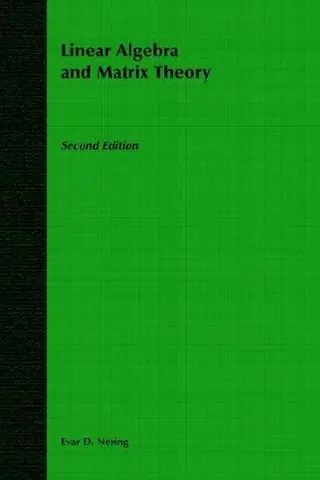
Linear algebra and matrix theory
by Evar D. Nering · first published 1963
50% recommend50% neutral
"This revision of a well-known text includes more sophisticated mathematical material. A new section on applications provides an introduction to the modern treatment of calculus of several variables, and the concept of duality receives expanded coverage. Notations have been changed to correspond to more current usage."--Publisher description.
Affiliate links. As an Amazon Associate I earn from qualifying purchases.
Mentions per year
What Hacker News says
Related books
 2010–2020
Computer solution of linear algebraic systems
George E. Forsythe
Recommended by 2 · mentioned by 32 recommend · 3 mention2 recommend · 32 recommend
 2015–2022
Introduction to abstract algebra
W. Keith Nicholson
Recommended by 2 · mentioned by 62 recommend · 6 mention2 recommend · 62 recommend
 2011–2024
Real Analysis
H. L. Royden, Patrick Fitzpatrick, Halsey Royden, Royden
Recommended by 4 · mentioned by 64 recommend · 6 mention4 recommend · 64 recommend
 2012–2024
Mathematical Analysis
Tom M. Apostol
Recommended by 6 · mentioned by 96 recommend · 9 mention6 recommend · 96 recommend
 2009–2024
Functions of Several Variables
Wendell Fleming, W. H. Fleming
Recommended by 4 · mentioned by 54 recommend · 5 mention4 recommend · 54 recommend
 2009–2026
General chemistry
Linus Pauling
Recommended by 13 · mentioned by 1513 recommend · 15 mention13 recommend · 1513 recommend
Evar D. Nering, Linear Algebra and Matrix Linear Algebra and Matrix Theory* Kenneth Hoffmann And Ray Kunze. Linear Algebra, 2nd Edition, Prentice-Hall, Englewood Cliffs, New Jersey, 1971. https://www.zuj.edu.jo/download/linear-algebra-2nd-edition-k... Halmos, Finite Dimensional…
on “Ask HN: Older textbooks/papers you consider classics still worth studying today?” ↗…processing). For Galois theory, took an oral exam on what was in Herstein. For linear algebra where the field is any of the rationals, reals, complex, and finite fields there is Evar D.\ Nering, {\it Linear Algebra and Matrix Theory,\/} John Wiley and Sons, New York, 1964.\ \ As I recall, Nering was an Artin student at Princeton. Some of the proofs for the rational, real, or complex fields don't work for finite fields so for those…
on “Learn you Galois fields for great good (2023)” ↗…introduction to Hilbert space for quantum mechanics. But FDVS is a little too much for a first book on linear algebra, or maybe even a second book, should be maybe a third one. Also high quality is Nering, Linear Algebra and Matrix Theory. Again, the quality comes through: Nering was a student of Artin at Princeton. There Nering does most of linear algebra on just finite fields, not just the real and complex fields; finite fields in…
on “Ask HN: Recommend a maths book for a teenager?” ↗…awfully old, but what it has are still the basics. ---------------------------------------- For my undergraduate honors paper I made some use of, and later read carefully nearly all of, Evar D. Nering, 'Linear Algebra and Matrix Theory', John Wiley and Sons, New York, 1964. The main part of this book is a relatively solid start, maybe a bit terse and advanced for a first text. The book also has in the back a collection of advanced…
on “Linear algebra tutorial in four pages” ↗…most precisely written texts, say, P. Halmos, Finite Dimensional Vector Spaces, W. Rudin, Principles of Mathematical Analysis, Neveu, Mathematical Foundations of the Calculus of Probability, E. Nering, Linear Algebra and Matrix Theory, Royden, Real Analysis where do a lot of the exercises as homework and where the professor DOES read and remark on your writing. Neveu was a Loeve student at Berkeley. Nering was an Artin student at…
on “Three sins of authors in computer science and math (1997)” ↗> you are extremely unlikely to learn linear algebra and matrix theory "on the job" Why? All of the information is available in books and on Wikipedia. Nowadays you can learn nearly anything for free with just an internet connection and some dedication. The biggest potential…
on “Is College Really Worth It? ” ↗Horn wrote about my work, "Best performance in the course throughout the semester. Knows this material cold." It was just true. Why? It was an 'advanced' course in linear algebra and matrix theory, and I'd never had even a first course in the subject. But long before the course, in total I'd done much more than just such a course. I had had two good courses in abstract algebra, each of which…
on “Linear algebra tutorial in four pages” ↗…5x - 2y + 7z = 3 From then on we work with matrices and try to avoid notation like 2x + 3y - 6z = 0 5x - 2y + 7z = 3 In this way, a course in linear algebra is commonly called a course, Linear Algebra and Matrix Theory. A matrix with just one column is a column vector; with just one row, a row vector. In short, either is called a vector. Linearity: Given m x n matrices A and B, m x 1 matrices u, v, and real numbers…
on “Ask HN: How to self-study mathematics from the undergrad through graduate level?” ↗…badly taught course in linear algebra. It turns out, I did really well in linear algebra, and "Part I" explains how well I did and how I did that. In "Part II" I give an outline of an introduction to linear algebra and matrix theory. For my background I've taught applied math and computer science at three well known research universities and have a Ph.D. in pure/applied math from a fourth. From how I learned math I have to say…
on “Why Won’t Anyone Teach Her Math?” ↗