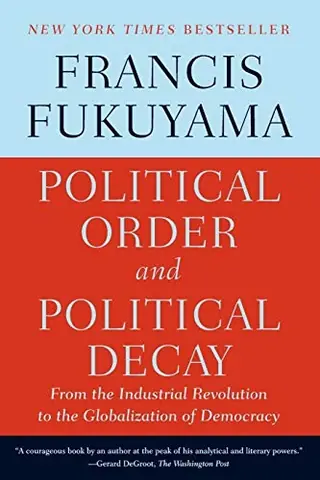
Political order and political decay
by Francis Fukuyama · first published 2014
67% recommend33% neutral
Why HN recommends it
Broad historical account of how states develop and decay, tracing where political institutions come from and why progress is not inevitable; recommended for readers interested in political history and governance.
Summarised by Claude from recommending comments
"The second volume of the bestselling landmark work on the history of the modern state Writing in The Wall Street Journal, David Gress called Francis Fukuyama's Origins of Political Order "magisterial in its learning and admirably immodest in its ambition." In The New York Times Book Review, Michael Lind described the book as "a major achievement by one of the leading public intellectuals of our time." And in The Washington Post, Gerard DeGrott exclaimed "this is a book that will be remembered. Bring on volume two." Volume two is finally here, completing the most important work of political th
Affiliate links. As an Amazon Associate I earn from qualifying purchases.
Mentions per year
What Hacker News says
Related books
 2011–2026
The origins of political order
Francis Fukuyama
Recommended by 22 · mentioned by 3222 recommend · 32 mention22 recommend · 3222 recommend
 2007–2026
The evolution of cooperation
Robert M. Axelrod
Recommended by 21 · mentioned by 3521 recommend · 35 mention21 recommend · 3521 recommend
 2008–2026
Finite and infinite games
James P. Carse, James Carse
Recommended by 58 · mentioned by 7858 recommend · 78 mention58 recommend · 7858 recommend
 2015–2026
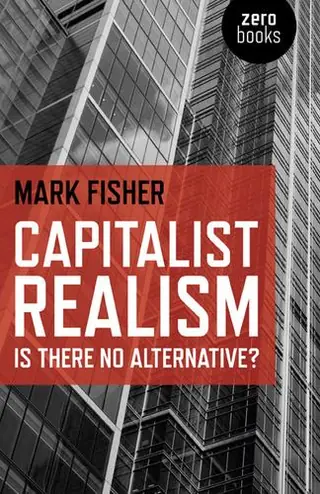
Capitalist Realism
Mark Fisher
Recommended by 41 · mentioned by 7741 recommend · 77 mention41 recommend · 7741 recommend
 2007–2026
Guns, Germs, and Steel
Jared Diamond
Recommended by 214 · mentioned by 510214 recommend · 510 mention214 recommend · 510214 recommend
 2012–2026
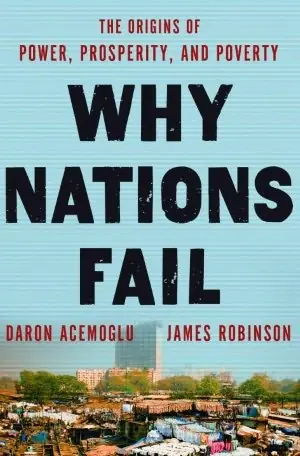
Why Nations Fail
Daron Acemoglu, James A. Robinson
Recommended by 74 · mentioned by 11774 recommend · 117 mention74 recommend · 11774 recommend
 2007–2026
Siddhartha
Hermann Hesse
Recommended by 138 · mentioned by 186138 recommend · 186 mention138 recommend · 186138 recommend
 2007–2026
The Structure of Scientific Revolutions
Thomas S. Kuhn, Dennis Holland
Recommended by 96 · mentioned by 21596 recommend · 215 mention96 recommend · 21596 recommend
…Moldbug as is popularly imagined. If you have a sincere interest in outcomes you find unexpected allies. Here is a good start: Volume 1: The Origins of Political Order by Francis Fukuyama Volume 2: Political Order and Political Decay by Francis Fukuyama Seeing Like a State by James Scott Exit, Voice and Loyalty by Albert Hirschman The Problem of Political Authority by Michael Huemer The Collapse of Complex Societies by Joesph…
on “Sam Altman’s Manifest Destiny” ↗…Lila unread you've left a lot on the table) The Beginning of Infinity by David Deutch Antifragile by Taleb Harry Potter and the Methods of Rationality by Yudkowski. Particularly Chapter 39. The two Political Order and Political Decay books by Fukuyama Life's Ratchet - Hoffman
on “Ask HN: What books fundamentally changed the way you think about the world?” ↗I would take a look at Fukuyama's "Origins of Political Order" and "Political Order and Political Decay". The first hints of meritocracy were in China during the Qin and Han dynasties, where exams where used to provide positions in bureaucracy to those not of noble birth. Prussia was really the first example…
on “Cal State will no longer require math and English placement exams” ↗Fukuyama's "The origin of political order" and "political order and political decay" I would recommend to anybody interested in this topic. They are, however, quite ... extensive.
on “Why the Industrial Revolution Didn’t Happen in China” ↗Reading Fukuyama's "The Origins of Political Order" and part 2, "Political Order and Political Decay" is a really good sweep on political progress where it comes from and whether or not it's inevitable (hint: it's not). Fukuyama is a real realist. What I mean by that is that he doesn't deny that progress…
on “Ask HN: What are some good (fiction/non-fiction) books about human progress?” ↗This is explored by Francis Fukuyama in "The Origins of Political Order" and "Political Order and Political Decay". He presents compelling arguments for why we have failed states but more interestingly, he works through how we got successful ones. Non-failed states are far more rare in history, and they are the goal,…
on “Direct Democracy in Switzerland” ↗…Accidents - Charles Perrow - Why Buildings Stand Up: The Strength of Architecture - Mario Salvadori - Maps of Meaning: The Architecture of Belief - Jordan Peterson - The Power Broker - Robert Caro - Political Order and Political Decay - Francis Fukuyama - The Creators - Daniel Boorstin - The Square and the Tower - Niall Ferguson
on “Ask HN: Book Recommendations?” ↗…aspects of government. A bit too negative for the topic, the factors outlined are also why commercial economies were able to develop more centralized economies than agrarian ones in the early modern era. Political Order and Political Decay: From the Industrial Revolution to the Globalization of Democracy - Quite good book on bureaucracy though not as excellent as the previous book on the origins of states. Last First Snow - It's always…
on “Ask HN: Books you read in 2015?” ↗Fukuyama's recent book Political Order and Political Decay goes into some detail on the forest service, from its origins as a model of a modern effective government agency in the Progressive era to one captured by special interests and turned ineffective by conflicting…
on “America in flames” ↗If businesses are exempt from satisfying social needs, is the expectation that the government (through legislation) and private citizens (by voting) are responsible for addressing them? They aren't exempt from serving any social needs -- that's taking what I said further than I said it. Business do serve many social needs. They just can't serve every social need. They are a limited institution wi
on “Tech Workers Now Want to Know: What Are We Building This For?” ↗…invoked other mechanisms. * John Stuart Mill, who was hardly a pompous conservative: https://sententiaeantiquae.com/2018/12/11/luxury-and-societa... * Toynbee too. * More recently Francis Fukuyama wrote Political Order and Political Decay.
on “We Were Builders Once, and Strong” ↗Francis Fukuyama mentions this in one his books -- The Origins of Political Order or Political Order and Political Decay, I can't remember which -- and argues that this is an important part of how American democracy was workable (and British democracy too, by the way). Other thinkers with related ideas are mentioned by…
on “Terence Tao: The role of small organizations in society has shrunk significantly” ↗>This is how most foreign services are run It is not. The vast majority of the world has a professionalized diplomatic corps roughly modeled on a Prussian or French system. As Fukuyama points out in Political Order and Political Decay the US is an odd case because it democratized before it developed an administrative state and as a result is somewhere between "Greece and Prussia" and ended up with a spoils-based and clientelist system,…
on “US orders diplomats to fight data sovereignty initiatives” ↗Reminds me of Fukyama's "Political Order and Political Decay", but in a more contemporary and narrow context. Interesting thought bubble, thanks for the read!
on “Build institutions, not apps” ↗