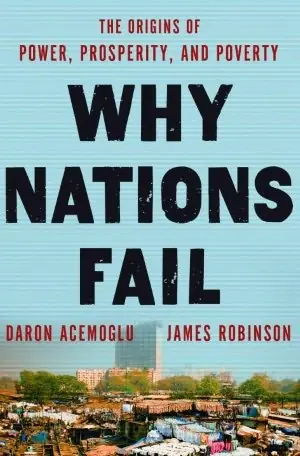
Why Nations Fail
The Origins of Power, Prosperity and Poverty
by Daron Acemoglu, James A. Robinson · first published 2012
63% recommend33% neutral3% critical
Why HN recommends it
Argues that inclusive political and economic institutions, not geography or culture, explain why some countries prosper and others stay poor. Suits readers curious about corruption, inequality, and development aid.
Common criticism: Some find its single-cause thesis oversimplified and its institution definitions muddled
Summarised by Claude from recommending comments
Why are some nations rich and others poor, divided by wealth and poverty, health and sickness, food and famine? Is it culture, the weather, or geography that determines prosperity or poverty? As Why Nations Fail shows, none of these factors is either definitive or destiny. Drawing on fifteen years of original research, Daron Acemoglu and James Robinson conclusively show that it is our man-made political and economic institutions that underlie economic success (or the lack of it). Korea, to take just one example, is a remarkably homogeneous nation, yet the people of North Korea are among t
Affiliate links. As an Amazon Associate I earn from qualifying purchases.
Mentions per year
What Hacker News says
Related books
 2022–2025
Upgrade
Blake Crouch
Recommended by 5 · mentioned by 85 recommend · 8 mention5 recommend · 85 recommend
 2019–2026
Say Nothing
Patrick Radden Keefe, Ariel Font Prades
Recommended by 9 · mentioned by 109 recommend · 10 mention9 recommend · 109 recommend
 2007–2026
Guns, Germs, and Steel
Jared Diamond
Recommended by 214 · mentioned by 510214 recommend · 510 mention214 recommend · 510214 recommend
 2009–2023
1776
David McCullough
Recommended by 3 · mentioned by 43 recommend · 4 mention3 recommend · 43 recommend
 2015–2024
Cats' Paws and Catapults
Steven Vogel
Recommended by 3 · mentioned by 33 recommend · 3 mention3 recommend · 33 recommend
 2016–2026
Prisoners of geography
Tim Marshall
Recommended by 21 · mentioned by 3221 recommend · 32 mention21 recommend · 3221 recommend
Why Nations Fail (amazing!) Chimpanzee Politics (interesting) Corporate Confidential (paranoid, but worth a read) Developer Hegemony (red pill for developers!!!) Bargaining For Advantage (reasonable) Tempo: Timing,…
on “Ask HN: Books you read in 2018?” ↗…trillion (with a "t") dollars to various developing countries. It hasn't done much. Why not? That's a question that a host of books have attempted to answer (I recommend Dead Aid, The Bottom Billion, and Why Nations Fail to the curious). I don't think we'll ever get a complete answer but we should at least be asking the right questions. (Relevant observation: I'm a grant writing consultant for nonprofit and public agencies.…
on “Good News You Might Have Missed in 2013” ↗A book to read immediately after Guns Germs and Steel is Why Nations Fail by Daron Acemoglu. It's also useful to know that Diamond does not have a degree in Geography and many geographers aren't particularly on board with his ideas. I think of him the same way I do Malcom…
on “Ask HN: Books you plan to read in 2020?” ↗There's a good book on this called "Why Nations Fail," [1] they posit that extractive economic policies (corrupted governments) essentially de-incentivize entrepreneurial businesses, while inclusive policies cause them to thrive. They use this argument…
on “Why Are Some Societies More Entrepreneurial than Others?” ↗A good thing, since fair methods of competition is the single differentiating policy of the USA that put it into a dominant world position over the last 200+ years. See Why Nations Fail by Acemoglu and Robinson.
on “FTC restores rigorous enforcement of law banning unfair methods of competition” ↗…You're telling me to eat cake since we ran out of bread The majority of economists would disagree. More economic and political freedom would accelerate economic progress, not hold it back. Check out Why Nations Fail by Daron Acemoglu for an in depth discussion of this in relation to China.
on “China passes law requiring tech firms to hand over encryption keys” ↗…readable book given that it's a propaganda piece written two thousands years ago. Highly recommended as it gives insight to just how organized-yet-cruel the ancient world was. General history: Acemoglu: Why nations fail. This is a must read. It attempts to explain (with great success) how institutions have molded the modern states into the way they are now, and what exactly seems to be at the root of inequality and prosperity.…
on “Ask HN: What, in your opinion, are the greatest and most useful textbooks?” ↗The only implementations are basically run by dominant elites, who emerge as the ruling class, resulting in exclusive political economic systems. Daron Acemoglu's "Why nations fail" offers a great framework to discuss this, I think. Appropriation of capital basically means that the government decides to eradicate right to private ownership, thus reducing the will for economic…
on “Marxism vs. Liberalism: An Interview Between J.V. Stalin and H.G. Wells (1934)” ↗Daron Acemoğlu explains the difference between Somalia and Botswana in his book "Why Nations Fail".
on “Why Is Zambia So Poor?” ↗…entire world has been getting richer for centuries, and in the last couple decades the world has seen unprecedented wealth creation due to the fall of Communism. See Cowen, noted above, or something like Why Nations Fail by Daron Acemoglu and James Robinson.
on “The consumer driven economy is for people who don't naturally automate things” ↗…On the off-chance that you're genuinely interested in the relations between regulatory capture, extreme concentrations of wealth, and the proliferation of rentier economies, I can strongly recommend "Why Nations Fail" by MIT's Daron Acemoglu. One of the essential point he makes is that Inclusive economies (i.e., the good kind) can often give way to Extractive economies (the bad kind) following periods of retrograde…
on “As Republicans Concede, F.C.C. Is Expected to Enforce Net Neutrality” ↗…find a strong correlation between former parts of the British Empire and now Commonwealth or Ex-Commonwealth and the successful implementation of institutions that give them wealth and freedom. Read "Why Nations Fail" [1] to get some examples of that, one that I remember was https://en.wikipedia.org/wiki/Botswana. [1] http://www.amazon.com/Why-Nations-Fail-Origins-Prosperity/dp...
on “School Is to Submit” ↗…growth: recovery from WW 2 and moving ppl from agriculture to industry. Is China similar story? http://blogs.ft.com/beyond-brics/2015/12/09/like-soviet-russ... A good read on that: https://www.amazon.com/Why-Nations-Fail-Origins-Prosperity/d... I give 50/50 chance to China will avoid this fate, but not more.
on “Germany’s Chinese investment problem” ↗I recommend everyone interested in this subject to read "Why Nations Fail: The Origins of Power, Prosperity, and Poverty" by Daron Acemoglu It's a great book that tries to explain why.
on “Why Are Some Countries Rich and Others Poor?” ↗…nations either grow or not, depending on their institutions, and the guys who kick-started this approach were Daron Acemoglu of MIT and James Robinson, of Chicago University. They have a book on it called "Why Nations Fail", released in 2012, which has already been recommended by another commenter. Their main thesis being that certain patterns of colonialism induce certain patterns of institutions, which they call "extractive",…
on “Why Are Some Countries Rich and Others Poor?” ↗