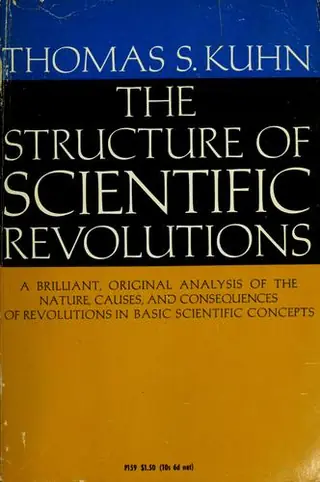
The Structure of Scientific Revolutions
by Thomas S. Kuhn, Dennis Holland · first published 1955
44% recommend53% neutral3% critical
Why HN recommends it
Explains how scientific communities move from an accepted paradigm through crisis to a new one, showing science as shaped by human and social forces. Suits readers who want context for Popper and the history of science.
Summarised by Claude from recommending comments
Thomas S. Kuhn's classic book is now available with a new index.
Affiliate links. As an Amazon Associate I earn from qualifying purchases.
Mentions per year
What Hacker News says
Related books
 2010–2025
The Copernican revolution
Thomas S. Kuhn
Recommended by 7 · mentioned by 117 recommend · 11 mention7 recommend · 117 recommend
 2007–2024
The Logic of Scientific Discovery
Karl Popper
Recommended by 15 · mentioned by 2615 recommend · 26 mention15 recommend · 2615 recommend
 2009–2025
Against Method
Paul K. Feyerabend
Recommended by 32 · mentioned by 7232 recommend · 72 mention32 recommend · 7232 recommend
 2020–2022
White
Kenya Hara
Recommended by 2 · mentioned by 22 recommend · 2 mention2 recommend · 22 recommend
 2022–2023
Always with Honor
Pyotr Wrangel
Recommended by 1 · mentioned by 21 recommend · 2 mention1 recommend · 21 recommend
 2015–2025
What is this thing called science?
A. F. Chalmers, Chalmers, Alan Chalmers, Alan F. Chalmers
Recommended by 6 · mentioned by 86 recommend · 8 mention6 recommend · 86 recommend
I remember reading The Structure of Scientific Revolutions in a seminar on philosophies of history and being struck by how clear Kuhn’s writing and thinking was. This quote from the article sums up why the book resonated with me: > Kuhn is a realist, in that…
on “Thomas Kuhn Wasn't So Bad” ↗…cultural movements within the physics community. What is true is true. Wrong book. Try looking at a history of science. You definitely see the same sort of behavior. A good place to start is Kuhn's The Structure of Scientific Revolutions. If anything, science is worse because the cycles are longer. As Max Planck wrote: "A new scientific truth does not triumph by convincing its opponents and making them see the light, but rather because…
on “Enough with the movements” ↗The Structure of Scientific Revolutions by Thomas Kuhn
on “Ask HN: Any recommendation for a good History of Science book?” ↗Don't read Popper without also reading 'The Structure of Scientific Revolutions' by Thomas Kuhn and 'Against Method' by Paul Feyerabend. Those critiques of Popper put his philosophy in a much clearer light. Both contain extremely pertinent historical facts about the Galilean, Newtonian…
on “Reading list for those who love to learn” ↗…things as e.g. "religion". This is very abstract, but more concretely, what I mean is that it helps to read about the philosophy/history of science. The canonical recommendation here is Thomas Kuhn's The Structure of Scientific Revolutions [1], but I also strongly recommend watching James Burke's Connections tv series [2] and then watching or reading his The Day the Universe Changed [3] to understand how our entire conception of "reality"…
on “Ask HN: How to tell what's true from false or right or wrong?” ↗…the reading I do for fun the same way, Google a list of "classics" and check for things I haven't read. My go to recommendations: http://www.amazon.com/Structure-Scientific-Revolutions-50th-... - The Structure of Scientific Revolutions, Thomas Kuhn, (1996) http://www.amazon.com/Pragmatic-Programmer-Journeyman-Master... - The Pragmatic Programmer, Andrew Hunt and David Thomas (1999) Things I've liked in the last 6 months: http://www.amazon.com/How-Measure-Anything-Intangibles-Busin...…
on “Ask HN: Which book are you reading these days?” ↗I strongly recommend reading The Structure of Scientific Revolutions by Thomas Kuhn for an excellent treatise on why the answer to "Would Newton be of negative value today?" is almost certainly yes (in the context of scientific progress). It's a dense book but it's a seminal…
on “Research questions that could have a big social impact, organised by discipline” ↗…together in a way that could more parsimoniously and accurate predict planetary motion. In other words, the experience that you describe perfectly fits into his argument. You might want to read Kuhn's "The Structure of Scientific Revolutions" to get the full picture.
on “When scientific orthodoxy resembles religious dogma” ↗Kuhn’s The Structure of Scientific Revolutions makes a similar point and is a must-read for anyone interested in this topic.
on “Science is the belief in the ignorance of experts (2020)” ↗"Structure of Scientific Revolutions" by Thomas Kuhn This philosophy of science masterpiece illustrates how a community evolves its mental model or paradigm - from a long-accepted world view, to a crisis caused by evidence that contradicts…
on “Ask YC: favorite books” ↗Regarding this, there is an excellent book: "Structure of Scientific Revolutions" by Thomas Kuhn
on “Ask News.YC: How difficult is it to break out of prevailing paradigms of the present?” ↗If you like this line of reasoning, Thomas Kuhn's "The Structure of Scientific Revolutions" [1] is a great academic approach to the same epistemological questions, applied to the academic community, and with some very bold conclusions about knowledge as a whole. 1. http://en.wikipedia.org/wiki/The_Structure_of_Scientific_Rev...
on “Feynman's Cargo Cult Science” ↗Thomas Kuhn is another one worth reading although more philosophical (none the less - relevant) "The Structure of Scientific Revolutions" http://en.wikipedia.org/wiki/The_Structure_of_Scientific_Rev...
on “Why Almost Everything You Hear About Medicine Is Wrong” ↗…unawareness of how poor a description it is of actual science through the ages. I highly recommend that you read Paul Feyerabend's, Against Reason to open your eyes, and also read Thomas Kuhn's book, The Structure of Scientific Revolutions for a better description. If you understand the last, then you'll understand that Einstein's rejection of QM (which was much more qualified than most people understand) needs no more explanation than…
on “Can the multiverse explain human history?” ↗This is a fairly uncharitable interpretation of Kuhn's thought. Please read my above explanation of Kuhn's thought or, better yet, skip the middleman and read "The Structure of Scientific Revolutions" and get it from the man himself :)
on “Harry Potter and the Methods of Rationality finished today” ↗