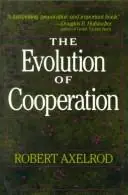
The evolution of cooperation
by Robert M. Axelrod · first published 1984
60% recommend37% neutral3% critical
Why HN recommends it
Accessible, math-light account of the iterated Prisoner's Dilemma tournaments and why tit for tat wins, showing cooperation can emerge without shared genes; suits readers wanting game theory in biology.
Summarised by Claude from recommending comments
This widely praised and much-discussed book explores how cooperation can emerge in a world of self-seeking egoists whether superpowers, businesses, or individuals when there is no central authority to police their actions
Affiliate links. As an Amazon Associate I earn from qualifying purchases.
Mentions per year
What Hacker News says
Related books
 2014–2026
The complexity of cooperation
Robert M. Axelrod
Recommended by 2 · mentioned by 32 recommend · 3 mention2 recommend · 32 recommend
 2018–2026
Behavioral Game Theory
Colin F. Camerer
Recommended by 2 · mentioned by 22 recommend · 2 mention2 recommend · 22 recommend
 2009–2026
Evolutionary Dynamics
Martin A. Nowak
Recommended by 5 · mentioned by 75 recommend · 7 mention5 recommend · 75 recommend
 2017–2025
Parable of the Talents
Octavia E. Butler
Recommended by 4 · mentioned by 64 recommend · 6 mention4 recommend · 64 recommend
 2015–2024
Letting go
David R. Hawkins
Recommended by 8 · mentioned by 98 recommend · 9 mention8 recommend · 98 recommend
 2012–2026
Garner's modern american usage
Bryan A. Garner
Recommended by 8 · mentioned by 108 recommend · 10 mention8 recommend · 108 recommend
 2007–2026
The Selfish Gene
Richard Dawkins
Recommended by 220 · mentioned by 431220 recommend · 431 mention220 recommend · 431220 recommend
The article reminded of me of Robert Axelrod's excellent "The Evolution of Cooperation." Axelrod uses similar computer modeling to create a tournament to help tease out how cooperative strategies emerge from primarily self-interested behavior. It is one of the best things I have ever read…
on “Bad science persists because poor methods are rewarded” ↗…mathematically. This was one. OpenBSD defected. The joke's on the security researcher, though, since this doesn't appear to have been their first time [1][2]. Robert Axelrod outlined, in his 1984 classic The Evolution of Cooperation [3] four requirements for a successful iterative prisoner's dilemma strategy. One is retaliating. Security researchers are letting OpenBSD play an iterating game as if it's an N=1, i.e. they're not retaliating.…
on “Key Reinstallation Attacks – Breaking WPA2 by Forcing Nonce Reuse” ↗…book with great explanations; fully worth the 72 euros I paid for it) • Behave and Why Zebras Don't Get Ulcers by Sapolsky (I wrote my "why" for Behave here[1]) • Moral Tribes by Joshua Greene • The Evolution of Cooperation by Robert Axelrod • Chimpanzee Politics by Frans de Waal • Homo Ludens: A Study of the Play-Element in Culture by Johan Huizinga • Metaphors We Live By, George Lakoff and Mark Johnson • Becoming Human…
on “Revisiting “The 4-Hour Workweek”” ↗…are subject to reputations, and have sophisticated communication, cooperation, and retaliation abilities. [4] Elinor Ostrom's "Rules, games, and common-pool resources" and Robert Axelrod's work "The Evolution of Cooperation" both explain game theory in the context of human scale realities. Of particular interest to the hacker community would be Ostrom's Common Pool Resource principles, which are applicable to adhoc decentralized…
on “A Brief Introduction to the Basics of Game Theory” ↗To see Game Theory from a 'cooperation' point of view, check out the landmark book, The Evolution of Cooperation[1] by Robert Axelrod. Axelrod's work was also summarized in The Selfish Gene. (And more recently, in Behave, by Sapolsky.) From the abstract: "We assume that, in a world ruled by natural selection,…
on “Game Theory (2007)” ↗For folks who like this sort of thing, I will once again make my monthly plug for folks to check out "The Evolution of Cooperation", by Robert Axelrod.
on “ALiEn – a GPU-accelerated artificial life simulation program” ↗It is astonishing to me that this discussion has gone on for as long as it has without anyone mentioning the work of Robert Axelrod: http://en.wikipedia.org/wiki/The_Evolution_of_Cooperation Axelrod showed that it is not necessary for individuals to share genes in order to cooperate to mutual benefit in an evolutionarily stable strategy.
on “Harvard's Edward O. Wilson tries to upend biology, again” ↗…system too. It really all boils down to game theory, and if the game is zero-sum, cooperation is not an evolutionarily stable strategy. (And if you don't know what that means, you need to read "The Evolution of Cooperation" by Robert Axelrod.)
on “The Poisonous Employee-Ranking System That Helps Explain Microsoft’s Decline” ↗…up with studies. Excellent advice for life and it's changed how I view decisions and interactions. [edit - if you want it and can't afford it, get in touch and I might be able to buy you a copy] The Evolution of Cooperation - Robert Axelrod Rather hammers the prisoners dilemma a lot, but it does feel justified. It's been maybe 9 years since I read this and it was the first thing that popped into my mind when I saw this…
on “Ask HN: What are the books that changed the perspective of your life?” ↗I'd also suggest a book by Axelrod, The Evolution of Cooperation. [1] Not software explicitly, but patterns of behavior, which is pretty close. [1] https://en.wikipedia.org/wiki/The_Evolution_of_Cooperation
on “Pack Hunters of the Silicon Savannas” ↗…to a small group at the top. I don't think that's necessarily true (unfortunately). There's probably a threshold where inequality becomes unsustainable, but it could be very high. See Axelrod's The Evolution of Cooperation. It's most famous for the iterated Prisoner's Dilemma contest, where the simple "tit for tat" strategy beat all the others, but there's a lot more great material in there. "Tit for tat" is just one stable…
on “How Stable Are Democracies? ‘Warning Signs Are Flashing Red’” ↗Richard Dawkins didn't pioneer that idea, it was Robert Axelrod. The seminal book about the topic is Axelrod's "The Evolution of Cooperation": https://en.wikipedia.org/wiki/The_Evolution_of_Cooperation (Dawkins was a prominent advocate of Axelrod's work, though. And "The Selfish Gene" is definitely a great read in its own right.)
on “'Snowdrift' game tops 'Prisoner's Dilemma' in explaining cooperation (2007)” ↗…bigger groups to overcome group weakness. Understanding how and why groups form/evolve/break/merge etc will change how you think about what can and can't be done by yourself. Check out Robert Axelrod's Evolution of Cooperation, and Complexity of Cooperation.
on “The Loneliness of a Long-Distance Thinker (1985)” ↗…popular books (eg. The 48 Laws of Power). * The classic "The Art of Worldly Wisdom" by Baltasar Gracian. Get the Penguin translation by Jeremy Robbins titled "The Pocket Oracle and Art of Prudence". * The Evolution of Cooperation by Robert Axelrod - Provides a game theoretic approach.
on “I Quit Being So Accommodating (1922)” ↗…communication, cooperation, reputation, trust, accountability, auditing, and retaliation capabilities. [1] [2] Elinor Ostrom's "Rules, games, and common-pool resources" and Robert Axelrod's work "The Evolution of Cooperation" both explain game theory in the context of human scale realities. Of particular interest to the hacker community would be Ostrom's Common Pool Resource principles, which are totally applicable to the…
on “A Brief Introduction to the Basics of Game Theory” ↗