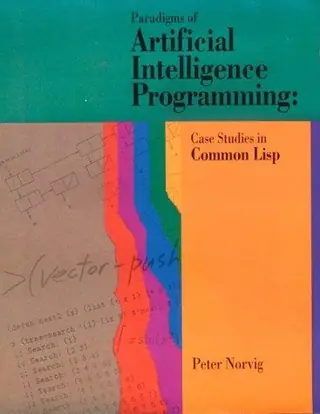
Paradigms of Artificial Intelligence
by Peter Norvig · first published 1991
58% recommend40% neutral2% critical
Why HN recommends it
Case-study tour of classic symbolic AI programs in Common Lisp, half AI book and half Lisp tutorial. Admired for polished, enjoyable code and general advice on building big programs; suits Lisp learners.
Summarised by Claude from recommending comments
Affiliate links. As an Amazon Associate I earn from qualifying purchases.
Mentions per year
What Hacker News says
Related books
 2007–2026
Practical Common Lisp
Peter Seibel
Recommended by 218 · mentioned by 294218 recommend · 294 mention218 recommend · 294218 recommend
 2007–2025
ANSI Common Lisp
Paul Graham
Recommended by 67 · mentioned by 13167 recommend · 131 mention67 recommend · 13167 recommend
 2007–2026
On LISP
Paul Graham
Recommended by 192 · mentioned by 355192 recommend · 355 mention192 recommend · 355192 recommend
 2010–2025
Warren's abstract machine
Hassan Aït-Kaci
Recommended by 5 · mentioned by 85 recommend · 8 mention5 recommend · 85 recommend
 2007–2026
Lisp in Small Pieces
Christian Queinnec
Recommended by 101 · mentioned by 141101 recommend · 141 mention101 recommend · 141101 recommend
 2007–2026
Structure and Interpretation of Computer Programs
Harold Abelson, Gerald Jay Sussman, Julie Sussman
Recommended by 347 · mentioned by 602347 recommend · 602 mention347 recommend · 602347 recommend
 2007–2026
The Little Schemer
Daniel P. Friedman, Matthias Felleisen
Recommended by 288 · mentioned by 438288 recommend · 438 mention288 recommend · 438288 recommend
 2009–2026
Land of Lisp
Conrad Barski
Recommended by 124 · mentioned by 198124 recommend · 198 mention124 recommend · 198124 recommend
…Introduction to the Theory of Computation - Sisper Information Theory, Inference, and Learning Algorithms - MacKay Modern Operating Systems - Tanenbaum On Lisp - Graham Hackers & Painters - Graham Paradigms of Artificial Intelligence - Norvig Pattern Recognition and Machine Learning - Bishop The Java Language Specification - Gosling, Joy, Steele Learning Python - Lutz & Ascher Programming Erlang - Armstrong Programming Ruby -…
on “ASK HN: Hacker Bibles” ↗I love Paradigms of Artificial Intelligence by Peter Norvig much more than AIMA, which I found excessively encyclopedic and shallow. While some will argue it is dated, I think it presents many timeless ideas that will get in vogue soon with little…
on “Ask HN: Best books on AI?” ↗For anyone not in the loop, Norvig was the author of Paradigms of Artificial Intelligence Programming. This was a substantial contribution to the field of educational computer science literature, and helped to kickstart the idea that the way to learn is to read, not just write. It's also…
on “Peter Norvig Joins Stanford HAI” ↗"Paradigms of Artificial Intelligence Programming: Case Studies in Common Lisp" by Peter Norvig is also excellent.
on “Some Lisp books (and then some)” ↗Yeah, that's definitely a nice, practical book for machine learning stuff (but not really AI proper). For a practical book on AI itself, Norvig's Paradigms of Artificial Intelligence Programming: http://norvig.com/paip.html is a great book, and a nice complement to Norvig and Russell, which is somewhat more theory-oriented.
on “Ask YC: AI” ↗Hmmm... my own list of memorable programming books would look like (in no specific order): 1. The Mythical Man Month, Brooks 2. Peopleware, DeMarco and Lister 3. Paradigms of Artificial Intelligence Programming, Norvig 4. The C Programming Language, Kernighan and Ritchie 5. The Ruby Way, Fulton I had a hard time deciding whether or not to include the Pragmatic Programmer, in the end I decided…
on “Five Memorable Books About Programming” ↗…quite a bit deeper.) * The Lambda papers - http://library.readscheme.org/page1.html * _Lisp in Small Pieces_ by Christian Queinnec ("LiSP"). On implementing Lisp, strongly skewed towards Scheme. * Paradigms of Artificial Intelligence Programming by Peter Norvig ("PAIP"). AI, problem solving techniques, Lisp practicalities and implementation, Prolog, tons more. Extremely lucid. (I wish it was a hardcover, though.) * C Interfaces &…
on “Books that will Substitute for a Computer Science Degree” ↗…way to have interfaces and implementations in C, without relying on macro hackery. Why, there's even a whole book on that: http://www.amazon.com/Interfaces-Implementations-Techniques-... Like Norvig's Paradigms of Artificial Intelligence: Case Studies in Common Lisp and Joshua Bloch's Effective Java, it's one of those books which despite having a specific programming language in the title, is really about programming in general.
on “Armin Ronacher: Collections in C” ↗I am afraid that this is a wrong recommendation - too narrow, too esoteric, too academic. I would suggest to read Norvig's old Common Lisp code from his Paradigms Of Artificial Intelligence Programming masterpiece (and the whole book, of course). AIMA and SICP are obviously good reads - the code is polished like fine poems. Norvig's new Python courses on Udacity are also absolutely wonderful,…
on “Programs to Read” ↗…languages, I suggest these four 'Lisp' books: 1. SICP (Structure and Interpretation of Computer Programs) 2. HTDP (How to Design Programs) https://htdp.org 3. LiSP (Lisp in Small Pieces), 4. PAIP (Paradigms of Artificial Intelligence Programming) https://github.com/norvig/paip-lisp SICP and HTDP are different but serve the same purpose. LiSP is about interpretation, semantics, and compilation. PAIP by Peter Norvig can seen as elementary…
on “If not SICP, then what? Maybe HTDP?” ↗…some Prolog. The two commercial Common Lisps (Allegro CL and LispWorks) still offer Prolog implementations. One of the more extensive treatments of implementing Prolog-like features can be found in "Paradigms of Artificial Intelligence Programming" (PAIP) by Peter Norvig. Book and code available here: https://github.com/norvig/paip-lisp
on “Interpreter for a simple Lisp, Written in Prolog” ↗…position infantalizes the OP instead of treating them as a full fledged intellect simply lacking knowledge. Nand2Tetris is a great resource. There are lots of great resources: Let's build a compiler, SICP, Paradigms of Artificial Intelligence: Case Studies in Common Lisp, Code Complete, Code, etc. and on and on. What to choose is the OP's problem. Nothing is as robust as Knuth. It's stood up longer than most Hacker News readers have been…
on “Ask HN: How do I choose the right resource to learn CS fundamentals?” ↗I feel like the Common Lisp and Erlang communities have produced writing about software that has really stood the test of time. From the CL spec, to Norvig's "Paradigms of Artificial Intelligence Programming: Case Studies in Common Lisp," to both of pg's CL books (this one and 'On Lisp') -- these all feel readable, even re-readable, and entertaining. And of course the same can be said of the…
on “ANSI Common Lisp (1995)” ↗for one of the possible starters, I would go for the MIT Licensed "Paradigms of Artificial Intelligence Programming" by Peter Norvig. https://github.com/norvig/paip-lisp a) you get the extra benefit of playing with Lisp b) it gets universal praise c) as you guessed, it's free in the freedom sense There…
on “The Hundred-Page Machine Learning Book” ↗…been mentioned. Unlike Practical Common Lisp, it has exercises and extensive sections in each chapter just on tools (such as dribble, trace, describe, step, et cetera). Moreover, I was expecting to see "Paradigms of Artificial Intelligence Programming", from Peter Norvig. I have not fully read it, but it seems to be an awesome book. Not just to learn Lisp but a good book in general, since the code is beautifully designed. Despite the title,…
on “Common Lisp Books” ↗