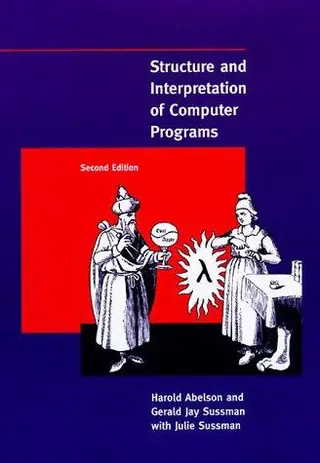
Structure and Interpretation of Computer Programs
by Harold Abelson, Gerald Jay Sussman, Julie Sussman · first published 1985
58% recommend41% neutral1% critical
Why HN recommends it
Teaches programming as abstraction and managing complexity, using Scheme, with hard exercises and video lectures. Suits self-learners and experienced programmers wanting deeper mental models, not practical tooling.
Summarised by Claude from recommending comments
Wizard Book n. Hal Abelson's, Jerry Sussman's and Julie Sussman's Structure and Interpretation of Computer Programs (MIT Press, 1984; ISBN 0-262-01077-1), an excellent computer science text used in introductory courses at MIT. So called because of the wizard on the jacket. One of the bibles of the LISP/Scheme world. Also, less commonly, known as the Purple Book. from The New Hacker's Dictionary, 2nd edition (MIT Press, 1993)
Affiliate links. As an Amazon Associate I earn from qualifying purchases.
Mentions per year
What Hacker News says
Related books
 2007–2026
How to Design Programs
Matthias Felleisen
Recommended by 277 · mentioned by 440277 recommend · 440 mention277 recommend · 440277 recommend
 2007–2026
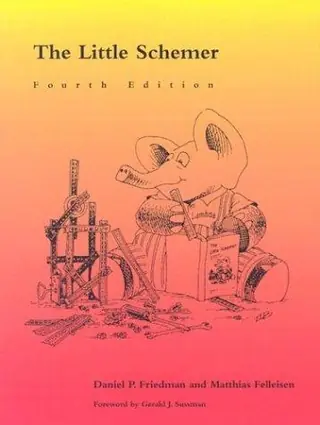
The Little Schemer
Daniel P. Friedman, Matthias Felleisen
Recommended by 288 · mentioned by 438288 recommend · 438 mention288 recommend · 438288 recommend
 2007–2026
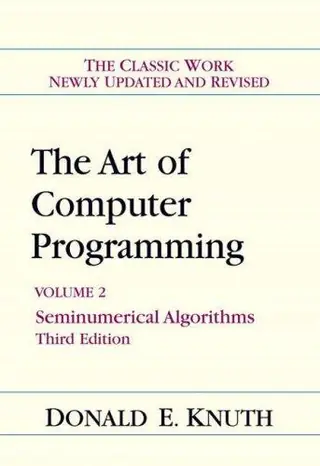
The art of computer programming
Donald Knuth
Recommended by 336 · mentioned by 1,125336 recommend · 1,125 mention336 recommend · 1,125336 recommend
 2007–2026
Introduction to Algorithms
Thomas H. Cormen, Charles E. Leiserson, Ronald L. Rivest, Clifford Stein
Recommended by 274 · mentioned by 712274 recommend · 712 mention274 recommend · 712274 recommend
 2007–2026
Code Complete
Steve McConnell
Recommended by 393 · mentioned by 669393 recommend · 669 mention393 recommend · 669393 recommend
 2007–2026
Concepts, techniques, and models of computer programming
Peter Van Roy, Seif Haridi
Recommended by 70 · mentioned by 9370 recommend · 93 mention70 recommend · 9370 recommend
 2007–2026
The seasoned schemer
Daniel P. Friedman
Recommended by 33 · mentioned by 4733 recommend · 47 mention33 recommend · 4733 recommend
 2008–2026
Code
Charles Petzold
Recommended by 243 · mentioned by 287243 recommend · 287 mention243 recommend · 287243 recommend
The book that has changed my life the most, so far, has been The Structure and Interpretation of Computer Programs by Abelson and Sussman. In 2010 I started a job that was far, far ahead of my skillset. I'd written fewer than 10,000 lines of code in my life, and I was completely ill-prepared for the work I was supposed…
on “What one book could give me a new, useful superpower?” ↗…you're hoping to do (definitions of "daily work" vary widely). If you're looking to get up on theory by doing your own program of sorts, you could do worse than start with these (in roughly this order): Structure and Interpretation of Computer Programs - Abelson, Sussman, and Sussman Introduction to Algorithms - Cormen, Leiserson, Rivest, and Stein The Art of Assembly Language - Hyde a digital logic book (not sure which is most recommended), and…
on “Must Read CS Books For Self Self-Taught Programmers” ↗…can adjust it to my pace. You could look up a curriculum (as someone else suggests) and compose a reading list from that. Also, there are some works where you really can't go wrong. Some examples: - Structure and Interpretation of Computer Programs, Abelson and Sussman - Algorithms, Sedgewick, Wayne - Introduction to Automata Theory, Languages, and Computation, Hopcroft, Motwani, Ullman Lesser known, but incredibly fun books: - Purely Functional…
on “Ask HN: How to best acquire theoretical computer science knowledge?” ↗I actually subscribe to the theory put forth in Structure and Interpretation of Computer Programs by Abelson and Sussman http://mitpress.mit.edu/sicp/full-text/book/book-Z-H-9.html#... Essentially, "computer science" is a myopic name for what is really "process studies." It just so happens that…
on “"My current theory is that programming is quite literally writing."” ↗Favorite computer book: Structure and Interpretation of Computer Programs - ISBN 0-07-000484-6 - Whether you actually like Scheme is beside the point. I got this book for an intro class into functional programming, and we only used sections one and two... but I enjoyed it so…
on “What books would you recommend reading? Why?” ↗…employable as soon as he gets out.) CS theory probably makes a good starting point, as a lot of it doesn't require actual coding, but still lays a solid foundation for future work. I would recommend SICP (Structure and Interpretation of Computer Programs, by Abelson and Sussman) as a good starting point. It uses Scheme, which isn't exactly a language he's likely to end up working in, but it will teach him a whole lot about thinking like a programmer.
on “Ask HN: Learning to code, without a computer?” ↗We had "Structure and Interpretation of Computer Programs" by Abelson/Sussman when I was at university, which I found a good introductory book. For a more thorough understanding I would recommend Donald Knuth's "The Art of Computer Programming".
on “Programming books you might want to consider reading” ↗Sussman wrote "Structure and Interpretation of Computer Programs" which is the book formerly used in many introductory CS courses including 6.001 "The wizard book" is a great read and I recently starting flipping through it again. PDF https://mitpress.mit.edu/sites/default/files/6515.pdf…
on “Why MIT Switched from Scheme to Python (2009)” ↗…Lisp, as the older language, has far more literature available including some of the best programming books ever written. Scheme is the most beautiful language and has one of the best textbooks ever made: Structure and Interpretation of Computer Programs (SICP). Emacs Lisp is the most fun, practical but also the most quirky. Luckily, learning any Lisp will put you in a better position to learn any other Lisp. Emacs Lisp is fun because it presents the most…
on “On Repl-Driven Programming” ↗…them to be much more enjoyable to think and hack in. If you want an absolute mind blowing trip, grab a copy of scheme or a lisp variant such as Clojure [hip at the moment].. and work through SICP - 'Structure and Interpretation of Computer Programs' the classic course by abelson and sussman of MIT. You can download the lecture videos and the full course is online. Seeing how they introduced lisp programs to calculate derivatives and do symbolic…
on “Ask HN: Confused semi-newbie programmer needs some advice.” ↗The best way to learn programming conceptually is to read Structure and Interpretation of Computer Programs, by Abelson and Sussman. The book is available free on-line, along with video lectures. - http://mitpress.mit.edu/sicp/ - http://groups.csail.mit.edu/mac/classes/6.001/abelson-sussma... Once you have…
on “How can I learn to program? ” ↗You might consider reading "Structure and Interpretation of Computer Programs" (SICP) by Abelson & Sussman At least one version available here: http://sicpebook.wordpress.com/ebook/
on “Ask HN: Are there any resources to learn how to think about programming?” ↗Blood Meridian, Cormac McCarthy. Philosphical Investigations, Ludwig Witgenstein. The Analects. Structure and Interpretation of Computer Programs, Ableson and Sussman. The Hamet and The Town and The Mansion, William Faulkner.
on “Ask HN: What are some good books?” ↗…Schaum's Outline of Principles of Computer Science. Then all the "big hits": The Art of Computer Programming Algorithms + Data Structures = Programs The C Programming Language The Little Schemer, Structure and Interpretation of Computer Programs, and Common Lisp the Language. Starting Forth, Thinking Forth, and the Forth-83 standard Smalltalk-80 the Language Programming in Prolog: Using the ISO Standard A Relational Model of Data for Large…
on “Ask HN: Advice for a prisoner learning to program” ↗The Structure and Interpretation of Computer Programs (SICP). About halfway through the book, they build an explicit dispatch table, and I instantly understood 1) why my C code was so crappy, and B) why C++ and OO languages miss the boat (hint: they only implement…
on “Ask HN: The book that did it for you in math and/or CS?” ↗