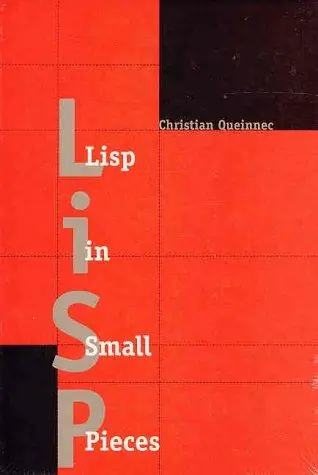
Lisp in Small Pieces
by Christian Queinnec · first published 1996
72% recommend27% neutral1% critical
Why HN recommends it
Walks through building Lisp and Scheme implementations, from a simple eval to fancier interpreters, continuations and an optimizing compiler. Suits Lisp users who have finished SICP and want to implement a language.
Common criticism: Some find the writing style dense and hard to get through
Summarised by Claude from recommending comments
Affiliate links. As an Amazon Associate I earn from qualifying purchases.
Mentions per year
What Hacker News says
Related books
 2010–2026
Anatomy of LISP
Allen, John
Recommended by 13 · mentioned by 1913 recommend · 19 mention13 recommend · 1913 recommend
 2009–2026
Compiling with Continuations
Andrew W. Appel
Recommended by 19 · mentioned by 3519 recommend · 35 mention19 recommend · 3519 recommend
 2007–2026
On LISP
Paul Graham
Recommended by 192 · mentioned by 355192 recommend · 355 mention192 recommend · 355192 recommend
 2008–2026
Essentials of programming languages
Daniel P. Friedman
Recommended by 43 · mentioned by 4843 recommend · 48 mention43 recommend · 4843 recommend
 2009–2026
Understanding and Writing Compilers
Richard Bornat
Recommended by 4 · mentioned by 44 recommend · 4 mention4 recommend · 44 recommend
 2007–2026
Practical Common Lisp
Peter Seibel
Recommended by 218 · mentioned by 294218 recommend · 294 mention218 recommend · 294218 recommend
 2007–2026
Compilers, principles, techniques, and tools
Alfred V. Aho, Monica S. Lam, Ravi Sethi, Jeffrey D. Ullman
Recommended by 195 · mentioned by 659195 recommend · 659 mention195 recommend · 659195 recommend
 2008–2026
Modern compiler design
Dick Grune
Recommended by 12 · mentioned by 2012 recommend · 20 mention12 recommend · 2012 recommend
…However, look at Physically Based Rendering (http://www.pbrt.org/). It won an Academy Award. It should win a Pulitzer. All of the actual source code is in the book and the book is quite readable. Or look at Lisp in Small Pieces (https://pages.lip6.fr/Christian.Queinnec/WWW/LiSP.html). There you will find a complete lisp system surrounded by enlightening text. Your confusion stems from the coding constraints of the 1970s. My…
on “Code is not literature (2014)” ↗if you really want to learn to build lisp, please lookup "lisp in small pieces" http://www.amazon.com/Lisp-Small-Pieces-Christian-Queinnec/d...
on “Learn C and build your own Lisp” ↗…think that would feel satisfying. Then again, maybe that's too ugly to consider. :-) In addition to some of the other book and web site recommendations people have made (SICP, MaL, etc...), I think "Lisp in Small Pieces" by Christian Queinnec is really good if you want to take it further. [0] https://wiki.c2.com/?EvalApply
on “Ask HN: What does a developer need to know to build their own Lisp from scratch?” ↗…excellent book on logic programming, using Prolog for exercises. (CTM also touches on Prolog, but this book goes quite a bit deeper.) * The Lambda papers - http://library.readscheme.org/page1.html * _Lisp in Small Pieces_ by Christian Queinnec ("LiSP"). On implementing Lisp, strongly skewed towards Scheme. * Paradigms of Artificial Intelligence Programming by Peter Norvig ("PAIP"). AI, problem solving techniques, Lisp…
on “Books that will Substitute for a Computer Science Degree” ↗Nice writeup on their use of the Cheney Trampoline. As is always the case in such discussions, I'll mention these three fine books for Scheme implementers: * Lisp in small pieces, by Christian Queinnec * Compiling with continuations, by Andrew Appel * Anatomy of Lisp, by John Allen
on “How Chicken Scheme compiles to C” ↗You might enjoy Lisp in Small Pieces. Is one of my favorite books The book is in two parts. The first starts from a simple evaluation function and enriches it with multiple name spaces, continuations and side-effects with commented variants,…
on “Little Lisp interpreter” ↗I recommend Lisp In Small Pieces (LISP) by Christian Queinnec and Compiling with Continuations by Andrew Appel if you're interested in writing a functional compiler. Also: http://matt.might.net/articles/cps-conversion/ http://lucacardelli.name/Papers/BasicTypechecking.pdf…
on “Write You a Haskell: Building a modern functional compiler from first principles” ↗…and Sussman - Paradigms of Artificial Intelligence Programming, by Norvig By general acclaim, some examples might be: - How to Design Programs, by Felleisen et al - Beautiful Racket, by Butterick - LISP In Small Pieces, by Queinnec - The Art of Computer Programming, by Knuth - The Elements of Computing Systems, by Nisan and Schocken What else comes to mind? (My list is very LISPy, but that's just bc I have high…
on “Crafting Interpreters: A Review” ↗…3. ANSI Common Lisp http://www.paulgraham.com/acl.html 4. On Lisp http://www.paulgraham.com/onlisptext.html 5. Paradigms of Artifical Intelligence Programming http://norvig.com/paip.html 6. Lisp in Small Pieces http://www.amazon.com/Lisp-Small-Pieces-Christian-Queinnec/d... SICP is also amazing...and there are at least three sets of videos to go with the book (Abelson/Sussman and HP/MIT, ArsDigita, and UC-Berkeley.)
on “Ask news.YC: For the lisp experts - tell me how you learned the language.” ↗…here - http://www.lua.org/source/5.1/ . It's written in strictly compliant ANSI C. For Lisp and Scheme, try Peter Norvig's _Paradigms of Artificial Intelligence Programming_ and Christian Queinnec's _Lisp in Small Pieces_ (PAIP and LiSP). The former has more Common Lisp, the latter Scheme. Both will give you quite a bit to think about. :)
on “Ask HN: Interesting code to read” ↗Lisp In Small Pieces (http://pagesperso-systeme.lip6.fr/Christian.Queinnec/WWW/LiS...) is sort of intermediate between SICP and the Peyton-Jones stuff; it still focuses on Lisp dialects that use dynamic typing and applicative-order…
on “Ask HN: After SICP, what next?” ↗If you're interested in getting into the details of implementing a Lisp/Scheme interpreter and compiler, I highly recommend Lisp in Small Pieces: http://www.amazon.com/Lisp-Small-Pieces-Christian-Queinnec/d...
on “Lisp interpreter in 90 lines of C++” ↗To be completely honest, I'm reading Queinnec's book at the moment, and don't know the others first hand. They're just on my reading list. Lisp in small pieces is a fantastic book for Lisp implementers. It starts off with a simple eval and then increases in scope and complexity. It's very complete. You can see the contents in PDF here: http://assets.cambridge.org/97805215/45662/toc/9780521545662...…
on “How Chicken Scheme compiles to C” ↗There is a great book about Lisp from Christian Queinnec titled "Lisp in Small Pieces" or LISP. Here is a little excerpt from it. "There are subjects treated here that can be appreciated only if you make an effort proportional to their innate difficulty. To harken back to something like…
on “The Tragedy of the Common Lisp, Or, Why Large Languages Explode” ↗Lisp in Small Pieces: https://pages.lip6.fr/Christian.Queinnec/WWW/LiSP.html An excellent and very fun read about compilation, interpretation, and programming semantics. I don’t think you already have to know LISP, although…
on “Ask HN: What's the best textbook you've read?” ↗