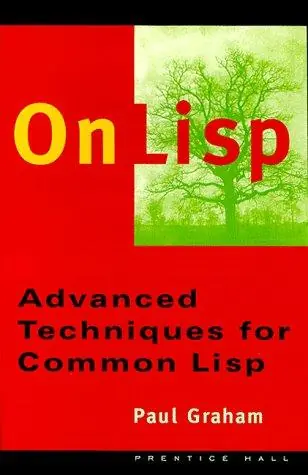
On LISP
by Paul Graham · first published 1993
54% recommend43% neutral3% critical
Why HN recommends it
Deep dive into Lisp macros and closures, showing how bottom-up programming works and what sets Lisp apart. Suited to experienced programmers who already know some Lisp and want to think differently; free online.
Summarised by Claude from recommending comments
The title itself, "On Lisp", is a reference to the idea that you can solve a programming problem by first building a programming language that lets you talk about your programming problem easier. In Lisp the programmer builds this problem specific language on top of Lisp itself using basic Lisp constructs called "macros". This style of programming is called "bottom-up programming". On Lisp is especially known for the complete description of Common Lisp macros and their uses, but the book also covers many other aspects of bottom-up programming in Common Lisp.
Affiliate links. As an Amazon Associate I earn from qualifying purchases.
Mentions per year
What Hacker News says
Related books
 2007–2025
ANSI Common Lisp
Paul Graham
Recommended by 67 · mentioned by 13167 recommend · 131 mention67 recommend · 13167 recommend
 2007–2026
Practical Common Lisp
Peter Seibel
Recommended by 218 · mentioned by 294218 recommend · 294 mention218 recommend · 294218 recommend
 2008–2026
Let Over Lambda
Doug Hoyte
Recommended by 66 · mentioned by 9866 recommend · 98 mention66 recommend · 9866 recommend
 2007–2026
Lisp in Small Pieces
Christian Queinnec
Recommended by 101 · mentioned by 141101 recommend · 141 mention101 recommend · 141101 recommend
 2007–2026
Paradigms of Artificial Intelligence
Peter Norvig
Recommended by 63 · mentioned by 10863 recommend · 108 mention63 recommend · 10863 recommend
 2009–2026
Land of Lisp
Conrad Barski
Recommended by 124 · mentioned by 198124 recommend · 198 mention124 recommend · 198124 recommend
 2007–2026
The seasoned schemer
Daniel P. Friedman
Recommended by 33 · mentioned by 4733 recommend · 47 mention33 recommend · 4733 recommend
 2007–2026
The Little Schemer
Daniel P. Friedman, Matthias Felleisen
Recommended by 288 · mentioned by 438288 recommend · 438 mention288 recommend · 438288 recommend
Common Lisp has macros. Paul Graham's book On Lisp is usually pointed to as the best treatment of macros in Lisp. CL also has many more features than Scheme, as mentioned in the other comments here.
on “Why I like Common Lisp” ↗Whenever anyone wants to talk to Paul Graham about writing I always wonder whether they've read any of his works, because since writing "On Lisp" (which I think is great) he's been in a death spiral of self-importance. Let's take a recent example (from [1]): > Though no doubt correct, such statements tell the reader > nothing. Useful writing…
on “An interview with Paul Graham on writing” ↗Frankly, I do not think very highly of _why's writing style. I find the book to be very difficult to read. If you want an example of excellent technical writing, consider Paul Graham's 'On Lisp' or 'ANSI Common Lisp'.
on “The Most Unusual (and Best) Computer Language Book I've Ever Seen.” ↗…work like management and self-help industries (hint: the "Linux Torvalds" effect.) I don't know if it's the intention of PG to become a "Get Rich Quick" guru, but to me he is the author of ANSI CL and On Lisp, a decent human being in the same league as Norvig, Kent Pitman and Dick Gabriel. Actually, I like Paul Graham more than "PG", thanks to all this idol-worshiping. Whatever that guy wrote in his blog…
on “My Love, Hate, Love Again, Affair with Paul Graham” ↗…and Computer Architecture by Money and Harris is very readable. Structure and Interpretation of Computer Programs is the classic intro text. The C Programming Language The C++ Programming Language On Lisp by Paul Graham. Algorithms by Baase Code Complete by McConnell. AI by Norvig. This list isn't about the latest sexy languages or technologies. This is about timeless principles and how things really…
on “The Hacker's Path” ↗You can do cool stuff with unhygienic macros, however, like anaphoric macros. Interested readers should check out On Lisp by Paul Graham, as well as Let Over Lambda by Doug Hoyte.
on “The Nature of Lisp” ↗…first heard of Paul Graham because he was a well-known Lisp hacker, and when I was starting in programming I was told to read a book of his to open my eyes to how much I did not understand. (I did read On Lisp and highly recommend it.) I first heard of Robert Morris because he famously accidentally took down the internet. They got the money with which they started ycombinator by running their own startup.…
on “The terrifying rise of the political entrepreneur” ↗Hi. Paul Graham's great book on macros: On Lisp could download for FREE. I'm wondering why not his intro book: ANSI Common Lisp download for FREE? Because On Lisp is for certain people who have enough Lisp experience. And ANSI Common Lisp is that experience…
on “Ask HN: Why On Lisp could download for FREE?” ↗Paul Graham wrote "On Lisp." If ever a book was written by a true hacker, that one is it, and it will be read as long as there are programmable computers.
on “Full-disclosure – Administrivia: The End” ↗…is for beginners and mid-level programmers. They either write macros for the wrong purpose or in problematic ways. Thus they should avoid macros. Still they need to use macros, since languages like Common Lisp provide a lot of functionality through macros. To get past that stage a book like 'On Lisp' by Paul Graham helps. Many, but not all, advanced programmers will use and write a lot of macros.
on “A farewell note to a programming language” ↗One thing that people forgot to mention is that Paul Graham was a Lisp expert before he started Viaweb - he had already written _On_Lisp_ which is still considered as one of the references to learn Common Lisp - and probably Robert Morris wasn't a bad lisper as well. They most likely were much better programmers than their competitors…
on “We need less powerful languages” ↗On LISP, by Paul Graham. LISP was the second language I learned in college, but only after 6 years programming Java and C# that I came back and really learned LISP. It was when I realized that I was doing everything…
on “Ask HN: What books had the greatest effect on how you structure your code?” ↗…good book that's pragmatic and for experienced developers. Many starts from the basics, or don't even talk about stuff like Quicklisp and ASDF. I want a book to make production-ready software in Common Lisp, not to faff around. The Paul Graham "On Lisp" book seems excellent, and I'll dive into it next.
on “Common Lisp and Music Composition” ↗…Really, call/cc is a bit of a parlor trick :) -- a fascinating parlor trick, but still a parlor trick. If you want much much more detail, I recommend two great books that deal with this subject: - On Lisp (by Paul Graham) - Lisp In Small Pieces In On Lisp, Paul Graham has a chapter where he builds a set of macros that give you Scheme-style continuations with minimal compromises in how you write Lisp…
on “Call/cc for C programmers (2012)” ↗…reading is to select inspiring developers and look at their code. Most of the developers in "Coders At Work" for example, have Open Source code we can look at learn from. The best code I've seen: - Common Lisp - "Paradigms of Artificial Intelligence Programming" by Peter Norvig and "On Lisp" by Paul Graham C - "C Interfaces and Implementations" and "LCC- a compiler for ANSI C" both by David Hanson. I also…
on “Ask HN: What source code is worth studying?” ↗