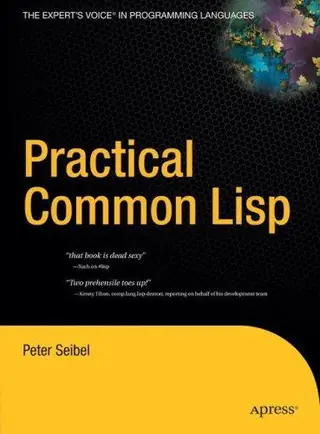
Practical Common Lisp
by Peter Seibel · first published 2005
73% recommend23% neutral4% critical
Why HN recommends it
Approachable, free-online introduction to Common Lisp that moves from basics to practical projects, with strong chapters on conditions and restarts; suits programmers new to Lisp, and companies use it to train new hires.
Summarised by Claude from recommending comments
Affiliate links. As an Amazon Associate I earn from qualifying purchases.
Mentions per year
What Hacker News says
Related books
 2015–2024
Common Lisp Recipes
Edmund Weitz
Recommended by 20 · mentioned by 2620 recommend · 26 mention20 recommend · 2620 recommend
 2007–2025
ANSI Common Lisp
Paul Graham
Recommended by 67 · mentioned by 13167 recommend · 131 mention67 recommend · 13167 recommend
 2009–2026
Land of Lisp
Conrad Barski
Recommended by 124 · mentioned by 198124 recommend · 198 mention124 recommend · 198124 recommend
 2007–2026
On LISP
Paul Graham
Recommended by 192 · mentioned by 355192 recommend · 355 mention192 recommend · 355192 recommend
 2007–2026
Paradigms of Artificial Intelligence
Peter Norvig
Recommended by 63 · mentioned by 10863 recommend · 108 mention63 recommend · 10863 recommend
 2008–2026
Let Over Lambda
Doug Hoyte
Recommended by 66 · mentioned by 9866 recommend · 98 mention66 recommend · 9866 recommend
 2007–2026
The Little Schemer
Daniel P. Friedman, Matthias Felleisen
Recommended by 288 · mentioned by 438288 recommend · 438 mention288 recommend · 438288 recommend
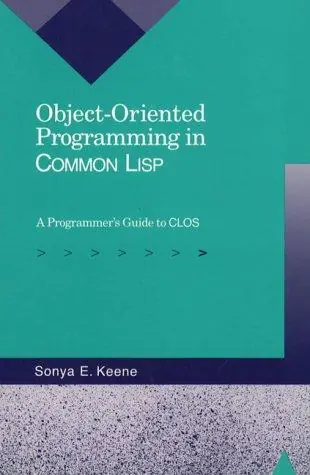 2013–2024
Object-oriented programming in Common LISP
Sonya E. Keene
Recommended by 8 · mentioned by 118 recommend · 11 mention8 recommend · 118 recommend
The article doesn't discuss macros, which is one of the answers to "Why Lisp?" I didn't "get" macros until I read a footnote in the (freely available) book Practical Common Lisp. In chapter 7, it introduces the `dolist` macro. DOLIST loops across the items of a list, executing the loop body with a variable holding the successive items of the list. This is the basic…
on “Why Lisp?” ↗…Stein (aka CLRS) Design Patterns - Gamma, Helm, Johnson, Vlissides The C Programming Language - Kernighan, Ritchie The C++ Programming Language - Stroustrup The Scheme Programming Language - Dybvig Practical Common LISP - Seibel Programming Perl - Wall, Christiansen and Orwant ANSI Common Lisp - Graham Refactoring - Fowler UML Distilled - Fowler Introduction to the Theory of Computation - Sisper Information Theory,…
on “ASK HN: Hacker Bibles” ↗…The LispWorks, SBCL, Clozure CL manuals discuss that. Since there is so much stuff to link to, I recommend to go fully old-school and read the fine manual. * as the starting book most will point you to Practical Common Lisp by Peter Seibel. Free online and available printed. It even explains a lot of CLOS. * 'The author goes on to recommend LispWorks as a platform.' I do that too. Not the free version. The full commercial…
on “Why I like Common Lisp” ↗…beginners to underestimate how mature and good it is. It is very under-hyped compared to Clojure. But there is the Common Lisp Cookbook on the web, which is really good. I can also warmly recommend the books "Practical Common Lisp" by Peter Seibel, and "Common Lisp Recipes" by (corrected!) Edmund Weitz. If you want to have true understanding, and are about to write industry-grade robust software, they are really worth every cent.…
on “Racket Compiler and Runtime Status” ↗Anybody who wants to judge try/catch should first go and read about Common Lisp's condition system. See for example the chapter about conditions and restarts from the excellent book "Practical Common Lisp" by Peter Seibel: http://www.gigamonkeys.com/book/beyond-exception-handling-co... Notice I'm not saying you should go and program in Common Lisp, just that you should understand those ideas before you…
on “Isaacs: try/catch is an anti-pattern” ↗As someone who learned a little Lisp in the last few years, I think there is a good collection of books available for the newbie who wants to learn. For Common Lisp, Land of Lisp, Practical Common Lisp, and Ansi Common Lisp all seem good enough to get hacking quickly. Thinking about community effects, I'm not as convinced a community represents a gating factor for hackers. I attend the occasional…
on “A Personal Lisp Crisis (2012)” ↗Common Lisp is an ancestor of LISP and is more active every year. It puts its eggs in a "pragmatism" basket. Very good introductory book "Practical Common Lisp" by Peter Seibel[1]. Scheme is a lisp made from scratch. It bets on clarity, functional programming, minimalism and elegance. There is a perfect introductory book "Structure and Interpretation of Computer…
on “Sild is a Lisp dialect” ↗…technical and dense? What is a "form"? What are multiple return values and how do I get to them? Should I spend time learning the loop macro DSL? The answer to that is simple: go and read a book :). Practical Common Lisp is available on-line for free, and it's a current best introductionary book for CL. http://www.gigamonkeys.com/book/
on “The Common Lisp Cookbook” ↗My free advice: Learn Lisp for the reasons PG outlines in Hackers and Painters [http://www.amazon.com/gp/product/0596006624] i.e. Lisp is a higher level language than x. Peter Seibel's Practical Common Lisp is available online (and as a book) and provides a lot good advice including a link to lispbox, which in the best "learn the hard way" tradition, requires you to finally learn emacs. [http://www.gigamonkeys.com/book/] [http://common-lisp.net/project/lispbox/]…
on “Ask HN: How do I improve my programming/engineering skills” ↗…like a symbol for crying out loud -- are scattered and not really complete, leading to frustration as I got deeper into extending Emacs. For me, the light bulb went off after I worked through Seibel's Practical Common Lisp. I've also read chunks of PG's On Lisp. Together these two outstanding books resulted in an epiphany regarding Lisp and the functional approach in general. The result is that, where before I couldn't…
on “Learn Emacs Lisp in 15 minutes” ↗However, if you ARE looking for a "teach yourself Lisp in 24 hours" type of book, you could do a lot worse than "Practical Common Lisp" by Peter Seibel (http://www.amazon.com/Practical-Common-Lisp-Peter-Seibel/dp/...).
on “On Lisp” ↗…for is whether there is a good introductory book, vs. just a scattered set of HOWTOs/READMEs/Wikis. However there are books online as well, nowadays, if you really prefer to read on a screen. Seibel's Practical Common Lisp is a good starting point: http://www.gigamonkeys.com/book/
on “Why I like Common Lisp” ↗At least in terms of the open-source community it feels much more lively now than, say, the early 2000s. There are new books like Practical Common Lisp and Land of Lisp, SBCL has matured into a solid implementation, Clozure CL was open-sourced, and Quicklisp has really improved the convenience of using libraries. I don't know whether that translates…
on “Why I like Common Lisp” ↗- Practical Common Lisp - Land of Lisp - http://landoflisp.com/ - watch the video, it's hilarious - Build Your Own Lisp - http://www.buildyourownlisp.com/ - Learn C by creating a lisp in C - In the spirit of making your own…
on “Ask HN: What are some books where the reader learns by building projects?” ↗I really liked Practical Common Lisp by Peter Seibel ( https://gigamonkeys.com/book/ ) however, ignore the environment setup: the recommendations it makes are no longer maintained, these days Portacle is the best way to get started. One…
on “Between two Lisps” ↗