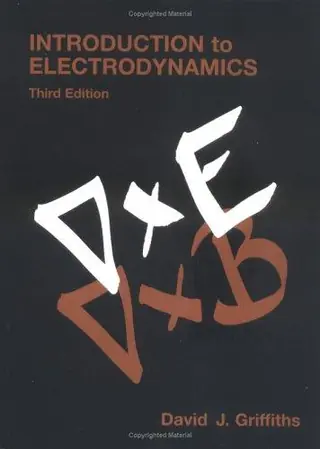
Introduction to electrodynamics
by David Jeffrey Griffiths · first published 1981
50% recommend50% neutral
Why HN recommends it
Well-written, enjoyable undergraduate E&M text that breaks hard material into digestible chunks and goes further than Purcell; suits self-learners with vector calculus, and later chapters reach radiation and relativity.
Summarised by Claude from recommending comments
This is an undergraduate-level text to introduce students to the basic concepts of electrodynamics.
Affiliate links. As an Amazon Associate I earn from qualifying purchases.
Mentions per year
What Hacker News says
Related books
 2008–2025
Electricity and magnetism
Edward M. Purcell
Recommended by 14 · mentioned by 1814 recommend · 18 mention14 recommend · 1814 recommend
 2010–2026
Introduction to Elementary Particles
David Jeffrey Griffiths
Recommended by 11 · mentioned by 1611 recommend · 16 mention11 recommend · 1611 recommend
 2018–2025
An Introduction to Thermal Physics
Daniel V. Schroeder
Recommended by 4 · mentioned by 44 recommend · 4 mention4 recommend · 44 recommend
 2011–2025
Introduction to Quantum Mechanics (2nd Edition) by David J. Griffiths
David Jeffrey Griffiths, Darrell F. Schroeter
Recommended by 12 · mentioned by 1812 recommend · 18 mention12 recommend · 1812 recommend
Modern Classical Physics
Kip S. Thorne, Roger D. Blandford
Recommended by 4 · mentioned by 64 recommend · 6 mention4 recommend · 64 recommend
 2012–2026
Classical electrodynamics
John David Jackson
Recommended by 10 · mentioned by 1610 recommend · 16 mention10 recommend · 1610 recommend
 2012–2024
Physics for scientists and engineers
Paul A. Tipler, Gene Mosca
Recommended by 5 · mentioned by 85 recommend · 8 mention5 recommend · 85 recommend
 2016–2023
Quantum Field Theory in a Nutshell
A. Zee
Recommended by 5 · mentioned by 85 recommend · 8 mention5 recommend · 85 recommend
> How long would I have to study physics to be able to understand everything in this sentence? Just start reading David J. Griffiths: Introduction to Electrodynamics. A very well written textbook. The problem might be, if you don't know vector calculus, you might not be able to read this book, so you need to learn some vector calculus, too. Then start reading Introduction…
on “There exists a classical model of the photon after all” ↗Introduction of Quantum Mechanics and Introduction to Electrodynamics, both by David J. Griffiths. He also wrote Introduction to Elementary Particles, but I have not read that one. Both books masterfully take exceptionally complex fields and break them down into easily…
on “Ask HN: What's the best textbook you've read?” ↗…to stick to the rules of thumb at the level of the ARRL handbooks. To understand the EM theory related to radiation and antennas, you really need to work through to the final chapters of Griffiths, "Introduction to Electrodynamics". But that is not necessary to get an intuitive understanding of antennas, to construct them, or to run the modeling software.
on “Antenna Theory (2016)” ↗Well yes, but curious what book you would recommend instead for graduate electrodynamics? Note that she already recommends first studying Griffith's Introduction to Electrodynamics at the undergraduate level (and that one is a true pleasure to read imho).
on “So You Want to Learn Physics” ↗…advanced Newtonian mechanics --- in particular Lagrangian and Hamiltonian dynamics. There is a chapter on chaotic dynamics towards the end, too. Another option here is Classical Mechanics by Goldstein. 8. Introduction to Electrodynamics by Griffiths. More advanced E&M than Purcell. If you want to go further, then there's always Classical Electrodynamics by Jackson. 9. Principles of Quantum Mechanics by Shankar. This spends more time…
on “Ask HN: How to self-study physics?” ↗…book report for English class, because I was a total nerd and it seemed like a fun project. Most others read a comic book because those passed as "non-fiction" (for real). One of the better textbooks is Introduction to Electrodynamics by David J. Griffiths. That one stands out in my mind.
on “Stephen Hawking has died” ↗Here are some books you may find helpful on these topics: "University Physics" by Francis Sears and Mark Zemansky "Introduction to Electrodynamics" by David J. Griffiths "Electricity and Magnetism" by Edward M. Purcell
on “Ask HN: Best content about energy, electromagnetism, circuits?” ↗David J Griffiths' Introduction to Electrodynamics was a fantastic undergraduate-level E&M textbook https://en.wikipedia.org/wiki/Introduction_to_Electrodynamic...
on “An intuitive guide to Maxwell's equations (2020)” ↗…- Quantum Chromodynamics on the Lattice Goldstein - Classical Mechanics (the old version, NOT with Poole and Safko) Griffiths - Introduction to Electrodynamics Griffiths - Introduction to Quantum Mechanics Jackson - Classical Electrodynamics (2nd edition---the last one entirely in CGS---is preferable)…
on “Ask HN: What are your favorite physics sites, documentaries, books?” ↗…John Taylor: I've heard very good things about this one. [* Classical Dynamics of Particles and Systems, by Thornton and Marion: I learned out of it. It was fine.] Intermediate Electromagnetism: * Introduction to Electrodynamics, by David Griffiths: Truly excellent introduction to analysis of electric and magnetic fields using vector calculus and partial differential equations. [* ?Classical Electromagnetic Radiation, by Heald…
on “The Best Textbooks on Every Subject” ↗…and Gregoire: The fastest and most convenient way to navigate the STL and find the feature you want with just enough information that covers 90% of usual needs. I saved a lot of time with this book. - Introduction to Electrodynamics by Griffiths: This is the best science book I have ever read and this sentiment was shared among my fellow physics class camaraderie at the time. The explanations are first intuitive and then builds to…
on “Ask HN: What are some must read books?” ↗Any undergraduate level textbook on E&M. Griffith's 'Introduction to Electrodynamics' is a commonly used one.
on “The magnetic universe begins to come into view” ↗…reading wikipedia is like trying to learn how to program by reading the C++ standard. It's a fine resource, but not for that. You need an introductory physics textbook, not an encyclopedia. Griffith's Introduction to Electrodynamics is a classic choice. > those iron filings are pulled by virtual photons created by the magnet No. Virtual particles are part of a notational scheme for carrying out certain computations in quantum field…
on “It’s time to admit quantum theory has reached a dead end” ↗…be an enjoyable read! (I'm linking to Wikipedia rather than to the publisher's website, so that you can read about the books. All of them are available on the used market, and in electronic format.) "Introduction to Electrodynamics, 3rd Ed." includes two chapters on special relativity and relativistic electrodynamics, and he covers causality very well: https://en.wikipedia.org/wiki/Introduction_to_Electrodynamic... For quantum…
on “Ask HN: Recommended Books on Physics?” ↗…ever mentioned. To quote wikipedia, Electricity and Magnetism is a standard textbook in electromagnetism originally written by Nobel laureate Edward Mills Purcell in 1963. Along with David Griffiths' Introduction to Electrodynamics, this book is one of the most widely adopted undergraduate textbooks in electromagnetism. A Sputnik-era project funded by the National Science Foundation grant, the book is influential for its use of…
on “Feynman's Hughes Lectures: 950 pages of notes” ↗