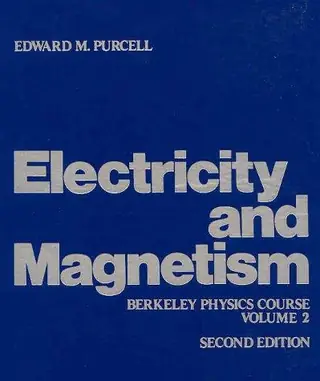
Electricity and magnetism
by Edward M. Purcell · first published 1985
78% recommend22% neutral
Why HN recommends it
Clear, rigorous undergraduate introduction to electromagnetism, needing only basic calculus and some mechanics. Features a standout chapter on fields of moving charges and pairs well with Feynman.
Summarised by Claude from recommending comments
A college-freshman physics textbook, designed for students with exceptional mathematical preparation.
Affiliate links. As an Amazon Associate I earn from qualifying purchases.
Mentions per year
What Hacker News says
Related books
 2018–2021
Fundamentals of Statistical and Thermal Physics
Frederick Reif
0 recommend · 2 mentioned0 recommend · 2 mention0 recommend · 20 recommend
 2010–2026
Introduction to electrodynamics
David Jeffrey Griffiths
Recommended by 14 · mentioned by 2814 recommend · 28 mention14 recommend · 2814 recommend
 2012–2020
Berkeley Physics Course
Edward M. Purcell
Recommended by 1 · mentioned by 21 recommend · 2 mention1 recommend · 21 recommend
 2016–2022
A first course in general relativity
Bernard F. Schutz
Recommended by 5 · mentioned by 75 recommend · 7 mention5 recommend · 75 recommend
 2017–2021
Introduction to Classical Mechanics
David Morin
Recommended by 3 · mentioned by 43 recommend · 4 mention3 recommend · 43 recommend
 2018–2025
An Introduction to Thermal Physics
Daniel V. Schroeder
Recommended by 4 · mentioned by 44 recommend · 4 mention4 recommend · 44 recommend
 2008–2026
Modern quantum mechanics
Jun John Sakurai
Recommended by 7 · mentioned by 107 recommend · 10 mention7 recommend · 107 recommend
 2015–2024
Conceptual physics
Paul G. Hewitt
Recommended by 4 · mentioned by 54 recommend · 5 mention4 recommend · 54 recommend
…60s and 70s. If you can do all the odd problems in this two volume set, you are an educated person, regardless of your greater aspirations. Edward Purcell’s Berkeley Physics Series Second Volume on Electricity and Magnetism. Might be the best undergraduate physics textbook ever written. Did you know that magnetism arises from electrostatics and relativistic length contraction? It’s right there. You should also get yourself…
on “Ask HN: How do I learn math/physics in my thirties?” ↗I never understood the appeal of Feynman and these Lectures. It has been a constant topic for years around here. For example, the Electricity and Magnetism book by Purcell is phenomenal but it is hardly ever mentioned. To quote wikipedia, Electricity and Magnetism is a standard textbook in electromagnetism originally written by Nobel laureate Edward Mills…
on “Feynman's Hughes Lectures: 950 pages of notes” ↗Ed Purcell is probably one of the least famous but amazing expositor of Physics that I have come across. His book on electricity and magnetism (part of Berkeley Physics Course) is one of the best introductions to the topic (but again not very well known) Edit: Linking to the amazon page of the US edition, which seems to be out of print(http://www.amazon.com/Electricity-Magnetism-Berkeley-Physics...)
on “Back of the Envelope [Physics] Problems” ↗…Resnick, e.g. I've read a lot of Classical Mechanics books, and this is my favourite for a solid foundation for university-level physics. The first half (volume) is Mechanics, and the second volume is on electricity and magnetism. So, that's a typical first-year (two term) course in physics. After that, do Purcell for Electricity & Magnetism You'll often get advice, like "you need to learn XYZ math first". Don't listen to this!…
on “Ask HN: How to self-study physics?” ↗Physics -- paper and pencil, in the late 1980s, at Harvard. Books such as Purcell, "Electricity and Magnetism", Reif, "Fundamentals of Statistical and Thermal Physics", Liboff, "Introductory Quantum Mechanics", Sakurai, "Modern Quantum Mechanics", Ashcroft and Mermin, "Solid State Physics", Brown and Churchill,…
on “Did you learn STEM with paper books or digital ones?” ↗…ENM along with several applications is also discussed in FLs (v2 I think). FLs V3 covers QM is great detail (well... the parts that we humans can solve mostly). Another very good book on ENM would be Electricity and Magnetism by Purcell, Berkley Physics Course Vol. 2. Oh btw. the central assumption of General Relativity is that force and gravity are just 2 different manifestations of the same phenomenon. Thus, for very weak…
on “Ask HN: What are physicists doing?” ↗My personal recommendations for an undergraduate course in physics (based in large part off of my own undergrad curriculum): Foundations: 1. Newtonian Mechanics by A.P. French (https://archive.org/details/NewtonianMechanics/mode/2up). This will give you a good foundation for what is to come. 2. Spacetime Physics by Taylor & Wheeler --- first edition if you can find it! It is much, much better
on “Ask HN: How to self-study physics?” ↗…the calculus as it's taught today, look into infinitesimal calculus (one free on-line book, one Dover reprint of a good MIT Press book). Maybe The Manga Guide to Electricity would help. Or Purcell's Electricity and Magnetism; yeah, it's an advanced, "honors physics" treatment (e.g. it derives magnetism from electricity using Special Relativity: http://en.wikipedia.org/wiki/Relativistic_electromagnetism), but maybe it'll give…
on “Ask HN: Tips/Guide for thinking like a physicist?” ↗Edward Purcell, Electricity and Magnetism, it is a standard lower division undergraduate textbook. The only prerequisites are basic calculus and some mechanics.
on “Ask HN: Books to read on electricity” ↗…didn't make it, even though she nailed some of the other "bibles". The following were my favorite books as an undergraduate physics major: - Introduction to Mechanics by Kleppner and Kolenkow - Electricity and Magnetism by Edward Purcell No true physics education would be complete without reading and going through the problems in those books. I knew physics was my passion before, but these books helped me fall in love…
on “So You Want to Learn Physics” ↗On electrodynamics, madhadron recommends Purcell's Electricity and Magnetism over Griffith's Introduction to Electrodynamics, Feynman's Lectures on Physics, and others. Right on!!
on “The Best Textbooks on Every Subject” ↗> Purcell for Electricity & Magnetism This once came out as part of Berkeley Physics Course [1] which I think would be a great complement to Feynman's Lectures. [1] https://en.wikipedia.org/wiki/Berkeley_Physics_Course
on “Ask HN: How to self-study physics?” ↗Yes indeed. Purcell’s Electricity and Magnetism book is so good, I could understand E & M from a sophisticated point of you even though I could do vector calculus only on very symmetrical situations. And Kleppner/Kolenkow books and Anthony French…
on “Ask HN: What, in your opinion, are the greatest and most useful textbooks?” ↗Here are some books you may find helpful on these topics: "University Physics" by Francis Sears and Mark Zemansky "Introduction to Electrodynamics" by David J. Griffiths "Electricity and Magnetism" by Edward M. Purcell
on “Ask HN: Best content about energy, electromagnetism, circuits?” ↗The book "Electricity and Magnetism 3rd Edition" by Edward M. Purcell, revised by David J. Morin, has been used for the introductory E&M class for physics majors at Harvard and other universities. It's a classic but is not easy.
on “Ask HN: Best learning resource to get started in Electricity and Magnetism” ↗