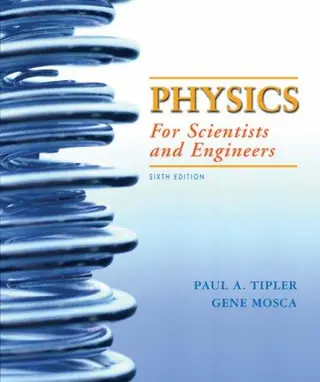
Physics for scientists and engineers
by Paul A. Tipler, Gene Mosca · first published 1990
63% recommend38% neutral
Why HN recommends it
A standard college-level generalist physics textbook widely adopted by colleges as a default for scientists and engineers. Its broad use and recent editions are key reasons to choose it.
Summarised by Claude from recommending comments
Maximize your course success by making the most of what Serway/Jewett's PHYSICS FOR SCIENTISTS AND ENGINEERS, Tenth Edition, has to offer. From a host of in-text features to a range of outstanding technology resources, you'll have everything you need to understand the natural forces and principles of physics. New context-rich exercises, Think-Pair-Share problems and MCAT-style passage problems enable you to put what you learn into practice. Also available, WebAssign is the world's easiest to use homework system. Throughout every chapter, the authors have built in a wide range of examples, exer
Affiliate links. As an Amazon Associate I earn from qualifying purchases.
Mentions per year
What Hacker News says
Related books
 2015–2024
Conceptual physics
Paul G. Hewitt
Recommended by 4 · mentioned by 54 recommend · 5 mention4 recommend · 54 recommend
 2010–2026
Introduction to electrodynamics
David Jeffrey Griffiths
Recommended by 14 · mentioned by 2814 recommend · 28 mention14 recommend · 2814 recommend
 2008–2026
The Feynman Lectures on Physics
Richard Phillips Feynman
Recommended by 69 · mentioned by 12669 recommend · 126 mention69 recommend · 12669 recommend
Physics for Scientists and Engineers Paul A. Tipler; Gene Mosca https://www.macmillanlearning.com/college/us/product/Physics...
on “Ask HN: Recommended Books on Physics?” ↗…are talking about textbooks, it really depends on what topic you want to learn (Algebra, Calculus, Mechanics, Electromagnetism…). If you want a generalist one, many colleges' choice has proven it's: Physics for Scientists and Engineers (the latest Edition is better of course) by Paul A. Tipler (Author), Gene Mosca Conceptual Physics by Hewitt http://www.conceptualphysics.com/
on “Ask HN: Best books to gain solid understanding in physics and math topics?” ↗I see a lot of people recommending Halliday and Resnick, but I used Serway- Physics for Scientists and Engineers in college and that textbook was one of the best I felt I ever read. Its been quite some time since I was in college though, maybe its fallen out of favor?
on “Ask HN: How to self-study physics?” ↗…without having the necessary mathematical background and doing the physics exercises. The Mechanical Universe textbooks are still available on Amazon. If you prefer a more recent textbook, Serway's "Physics for Scientists and Engineers" is well regarded, as is Halliday & Resnick, though the latter is aimed more at career physicists. [EDIT] Regarding the Feynman Lectures on Physics mentioned elsewhere, while Feynman indeed intended…
on “Ask HN: How can I get the equivalent of undergrad phsyics knowlege?” ↗…reasonable for their book to give true equations from the start (like the equation for relativistic momentum rather than just p=mv) and then state the more familiar forms as approximations. Randall Knight's Physics for Scientists and Engineers is a much more standard text than those two, but it's still worlds better than most traditional texts that I've used: it changes the old standards in smaller ways, but still incorporating lots of research-based…
on “States are moving to cut college costs by introducing open-source textbooks” ↗…some experiments that should have been accurate enough to detect the orbital motion of the earth and it's effect on the speed of light. Google '1890 speed of light experiments' and you should get Modern Physics for Scientists and Engineers page 21 - 27. It talks about the interferometer experiments that suggested the speed of light was constant. http://en.wikipedia.org/wiki/Interferometry
on “How Geniuses Think” ↗…else mentioned the EEV YouTube channel. Great content in general (although I can't vouch for all videos). It's nice to watch some and try to Google more information based on what interests you. [1] "Physics for Scientists and Engineers" (now that I searched the title, I realize there are many books with the same title, from my short glances they all seem pretty equal, but I am sorry I can't remember the authors of my book) [2] "Basic…
on “Ask HN: Resources to learn Electrical Engineering?” ↗…text of learning books things like a multiplication table, a list of ways triangles can be proven to be congruent, the periodic table, physical contexts, the expansion rules for differential calculus, "Physics for scientists and engineers", the whole thing. Yes that will absolutely blow out the latent space, but clearly we've decided that a billion or 2 of extra investments will still allow us to calculate the output.
on “World model on million-length video and language with RingAttention” ↗