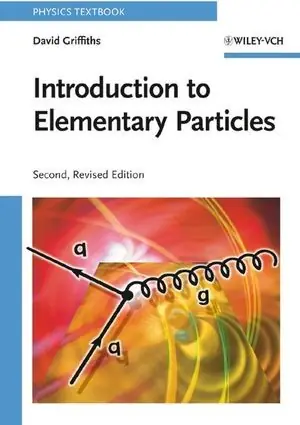
Introduction to Elementary Particles
by David Jeffrey Griffiths · first published 2008
69% recommend25% neutral6% critical
Why HN recommends it
A readable introduction to particle physics that starts with Feynman diagrams and historical background, telling how the theory developed. Suits readers with undergraduate physics who want an entry before heavier texts.
Summarised by Claude from recommending comments
2nd ed.
Affiliate links. As an Amazon Associate I earn from qualifying purchases.
Mentions per year
What Hacker News says
Related books
 2016–2021
Drawing Theories Apart
David Kaiser
Recommended by 2 · mentioned by 32 recommend · 3 mention2 recommend · 32 recommend
 2010–2024
An introduction to quantum field theory
Michael Edward Peskin
Recommended by 2 · mentioned by 62 recommend · 6 mention2 recommend · 62 recommend
 2010–2026
Introduction to electrodynamics
David Jeffrey Griffiths
Recommended by 14 · mentioned by 2814 recommend · 28 mention14 recommend · 2814 recommend
 2016–2023
Quantum Field Theory in a Nutshell
A. Zee
Recommended by 5 · mentioned by 85 recommend · 8 mention5 recommend · 85 recommend
 2016–2025
Quantum field theory for the gifted amateur
Tom Lancaster
Recommended by 8 · mentioned by 88 recommend · 8 mention8 recommend · 88 recommend
 2008–2026
Modern quantum mechanics
Jun John Sakurai
Recommended by 7 · mentioned by 107 recommend · 10 mention7 recommend · 107 recommend
 2012–2026
Classical electrodynamics
John David Jackson
Recommended by 10 · mentioned by 1610 recommend · 16 mention10 recommend · 1610 recommend
 2008–2025
Electricity and magnetism
Edward M. Purcell
Recommended by 14 · mentioned by 1814 recommend · 18 mention14 recommend · 1814 recommend
…the Freenode ##physics channel can still be nicely active sometimes, though not as active as ##math is. If you want that sort of story, one textbook that you might incredibly like would be Griffiths' Introduction to Elementary Particles, which has a very readable first section going into the history of how we came to have the Standard Model that we have today, some names of who discovered what, etc. A. Zee's Quantum Field Theory in…
on “Ask HN: What are your favorite physics sites, documentaries, books?” ↗The introductory chapter of "Introduction to Elementary Particles" by David Griffiths. It doesn't require much knowledge of physics but tells the story of how the theory came to be over the 20th century (based on experimental evidence and the theoretical work happening…
on “Long-sought decay of Higgs boson observed at CERN” ↗…is a mix of history and physics, by explaining how physicists came to discover their theories. I actually don't think it says much about modern particle physics though. It includes quantum mechanics. Introduction to Elementary Particles by David Griffiths if you just want particle physics. Griffiths also has an intro book on quantum mechanics.
on “Measurement of the W boson mass reveals 7σ deviation from calculations” ↗…towards the end of the book. 10. A First Course in General Relativity by Schutz. There are arbitrarily advanced texts on GR, but I'd recommend starting off with something friendly like Schutz. 11. An Introduction to Elementary Particles by Griffiths. Not super advanced mathematically, but it's a good thing to read over to prepare you for more advanced QFT texts. The first chapter is especially good as a history of the development of…
on “Ask HN: How to self-study physics?” ↗If you're interested in how these really work, a good place to start is Introduction to Elementary Particles by David Griffiths. For the full-strength stuff, go with An Introduction to Quantum Field Theory by Peskin and Schroeder.
on “Let’s draw Feynman diagrams!” ↗I recommend the first two chapters of Griffiths's Introduction to Elementary Particles which gives a very readable approach of showing which Feynman diagrams occur and what they mean. After that, the book gets more technical, but the first two chpaters give historical background and make…
on “Why Feynman Diagrams Are So Important” ↗As others have noted, it sounds like what you're really interested in is particle physics. In that case, I'd recommend Griffiths's "Introduction to Elementary Particles", which would be accessible to someone with an undergraduate level knowledge of physics. But you could probably get away with knowing less, depending on your background.
on “Particle mystery: physicists confirm the muon is more magnetic than predicted” ↗…A Student's Guide to Maxwell's Equations (Daniel Fleisch) or if you're also interested in a visual guide, I wrote one as well: https://github.com/photonlines/Intuitive-Guide-to-Maxwells-Equations - Introduction to Elementary Particles (David J. Griffiths) - An Invitation to Applied Category Theory: Seven Sketches in Compositionality (Brendan Fong, David I Spivak) - Solving Mathematical Problems: A Personal Perspective (Terence…
on “Ask HN: Serious mathematics books that can replace a good teacher?” ↗Sure - like I said, it's hard for me to say what my favorite is without naming a category, but since we're on the topic of Electromagnetism I'll stick to physics and recommend 1) Introduction to Elementary Particles by Griffiths (best into to standard model in particle physics) and 2) QED by Richard Feynman. QED btw is very well done and literally shows you the 'algorithm' behind standard particle physics and does…
on “An intuitive guide to Maxwell's equations (2020)” ↗…resulting black hole in other words would have way more of a mass than 2M since you're talking about a 'sticky' collision in the above instance. You can see an example of why this is in Griffiths' text (Introduction to Elementary Particles (which I highly recommend)) -- page 101 contains a great example of what happens to the mass of particles in 'sticky' collisions: https://www.hlevkin.com/hlevkin/90MathPhysBioBooks/Physics/Q...
on “LIGO detects most massive black hole merger to date” ↗…degree holder. The insights above are my own and extractable from this material but not necessarily stated out loud (unless I'm unconsciously plagiarizing which is entirely possible) * David Griffiths - Introduction to Elementary Particles * Chris Quigg - Gauge Theories of the Strong, Weak, and Electromagnetic Interactions And the wonderful Richard Behiel's videos on YouTube https://www.youtube.com/watch?v=8Iu74b5iCuQ
on “Einstein's relativity rules chemical bonds in heavy elements, new research shows” ↗…standard answer. It's very much a "shut up and calculate" book, you'll learn how to compute expected values of commutators without much intuition for what they mean. Update: Others point out Griffth's "Introduction to Elementary Particles", read their recommendations, sounds like the way to go. If don't want to spend 12 hours a week for 3 months and still not have learned much about the 3 generations, then ... I don't know, maybe QED:…
on “Particle mystery: physicists confirm the muon is more magnetic than predicted” ↗Actually just for High Energy Physics you do not really need Quantum mechanics, I think Griffith 'Introduction to Elementary Particles' was pretty good. You might want to look more into special relativity first.
on “Particle mystery: physicists confirm the muon is more magnetic than predicted” ↗Introduction of Quantum Mechanics and Introduction to Electrodynamics, both by David J. Griffiths. He also wrote Introduction to Elementary Particles, but I have not read that one. Both books masterfully take exceptionally complex fields and break them down into easily digested chunks, with a clear progression of ideas as you go through the book.…
on “Ask HN: What's the best textbook you've read?” ↗> Looking at a recent page of that course, the recomended books are * F. Halzen, A. Martin, “Quarks and Leptons: An introductory course in modern particle physics” (Wiley 1984) * D. Griffiths, “Introduction to elementary particles” (Wiley 1987) It is telling that for a recent course the recommended books are over 35 years old. Consistent with the OP proposition.
on “Ten years after the Higgs, physicists face the nightmare of finding nothing else” ↗