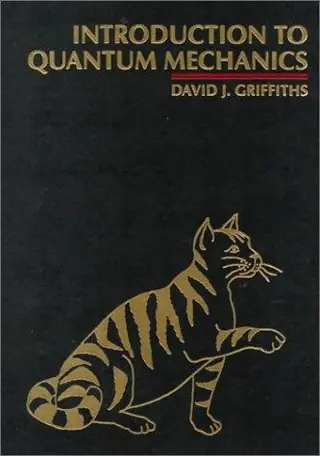
Introduction to Quantum Mechanics (2nd Edition) by David J. Griffiths
by David Jeffrey Griffiths, Darrell F. Schroeter · first published 1994
67% recommend33% neutral
Why HN recommends it
Clear, informal-yet-rigorous undergraduate introduction to quantum mechanics that builds the Schrödinger equation and wave function ideas step by step; suits students and anyone who knows calculus and linear algebra.
Summarised by Claude from recommending comments
Changes and additions to the new edition of this classic textbook include: new chapter on Symmetries, new problems and examples, improved explanations, more numerical problems to be worked on a computer, new applications to solid state physics, consolidated treatment of time-dependent potentials.
Affiliate links. As an Amazon Associate I earn from qualifying purchases.
Mentions per year
What Hacker News says
Related books
 2010–2022
A modern approach to quantum mechanics
John S. Townsend
Recommended by 3 · mentioned by 43 recommend · 4 mention3 recommend · 43 recommend
 2010–2026
Introduction to electrodynamics
David Jeffrey Griffiths
Recommended by 14 · mentioned by 2814 recommend · 28 mention14 recommend · 2814 recommend
 2015–2026
Six Ideas That Shaped Physics
Thomas A. Moore
Recommended by 2 · mentioned by 22 recommend · 2 mention2 recommend · 22 recommend
 2012–2022
Classical Mechanics
John R. Taylor
Recommended by 4 · mentioned by 74 recommend · 7 mention4 recommend · 74 recommend
 2011–2023
Quantum mechanics and path integrals
Richard Phillips Feynman
Recommended by 3 · mentioned by 73 recommend · 7 mention3 recommend · 73 recommend
 2008–2025
Electricity and magnetism
Edward M. Purcell
Recommended by 14 · mentioned by 1814 recommend · 18 mention14 recommend · 1814 recommend
 2016–2023
Quantum Field Theory in a Nutshell
A. Zee
Recommended by 5 · mentioned by 85 recommend · 8 mention5 recommend · 85 recommend
 2007–2026
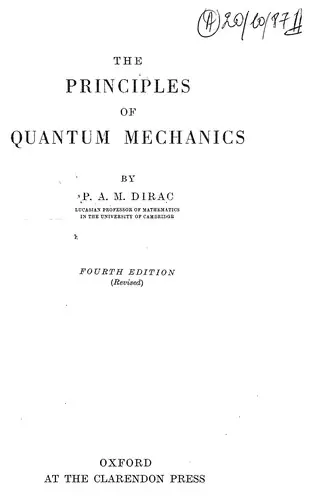
The Principles of Quantum Mechanics
Paul Adrian Maurice Dirac
Recommended by 10 · mentioned by 1410 recommend · 14 mention10 recommend · 1410 recommend
…Electrodynamics. A very well written textbook. The problem might be, if you don't know vector calculus, you might not be able to read this book, so you need to learn some vector calculus, too. Then start reading Introduction to Quantum Mechanics by Griffiths, too. Best introductory QM book that I know of. If you managed to read Electrodynamics, you should by now know enough calculus for this book, too. But you also need to know about complex…
on “There exists a classical model of the photon after all” ↗…written. There are some real gems out there though. So maybe we can list some here? Here's some of my favorites: - Statistical Rethinking : Richard McElreath (also great Twitter and online lectures) - Introduction to Quantum Mechanics: Griffiths (anything he writes is good) - Classical Dynamics of Particles and System : Stephen Thornton
on “Ask HN: What do you read for general knowledge?” ↗…statistical interpretation of the wave function. There are questions of interpretation even at this point. Schrödinger himself was skeptical of his own equation[0]! The classic intro text is Griffiths', Introduction to Quantum Mechanics. But it's a mathematical treatment -- as it has to be -- although it might be readable by accepting the key equations as axioms and reading the text. A smart, determined person would get something out…
on “A Brazilian Wunderkind Who Calms Chaos” ↗Learning a bit of Quantum Mechanics is going to be more helpful than anything else in physics to understand quantum computing. Introduction to Quantum Mechanics by Griffiths is a standard undergrad text. The math is all "simple" (linear algebra and calculus). It's the learning a new way to think about the world that's the hard part.
on “Google, D-Wave, and the case of the factor-10^8 speedup” ↗…the Fourier Transform of the postion-wavefunction. And in order to make a well defined peak using sines & cosines, you need a lot of high frequency (high momentum) waves. IIRC this is shown in Griffiths Introduction to Quantum Mechanics, quite a good introduction to QM.
on “Please check my quantum physics browser game for accuracy” ↗…mathematical machinery can be built up to understand concepts as simple as “space” and “continuity.” Then these tools can be used to quickly prove facts about mind-boggling higher dimensional objects. _Introduction to Quantum Mechanics_ by David Griffiths. Not CS or Math, but an amazing book because if you sit down and work through it it gives you a manageable intro to a completely non-intuitive and mysterious scientific field. Prerequisites…
on “Ask HN: The book that did it for you in math and/or CS?” ↗…to find in print, but a really excellent textbook. Waves are a fascinating topic because they come up in every area of physics, so a course focused around them has a huge number of applications. 5. Introduction to Quantum Mechanics by Griffiths. The best introduction to the topic you will find! 6. Thermal Physics by Kittel & Kroemer. I haven't actually found an introductory book on statistical physics that I'm crazy about, but…
on “Ask HN: How to self-study physics?” ↗I'd recommend Griffiths "Introduction to Quantum Mechanics". The writing style is informal enough that it's comfortable to read, but still had enough mathematical rigor to teach the material. It's certainly not a definitive reference, but I only reach for my…
on “Ask HN: What's the best book on quantum mechanics you've ever read?” ↗Depends how much maths you already know. I've liked Griffiths' Introduction to Quantum Mechanics- the first chapter goes into the Schrodinger equation.
on “Microsoft, Brilliant team up to offer quantum curriculum” ↗…Aaronson [0] and "Quantum Computation and Quantum Information" by Nielsen and Chuang [1]. "Quantum Computer Science" by Mermin is really good too. - Leonard Susskind's lectures on quantum mechanics [3] - "Introduction to Quantum Mechanics" by David Griffiths [4] -- just your regular QM textbook. Recommended by many and I found the explanations clear and easy to follow - also there are some recommendations by John Baez [5], that I've personally…
on “Ask HN: How to start on the path of learning Quantam Physics?” ↗…field theory -- people who've spent years calculating path integrals of mind-boggling complexity -- ask me to explain the Bell inequality to them. My favourite quantum mechanics textbook is Griffiths: Introduction to Quantum Mechanics. It is popular as a textbook for the first quantum mechanics course, which is typically in the second or third year of a physics curriculum. It has sections on EPR paradox and Bell's Theorem. First edition…
on “PHYS771 Lecture 9: Quantum – Scott Aaronson” ↗I think the best, and also most popular, textbook for a Quantum Mechanics 1 course is "Introduction to Quantum Mechanics" by David J. Griffiths. This is also what Claude says. But you also need some math: Complex numbers, linear algebra, some basics of partial differential equations. But a traditional university course…
on “Why Quantum Engineering Is Emerging as a Distinct Industrial Sector” ↗…- Classical Mechanics (the old version, NOT with Poole and Safko) Griffiths - Introduction to Electrodynamics Griffiths - Introduction to Quantum Mechanics Jackson - Classical Electrodynamics (2nd edition---the last one entirely in CGS---is preferable) Kleppner and Kolenkow - An Introduction to Mechanics…
on “Ask HN: What are your favorite physics sites, documentaries, books?” ↗…stuff on perturbation theory and scattering and some hints toward field theory. (This may work best if students had a strong "Modern Physics" course first that studied wavefunctions in some depth.) [* Introduction to Quantum Mechanics, by David Griffiths: I haven't used this myself. An excellent quantum book with a more "traditional" organization, starting with wavefunctions and only later talking about Dirac notation and spin.] Thermodynamics…
on “The Best Textbooks on Every Subject” ↗…constant tension in textbooks between the how-to-manual—spartan, practical, containing all of these scaffolding steps and nitty-gritty–and the coffeetable book—rich, whimsical, pop-simplified. Griffiths’ Introduction to Quantum Mechanics begins with a prologue to this effect, though I thought it was just a quantum quirk at the time I think it's actually much more general now. He says [these will not be exact quotes] that, “This book will…
on “Immersive Linear Algebra (2016)” ↗