Foundations and Fundamental Concepts of Mathematics
by Howard Eves · first published 2012
100% recommend
Why HN recommends it
Broad, readable overview of the major developments in mathematics, covering foundations and key concepts; suits readers wanting a big-picture map of the field rather than drill-focused practice.
Summarised by Claude from recommending comments
Affiliate links. As an Amazon Associate I earn from qualifying purchases.
Mentions per year
What Hacker News says
Related books
 2010–2024
A concise history of mathematics
Dirk Jan Struik
Recommended by 4 · mentioned by 64 recommend · 6 mention4 recommend · 64 recommend
 2008–2024
Mathematics and plausible reasoning
George Pólya
Recommended by 10 · mentioned by 1310 recommend · 13 mention10 recommend · 1310 recommend
 2008–2025
The Art and Craft of Problem Solving
Paul Zeitz
Recommended by 12 · mentioned by 1512 recommend · 15 mention12 recommend · 1512 recommend
 2008–2025
The Mathematical Experience
Philip J. Davis, Reuben Hersh, Elena Anne Marchisotto
Recommended by 20 · mentioned by 2820 recommend · 28 mention20 recommend · 2820 recommend
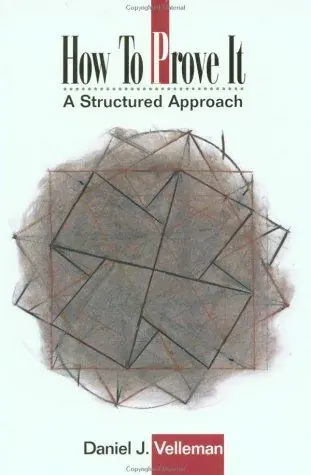 2007–2026
How to prove it
Daniel J. Velleman
Recommended by 78 · mentioned by 10478 recommend · 104 mention78 recommend · 10478 recommend
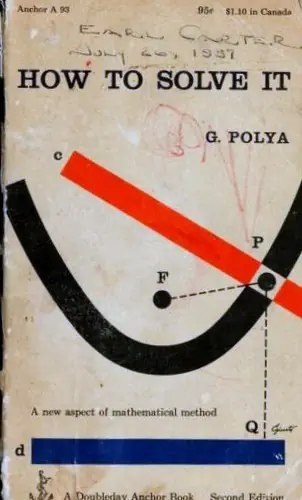 2007–2026
How to solve it
George Pólya
Recommended by 161 · mentioned by 206161 recommend · 206 mention161 recommend · 206161 recommend
 2008–2026
Principles of Mathematical Analysis
Walter Rudin
Recommended by 52 · mentioned by 8852 recommend · 88 mention52 recommend · 8852 recommend
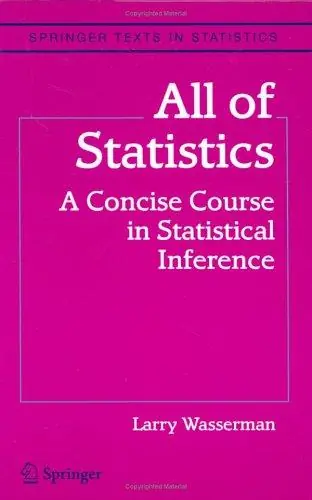 2008–2026
All of Statistics
Larry Wasserman
Recommended by 40 · mentioned by 6040 recommend · 60 mention40 recommend · 6040 recommend
…author. - "A Concise History of Mathematics" by Dirk Struik, - "A History of Mathematics" by Boyer - And of course, the internet. 3. Read a few "big picture" books side-by-side. A few suggestions: - "Foundations and Fundamental Concepts of Mathematics" by Howard Eves - "Concepts of Modern Mathematics" by Ian Stewart 4. IMHO - and this is just my preference - study application of Mathematics to Physics and Engineering. Physics especially was an inspiration…
on “Ask HN: How Do I Get Math?” ↗…wonderfully tight, indeed very little noise and a whole lot of signal. Here's two books if you want to learn about math you might want to learn about: The Facts on File Dictionary on Mathematics by Gibson, and Foundations and Fundamental Concepts of Mathematics by Howard Eves, which takes a historical approach, but is not a history per se. More like "this is what the Greeks did, in this period the use of calculus was pretty loose and look at this equation that…
on “Ask HN: Books with a high signal to noise ratio?” ↗In that vein I highly recommend Foundations and Fundamental Concepts of Mathematics by Howard Eves. I think it might be a little dated, but it gives an amazing overview of the most important developments in mathematics that were relevant at the time. It's less focused on practice (though…
on “Ask HN: Math books that made you significantly better at math?” ↗…(rigorous (for practitioners) and comprehensive. Starts from nothing, with sets, then teaches you fractions, then quadratic equations until you're doing vector analysis and Laplace transformations) - Foundations and Fundamental Concepts of Mathematics by Howard Eves (wide overview of the man developments in mathematics, up to its publication)
on “G. Polya, How to Solve It” ↗Foundations and Fundamental Concepts of Mathematics, by Howard Eves
on “Ask HN: Math books that made you significantly better at math?” ↗According to Howard Eves in Foundations and Fundamental Concepts of Mathematics (pages 176-7), this and much of Euler's work was achieved purely by formal manipulation. He had great intuition, although that sometimes led him to "absurdities" in e.g. limits.
on “(e^(i * pi)) + 1 = 0” ↗