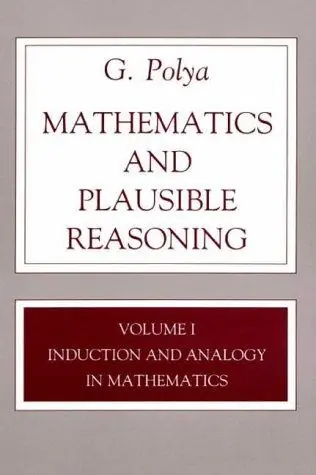
Mathematics and plausible reasoning
by George Pólya · first published 1954
77% recommend23% neutral
Why HN recommends it
Explores how mathematicians make good guesses and spot patterns through analogy and plausible reasoning. A close look at how working mathematicians think, with exercises, for undergraduates and intuition-builders.
Summarised by Claude from recommending comments
One of the best books to read about math and math education
Affiliate links. As an Amazon Associate I earn from qualifying purchases.
Mentions per year
What Hacker News says
Related books
 2020–2023
Common Sense Mathematics
Ethan D. Bolker, Maura B. Mast
Recommended by 2 · mentioned by 22 recommend · 2 mention2 recommend · 22 recommend
 2008–2023
Number theory
George E. Andrews
Recommended by 5 · mentioned by 65 recommend · 6 mention5 recommend · 65 recommend
 2012–2024
Mathematical discovery
George Pólya
Recommended by 2 · mentioned by 42 recommend · 4 mention2 recommend · 42 recommend
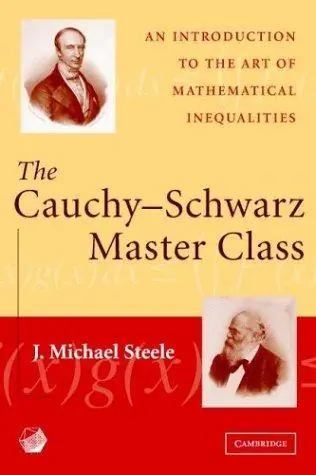 2011–2023
The Cauchy-Schwarz Master Class
J. Michael Steele
Recommended by 3 · mentioned by 33 recommend · 3 mention3 recommend · 33 recommend
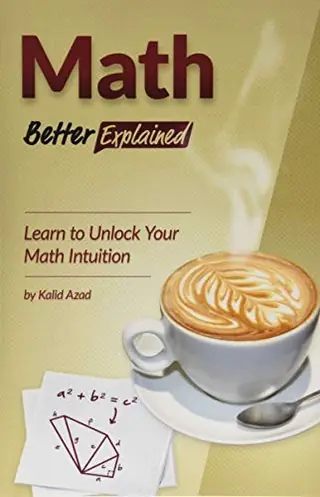 2018–2023
Math, Better Explained
Kalid Azad
Recommended by 2 · mentioned by 32 recommend · 3 mention2 recommend · 32 recommend
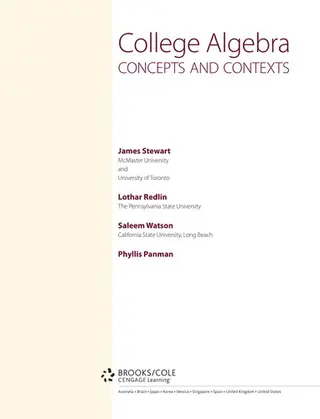 2012–2024
College algebra
James Stewart
Recommended by 2 · mentioned by 42 recommend · 4 mention2 recommend · 42 recommend
Geometry and the imagination
David Hilbert
Recommended by 7 · mentioned by 107 recommend · 10 mention7 recommend · 107 recommend
Foundations and Fundamental Concepts of Mathematics
Howard Eves
Recommended by 5 · mentioned by 55 recommend · 5 mention5 recommend · 55 recommend
I wouldn’t dismiss analogy so easily. George Polya opened my eyes to the power of analogy in math. I can’t recommend his “Mathematics and Plausible Reasoning” enough.
on “How to Read Mathematics” ↗…problem solving, and wants to codify their existing methods. Even advanced undergraduate math students who read it aren’t going to fully understand the book IMO; I would recommend Pólya’s other books (Mathematics and Plausible Reasoning, Mathematical Discovery), or maybe start with a gentler book like Mason, Burton, & Stacey, Mathematical Thinking.
on “Book: Mathematics for Machine Learning” ↗Most competitive programmers suggest Polya's "How to Solve It". His "Mathematics and Plausible Reasoning" is also good, but longer and more dense.
on “Ask HN: How to improve my abstract thinking?” ↗Mathematics and Plausible Reasoning, in two volumes also by Polya, is the closest thing I've ever found to an explanation of how a working mathematician goes about her business. It has exercises, too. Great fun when I was in undergrad.
on “G. Polya, How to Solve It” ↗Steinhaus, Mathematical Snapshots Polya, Mathematics and Plausible Reasoning Pappas, The Joy of Mathematics Gardner, The Colossal Book of Short Puzzles and Problems Winkler, Mathematical Puzzles: A Connoisseur's Collection Andrews, Number Theory (Dover Books on Advanced Mathematics)…
on “Ask HN: Good books on mathematics for somebody who's only taken high school math?” ↗Even more useful as a first step in my opinion is to think about problem solving per se. E.g. see: Mason, Burton, & Stacey, Thinking Mathematically Pólya, How to Solve It; Mathematics and Plausible Reasoning (2 vols); Mathematical Discovery (2 vols) Schoenfeld, Mathematical Problem Solving Larson, Problem-Solving Through Problems
on “How to Study Mathematics (2017)” ↗Something I found useful and related was George Polya's book series "Mathematics and Plausible Reasoning" [1]. It goes into how we make "good" guesses in mathematics and how to improve the way we recognize patterns. If you are curious about this subject and want to improve your "mathematical intuition",…
on “Mathematical Concepts: How Do Mathematicians Jump to Conclusions? (1998)” ↗…sections on particular named problem solving topics, and is somewhat hard to interpret for novices without guidance, let me recommend Polya’s other two books (each 2 volumes), Mathematical Discovery and Mathematics and Plausible Reasoning.
on “Ask HN: Recommend a maths book for a teenager?” ↗…ask the same thing! :D "How to solve it" [1] was helpful for me in this regard, but it isn't really condensed like this blog post. After you finish "how to solve it", you can read the more advanced "Mathematics and Plausible Reasoning" [2] [1] https://www.amazon.com/How-Solve-Mathematical-Princeton-Scie... [2] https://www.amazon.com/Mathematics-Plausible-Reasoning-Two-V...
on “Problem solving strategies in a graduate real analysis course (2010)” ↗They were not textbooks for any course. But I liked these: 1. Mathematics and Plausible Reasoning by George Pólya 2. Probability Theory: The Logic of Science by E.T. Jaynes
on “Ask HN: What are the most eye-opening textbooks you have ever read?” ↗…translated into French). Among these are Numbers and figures by Rademacher and Töplitz, Geometry and the imagination by Hilbert and Cohn-Vossen, What is mathematics? by Courant and Robbins, How to solve it and Mathematics and plausible reasoning by Polya, Development of mathematics in the 19th century by F. Klein.
on “Teaching Mathematics” ↗…is very lively and has a lot of material you won't find in a standard complex analysis book, including Dirichlet series. Excellent as a supplement to a standard complex analysis book. 6. George Polya. Mathematics and Plausible Reasoning. An excellent expansion on Polya's ideas on How to Solve it. While the goal is to seek rigorous proofs, to get there it's powerful to be able to think based on intuition, heuristics, and plausible reasoning.…
on “Ask HN: Math books that made you significantly better at math?” ↗…CONJECTURE: If a function has a power series with integer coefficients and radius of convergence 1, then either the function is rational or the unit circle is a natural boundary. > Reference: Polya, Mathematics and Plausible Reasoning, volume 2, page 46. Has this conjecture been proved or disproved by now?
on “HAKMEM (1972)” ↗Last year I read How to Solve It and the first half of one of Polya's other books - Mathematics and Plausible Reasoning. I certainly didn't commit them to memory, and I never systematically tried to apply them during self-study, but they do sometimes help give me a pointer in the right direction (i.e. trying to think of…
on “Everyone is capable of, and can benefit from, mathematical thinking” ↗I'm surprised that E.T. Jaynes Probability Theory, nor Ploya's Mathematics and Plausible Reasoning is mentioned at all in this book, even in the references.
on “Belief Reasoning with Subjective Logic” ↗