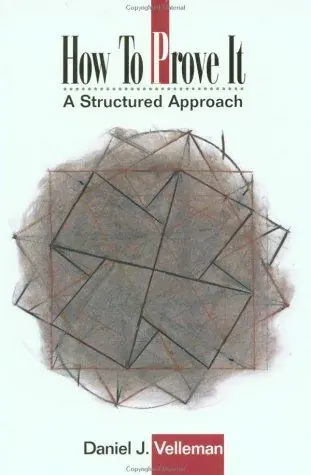
How to prove it
by Daniel J. Velleman · first published 1994
75% recommend24% neutral1% critical
Why HN recommends it
Structured introduction to proof-writing, logical notation, and set theory for people with no prior proof experience, such as self-taught programmers, older learners, and those preparing for analysis.
Summarised by Claude from recommending comments
Many students have trouble the first time they take a mathematics course in which proofs play a significant role. This new edition of Velleman's successful text will prepare students to make the transition from solving problems to proving theorems by teaching them the techniques needed to read and write proofs. The book begins with the basic concepts of logic and set theory, to familiarize students with the language of mathematics and how it is interpreted. These concepts are used as the basis for a step-by-step breakdown of the most important techniques used in constructing proofs. The autho
Affiliate links. As an Amazon Associate I earn from qualifying purchases.
Mentions per year
What Hacker News says
Related books
 2013–2024
Mathematical proofs
Gary Chartrand, Albert D. Polimeni, Zhang, Ping, Ping Zhang
Recommended by 17 · mentioned by 2017 recommend · 20 mention17 recommend · 2017 recommend
Book of Proof
Richard Hammack
Recommended by 54 · mentioned by 6654 recommend · 66 mention54 recommend · 6654 recommend
 2008–2026
Calculus
Michael Spivak
Recommended by 88 · mentioned by 13088 recommend · 130 mention88 recommend · 13088 recommend
A Book of Abstract Algebra
Charles C. Pinter
Recommended by 25 · mentioned by 2725 recommend · 27 mention25 recommend · 2725 recommend
 2010–2023
A transition to advanced mathematics
Smith, Douglas
Recommended by 15 · mentioned by 1715 recommend · 17 mention15 recommend · 1715 recommend
 2008–2022
The foundations of mathematics
Ian Stewart, David Orme Tall
Recommended by 6 · mentioned by 66 recommend · 6 mention6 recommend · 66 recommend
 2008–2026
Principles of Mathematical Analysis
Walter Rudin
Recommended by 52 · mentioned by 8852 recommend · 88 mention52 recommend · 8852 recommend
 2010–2026
Understanding Analysis
Stephen Abbott
Recommended by 31 · mentioned by 3831 recommend · 38 mention31 recommend · 3831 recommend
…Calculus: The Calculus Tutoring Book - Ash. College: 3. Preparation for Collegel-level maths: 3a. General prep for high level maths: How to Study as a Mathematics Major - Alcock 3b. Proof writing: How to Prove It - A Structured Approach - Velleman OR Book of Proof (2nd ed) - Hammack (it's free!) 4. Mathematical Analysis: 4a. Good prep for Analysis: How to Think About Analysis - Alcock 4b. Understanding Analysis…
on “Ask HN: How to self-learn math?” ↗…our work. If your class also applies thinking routines, it’ll get even easier for everyone to learn and understand each other. I recommend the following books: - Polya, How to Solve It - Velleman, How to Prove It: A Structured Approach - Ritchhart: Make Thinking Visible Mathematical work is basically a series of equivalent transformations and logical reasonings, starting from the given informations to get where…
on “Ask HN: How do I improve my command of mathematical language?” ↗…thinking. Here’s some off the top of my head. I really think these will help you build a good foundation for mathematical thinking. Concrete Mathematics by Graham, Knuth, Patashnik Spivak’s Calculus How to Prove It by Velleman Polya’s How to Solve It E.T. Jaynes’ Probability Theory Conceptual Mathematics by Lawvere and Schanuel
on “Book: Mathematics for Machine Learning” ↗…connect true statements together into a massive graph and extend that graph through speculation if possible. With that intuition it's simply a matter of slogging through a proof textbook like Velleman's "How to Prove It" until you have the confidence to work through the texts that truly interest you. If you don't feel like a clueless fool you're not trying hard enough. Confusion and self-doubt are sure signs you're finally…
on “Ask HN: How to learn mathematical proofs from scratch?” ↗Well, if you're looking for an introduction to the basics of mathematics (which I would recommend for anyone looking to delve deeper into any specific area), you can't really beat 'How to Prove It' by Velleman. It covers the fundamental concepts of mathematical analysis and proof-writing (and, perhaps more importantly, reading proofs) and will help give you a great grounding for further reading,…
on “Ask HN: good math books” ↗If anyone is interested in how mathematicians think and do proofs there are many helpful books. For example, Mathematical Proofs: A Transition to Advanced Mathematics by Chartrand and others. How to Prove It: A Structured Approach by Velleman. Learning to Reason: An Introduction to Logic, Sets, and Relations by Nancy Rodgers. Elementary Discrete Math books make for great intro to proofs and math thought:…
on “A Software Engineer’s Adventures in Learning Mathematics” ↗On the topic of newcomers to proof-based math - "How to Prove It" is a great resource: https://www.amazon.com/How-Prove-Structured-Approach-2nd/dp/...
on “Ask HN: Resources to learn real analysis?” ↗…coverage of the material that emphasizes a proof-based approach, you can supplement your reading with a book on general proof strategies, such as: 1. Mathematical Proofs by Chartrand, Polmeni, Zhang 2. How to Prove It by Daniel Velleman The first book by Chartrand et al is more of a traditional textbook and gives a comprehensive introduction to set theory in the context of various types of mathematical proofs. It's…
on “Ask HN: Resources to learn Discrete Mathematics?” ↗…how to go about learning algorithms today, I would ask him to first learn the basics of proofs ("The Hsskell Road to Logic Maths and Programming" by Doets and Van ejck is a good book as is Velleman's "How To Prove It"), then work through (at least) the first three chapters of Knuth et al's "Concrete Mathematics" - to get a handle on recurrences - and then tackle "Introduction to Algorithms" , probably supplemented…
on “Algorithm Basics?” ↗…(like Calculus I/II/III teaches, no offence/looking down one's nose is intended), you'll need to eventually learn to write proofs. A good book to get you over the initial hurdles is Daniel Velleman's How to Prove It.
on “Ask HN: Independent Math Study” ↗…you(made-your-money? unemployment? ..??) Have you already finalized your specialization? Has anyone influenced you in choosing your subjects? finally, What are you doing for math-prep for CS classes? fwiw- 'how to prove it' -velleman has helped me to some extent. (http://www.amazon.com/How-Prove-Structured-Daniel-Velleman/d...)
on “Ask HN: going back to school, what books before CS?” ↗Since you consider yourself an older learner, how about trying your hand at "Intro to Mathematical Proof" or "Intro to Problem Solving" books? Velleman's "How to Prove it" and Polya's "How to Solve It" seem like good places to start (after you finish reviewing high school math) and will help you develop a deeper appreciation for the subject. If I may ask, why the sudden…
on “Ask HN: How to get back into mathematics?” ↗This is part of a series. I haven't read Solve It but there is another one that I worked through several years ago before returning to school, How to Prove It, that really cleared up how to do proofs for me. It is all based around set theory and some of the later proofs are quite deep: http://www.amazon.com/gp/aw/d/0521675995/
on “Algorithms from the “Book”” ↗There are some great books to build up some intuition and rigor in all branches of math, with no prior knowledge: * How to Prove It (Velleman) * Algebra; Trigonometry; F&G; The Method of Coordinates (Gelfand) * Geometry (Kiselev) * Calculus Made Easy (Thompson) * How to Count without Counting (Niven) * Introduction to Probability…
on “How I faced my fears and learned to be good at math” ↗This is a jump straight into the deep end. I can't recommend starting here. "How to prove it" https://www.amazon.com/How-Prove-Structured-Approach-2nd/dp/... would be a much more appropriate start
on “Whiteboard problems in pure Lambda Calculus” ↗