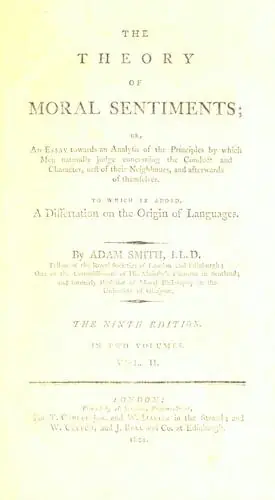
The theory of moral sentiments
by Adam Smith · first published 1759
25% recommend75% neutral
Why HN recommends it
Smith's earlier work applies the same bottom-up reasoning as Wealth of Nations to morality, and it is the context for the invisible hand. Suits readers who want the real Smith and a grounding before Wealth of Nations.
Summarised by Claude from recommending comments
The Theory of Moral Sentiments, Smith’s first and in his own mind most important work, outlines his view of proper conduct and the institutions and sentiments that make men virtuous. Here he develops his doctrine of the impartial spectator, whose hypothetical disinterested judgment we must use to distinguish right from wrong in any given situation. We by nature pursue our self-interest, according to Smith. This makes independence or self-command an instinctive good, and neutral rules as difficult to craft as they are necessary. But society is not held together merely by neutral rules; it is he
Affiliate links. As an Amazon Associate I earn from qualifying purchases.
Mentions per year
What Hacker News says
Related books
 2007–2026
The Wealth of Nations
Adam Smith
Recommended by 92 · mentioned by 40592 recommend · 405 mention92 recommend · 40592 recommend
Essays on Philosophical Subjects
Dugald Stewart, Adam Smith
0 recommend · 2 mentioned0 recommend · 2 mention0 recommend · 20 recommend
 2009–2026
Inquiry into the nature and causes of the wealth of nations
Adam Smith, Andrew Skinner
Recommended by 9 · mentioned by 359 recommend · 35 mention9 recommend · 359 recommend
 2010–2026
The fable of the bees
Bernard Mandeville
Recommended by 3 · mentioned by 63 recommend · 6 mention3 recommend · 63 recommend
Dynamic Economic Systems
John M. Blatt
Recommended by 2 · mentioned by 22 recommend · 2 mention2 recommend · 22 recommend
 2012–2023
Capitalism
George Reisman
Recommended by 4 · mentioned by 64 recommend · 6 mention4 recommend · 64 recommend
 2018–2026
The God of Small Things
Arundhati Roy
Recommended by 6 · mentioned by 106 recommend · 10 mention6 recommend · 106 recommend
 2010–2024
A conflict of visions
Thomas Sowell
Recommended by 18 · mentioned by 2318 recommend · 23 mention18 recommend · 2318 recommend
After reading a fair amount about Stoicism and still being unclear, I've found a good summary in Adam Smith's almost forgotten classic, "The Theory of Moral Sentiments" (1759) [1]: "Human life the Stoics appear to have considered as a game of great skill; in which, however, there was a mixture of chance [...] In such games the stake is commonly a trifle, and the whole…
on “Stoicism: Indifference is a power” ↗…and does not get into computational model based economics - specifically microeconomics, which comprises the bulk of economics education today: Schumpeter - History of economic analysis Adam Smith - Theory of Moral Sentiments Kaynes - The General Theory of Employment, Interest and Money Marx - Capital Benjamin Graham - The Intelligent Investor Galbraith - The Affluent Society Galbraith - The Great Crash Milton Friedman…
on “Ask HN: What are the must-read books about economics/finance?” ↗…you're going to read one economics book, read Thomas Piketty, "Capital for 21st Century". These are the classic economics tomes that you'd read over a lifetime: Karl Marx, "Capital" Adam Smith, "The Theory of Moral Sentiments" Adam Smith, "The Wealth of Nations" FA Hayek, "The Road to Serfdom"
on “Ask HN: What are the must-read books about economics/finance?” ↗…economic system in history that resulted in the enduring abolition of slavery. Modern, alternative economic systems still devolve into utilizing slavery to this very day. You should read Adam Smith's The Theory of Moral Sentiments, and The Wealth of Nations, which, in great detail, illustrate the economic inefficiency and moral repugnance of slavery in what we now call capitalism. Slavery was definitely not capitalistic, using…
Or you could read Adam Smith's Wealth of Nations yourself as it is available for free from multiple sources. You should his book The Theory of Moral Sentiments first. It helps with the understanding of the later material.
on “Adam Smith did not mean what he is often made to say (1998)” ↗…it is too complex a phenomenon to categorise based on the average proportion at any given point in time. Adam Smith has this wonderful quote on why it is difficult to model humans and societies in the theory of moral sentiments, which I feel holds even today: > The man of the system. seems to imagine that he can arrange the different members of a great society with as much ease as the hand arranges the different pieces upon…
on “Do countries lose religion as they gain wealth? (2013)” ↗Some related readings: Adam Smith's Theory of Moral Sentiments (1759) - http://www.econlib.org/library/Smith/smMSCover.html Adam Smith's Lectures on Justice, Police, Revenue and Arms (1763) - http://oll.libertyfund.org/titles/2621 (warning: long page) Edward Gibbon's…
on “Ask HN: What are your recommended reads that are available for free?” ↗…away has proven necessary, empirically, to avoid winding up in a highly non-optimal equilibrium point. If you're interested in ethical ramifications, I recommend two excellent works on the topic: A Theory of Moral Sentiments and An Inquiry into the Nature and Causes of the Wealth of Nations. Even that treatment is unsatisfactory as it neglects considerations of short-term vs. long-term trade-offs. Your example is contrived…
on “White House urges ban on non-compete agreements for many workers” ↗…developments in economics will find things to disagree with, but it's important to know what he actually said instead of the self-justifying caricature presented by Rand and her ilk. If you go on to read Theory of Moral Sentiments the contrast becomes even more clear.
on “Ask HN: Which books do you wish you'd read earlier in life?” ↗If you are going to read Adam Smith's Wealth of Nations, then you should probably read The Theory of Moral Sentiments first. It helps with the understanding.
on “Ask HN: What are your favorite books or essays written at least 100 years ago?” ↗Have you read Smith's Theory of Moral Sentiments? It applies the same kind of thinking found in Wealth of Nations (deriving systemic social principles from individual human motivations) to the moral sphere. He first introduced the phrase "invisible…
on “How to Think about Pleasure” ↗…claims not because others have told me what they say but because I heard it from the horse's mouth. Maybe you should too. And before you talk about Smith's Invisible Hand, maybe you should read "The Theory of Moral Sentiments" and "The Wealth of Nations." Maybe you should also read the work of his best friend. You are so quick to call out others for being "sheeple" yet you demonstrate that you have not read the source materials.…
on “Stories are bad for your intelligence: How Historians Make Themselves Stupid” ↗…American Cities * The Philosophy of Andy Warhol * Influence by Robert Caldini * Shakespeare: The Invention of the Human * The Art of Looking Sideways * Cosmos * Operating Manual for Spaceship Earth * The Theory of Moral Sentiments And just specifically for computer UX, Smashing UX Design is a pretty good crash course.
on “Ask HN: What are the best resources to learn Product Design?” ↗I've never been clear on why people who know nothing about Smith other than a few quotes appeal to his expertise. This article does a little to help, but really everyone should read Theory of Moral Sentiments and Wealth of Nations instead of some blog post if they want to be informed on the topic.
on “The Real Adam Smith” ↗It's fun but the English is not easy. Smith has some cool insights (which must have seemed much more novel at the time) and great skill at imparting them. I only read book 1(and the theory of moral sentiments).
on “A note on reading big, difficult books” ↗