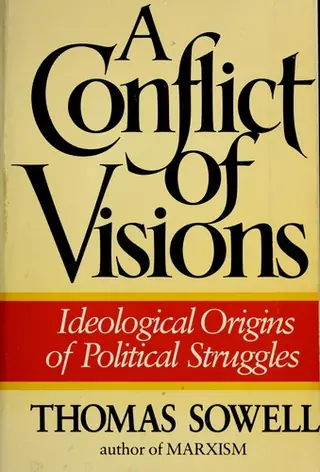
A conflict of visions
by Thomas Sowell · first published 1987
78% recommend22% neutral
Why HN recommends it
Explains why people split into left and right across time and cultures, framing it as two visions, constrained and unconstrained, that differ in assumptions about human nature. Good for understanding opponents.
Summarised by Claude from recommending comments
Controversies in politics arise from many sources, but the conflicts which endure for generations or for centuries show a remarkably consistent pattern. This book maintains that the enduring political controversies of the past two centuries reflect radically different assumptions about the nature of man. The very meaning of such words as "freedom," "equality," "rights," and "power" is drastically different in the context of different visions of man. Issues as diverse as criminal justice, income distribution, or war and peace repeatedly show those with one vision lining up on one side and those
Affiliate links. As an Amazon Associate I earn from qualifying purchases.
Mentions per year
What Hacker News says
Related books
 2014–2024
After Dark
Jayne Ann Krentz
Recommended by 3 · mentioned by 33 recommend · 3 mention3 recommend · 33 recommend
 2011–2025
The Vision of the Anointed
Thomas Sowell
Recommended by 7 · mentioned by 117 recommend · 11 mention7 recommend · 117 recommend
 2012–2022
Intellectuals and Society
Thomas Sowell
Recommended by 7 · mentioned by 107 recommend · 10 mention7 recommend · 107 recommend
 2012–2026
How to talk so kids will listen & listen so kids will talk
Adele Faber, Elaine Mazlish
Recommended by 30 · mentioned by 3530 recommend · 35 mention30 recommend · 3530 recommend
 2008–2026
The theory of moral sentiments
Adam Smith
Recommended by 16 · mentioned by 6316 recommend · 63 mention16 recommend · 6316 recommend
Hard-Boiled Wonderland and the End of the World
Cun Shang Chun Shu
Recommended by 28 · mentioned by 4328 recommend · 43 mention28 recommend · 4328 recommend
 2007–2026
Free to choose
Milton Friedman, Rose D. Friedman
Recommended by 21 · mentioned by 4121 recommend · 41 mention21 recommend · 4121 recommend
 2008–2025
Anarchy, State, and Utopia
Robert Nozick
Recommended by 14 · mentioned by 4214 recommend · 42 mention14 recommend · 4214 recommend
> He does take a conservative approach to a lot of topics... Sowell's book A Conflict of Visions: Idealogical Origins of Political Struggles [1] is, ironically, a very good starting point in understanding what makes Sowell "conservative" (the Constrained Vision) vs "progressive" (the Unconstrained…
on “Thomas Sowell interview” ↗…but it's still a single dimension variable (there is less complexity to it than lots of people like to believe). The best explanation for what it truly is and why it occurs throughout history is in "Conflict of Visions" by Thomas Sowell. I'll give a précis of the argument here: The red/blue divide is ultimately a disagreement over the span of human nature. All humans develop intuitive beliefs about human nature merely…
on “Mastodon WTF timeline (2017)” ↗A Conflict of Visions, Thomas Sowell. A good book regardless of what you think of Sowell’s politics.
on “Ask HN: What's the best book you read in 2021?” ↗…extent to which people differ in their moral and intellectual potential is the defining difference that creates right wing vs left wing politics in basically any democratic society. Read Thomas Sowell's "A Conflict of Visions" to get a very insightful analysis of why this is so. Far from being mind boggling, it's entirely expected that different people have different intuitions about the capability of the average person.
on “Direct Democracy in Switzerland” ↗…me when I started to think about these issues more deeply and they are considered seminal works that in my opinion shouldn't be skipped while studying the questions of political and economic theory. A Conflict of Visions by Thomas Sowell further reflects on this question and makes some conclusions about why smart people end up disagreeing in such fundamental ways. I find Sowell's thinking and writing to be clear and well…
on “Why Are the Highly Educated So Liberal?” ↗A Conflict of Visions by Thomas Sowell. http://en.wikipedia.org/wiki/A_Conflict_of_Visions http://www.amazon.com/Conflict-Visions-Ideological-Political... Really good read, though a bit longish. But that could be due to the…
on “Ask HN: What book changed your life in 2014?” ↗You should read Thomas Sowell's "A conflict of visions". It's short and really great. It's about why people group themselves into the political left and right, and why those sides disagree. One of the points he makes is that the left and right don't agree…
on “The Triumph of Stupidity (1933)” ↗I think Thomas Sowell's "A conflict of visions" should be mandatory reading at high school for this sort of reason. And not just in America. In every democracy. The book really is that good. (it presents a very compelling theory as to why people…
on “Why are Americans so angry?” ↗Yes. Read a conflict of visions by Thomas Sowell. It explains why people separate into these two camps across time, place and culture.
…done reasonable job (as a liberal) of trying to understand the conservative mind. I also recommend Arnold Kling, an economist who wrote The Three Languages of Politics, and Thomas Sowell, who wrote A Conflict of Visions. I should also add that there is an increased intensity with some of the rhetoric, but I think that has more to do with people (on both sides) sensing that we may be undergoing a shift in the political…
on “The High Priest of Heterodoxy” ↗…by Thomas Sowell than by any other author, by a very wide margin. The one which has influenced me the most is the one which best captures the fundamental principles underlying his view of the world: A Conflict of Visions. I'd suggest it as required reading for anyone who wants to fully appreciate Sowell's work, as it provides insight into how he makes normative judgments about the merits of economic policy choices. In…
on “Thomas Sowell interview” ↗…and condemnation of the intellectual establishment as he sees it. I had this opinion of Sowell based on reading his public commentary/watching interviews. But I will say that, having just finished 'Conflict of Visions' some of his written work is quite excellent. I picked it up based on Steve Pinker's review and was not disappointed.
on “Encountering Thomas Sowell” ↗A more rigorous version of this can be found in the book, Conflict of Visions by Thomas Sowell. What you're calling a lens or worldview, he calls a "vision". He precisely defines two visions that are at opposite ends of an axis and which differ only in a single assumption: an intuition…
on “The “misinformation problem” seems like misinformation” ↗I think you might find Thomas Sowell’s A Conflict of Visions interesting; he argues that it’s only about half of society that has this view you describe (expecting people in authority to be somewhat saintly, self-sacrificing, or monk-like), and the other half has…
on “Why Barney Frank Went to Work for Signature Bank” ↗…(such as drug use) as the proximate cause, and that bigger government will only ultimately hinder the ability of those most poorly off to help themselves. You may be interested in Thomas Sowell's book, A Conflict of Visions, for a truly elegant analysis of this type of dichotomy.
on “On the Rise of Socialist Engineers” ↗