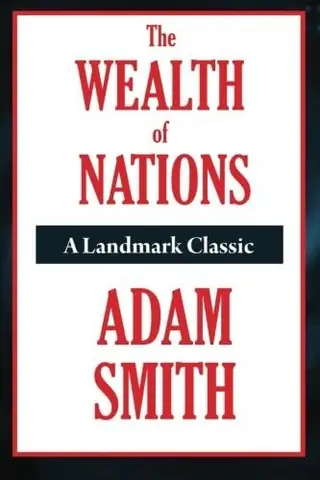
The Wealth of Nations
by Adam Smith · first published 1776
23% recommend75% neutral2% critical
Why HN recommends it
Foundational account of markets, division of labor, wages and rent, written clearly enough to read directly; suggested for anyone discussing capitalism, with chapters on pay and land rent often singled out.
Common criticism: Some say its market claims are outdated or overlook slavery and government's role
Summarised by Claude from recommending comments
Adam Smith's The Wealth of Nations was recognized as a landmark of human thought upon its publication in 1776. As the first scientific argument for the principles of political economy, it is the point of departure for all subsequent economic thought. Smith's theories of capital accumulation, growth, and secular change, among others, continue to be influential in modern economics. This reprint of Edwin Cannan's definitive 1904 edition of The Wealth of Nations includes Cannan's famous introduction, notes, and a full index, as well as a new preface written especially for this edition by the disti
Affiliate links. As an Amazon Associate I earn from qualifying purchases.
Mentions per year
What Hacker News says
Related books
 2008–2026
The theory of moral sentiments
Adam Smith
Recommended by 16 · mentioned by 6316 recommend · 63 mention16 recommend · 6316 recommend
 2010–2016
On the Wealth of Nations
P. J. O'Rourke
Recommended by 2 · mentioned by 82 recommend · 8 mention2 recommend · 82 recommend
Wealth of Nations
Collins, John
0 recommend · 2 mentioned0 recommend · 2 mention0 recommend · 20 recommend
 2012–2026
The wealth and poverty of nations
David S. Landes
Recommended by 4 · mentioned by 94 recommend · 9 mention4 recommend · 94 recommend
 2011–2024
The Ordinary Business of Life
Roger E. Backhouse
Recommended by 3 · mentioned by 33 recommend · 3 mention3 recommend · 33 recommend
A treatise on money
John Maynard Keynes
0 recommend · 2 mentioned0 recommend · 2 mention0 recommend · 20 recommend
 2008–2024
The worldly philosophers
Robert L. Heilbroner
Recommended by 17 · mentioned by 1817 recommend · 18 mention17 recommend · 1817 recommend
Essays on Philosophical Subjects
Dugald Stewart, Adam Smith
0 recommend · 2 mentioned0 recommend · 2 mention0 recommend · 20 recommend
…culture, and biography. For instance I read all the books of Euclid, Newton's Optiks and Principia (I slogged through the Motte transaltion before the first modern English translation became available), The Wealth of Nations, Shelby Foote's 3-volume history of the Civil War, and The Origen of Species. (It's real easy for me to spot folks who spoot-off about Wealth or Origen who have not actually read the books.) My program…
on “PG's Rarely Asked Questions” ↗Henry Hazlitt - 'Economics in one lesson' Mises - 'Theory of Credit and Money' Adam Smith - 'Wealth of Nations' Milton Friedman - 'Capitalism and Freedom' Murray Rothbard - 'A New Liberty' Have been my personal, but somewhat one-sided favourites.
on “Ask HN: What are the must-read books about economics/finance?” ↗…decisions is going to cause way more damage to the world than this virus ever could have on its own. I think more people making these decisions could benefit from a good deep reading of Adam Smith's "The Wealth of Nations".
on “U.S. will suspend all travel from Europe for 30 days” ↗After hearing so much about it for years, I've recently made time and read The Wealth of Nations. It's full of amazing insights that are still valid three centuries later. Thoughtful arguments in favor of free markets are balanced with lucid exposure of capitalism's limitations and inefficiencies.…
on “Das Capitalist (review of new biography of Adam Smith)” ↗…in the first place. There is absolutely nothing worse for the people at large than the collusion between government and the private enterprise. It is very simply the definition of corruption. Read the Wealth of Nations by Adam Smith for more love. As for AT&T and T-Mobile, the government created the problem in the first place. By selling spectrum, they necessitate the existence of large massive companies in the space.…
on “AT&T Drops T-Mobile USA Deal” ↗…Thomas Piketty, "Capital for 21st Century". These are the classic economics tomes that you'd read over a lifetime: Karl Marx, "Capital" Adam Smith, "The Theory of Moral Sentiments" Adam Smith, "The Wealth of Nations" FA Hayek, "The Road to Serfdom"
on “Ask HN: What are the must-read books about economics/finance?” ↗…Henry Hazlitt - 'Economics in One Lesson': https://fee.org/resources/economics-in-one-lesson-2/ Mises - 'Theory of Credit and Money': https://mises.org/library/theory-money-and-credit Adam Smith - 'Wealth of Nations': http://www.ibiblio.org/ml/libri/s/SmithA_WealthNations_p.pdf Murray Rothbard - 'For a New Liberty': https://mises.org/library/new-liberty-libertarian-manifesto And for those who want to really go…
on “Ask HN: What are the must-read books about economics/finance?” ↗Economics: - The Wealth of Nations, Adam Smith - Das Kapital, Karl Marx - That Which Is Seen, and That Which Is Not Seen, Frederic Bastiat Philosophy / Politics: - The Republic, Plato - Second Treatise on Government, John Locke -…
on “Ask HN: What are your favorite books or essays written at least 100 years ago?” ↗Frankly, Smith's attachment to the labor theory of value is a bigger mistake than this. Wealth of Nations isn't an important book because Adam Smith was right about everything he wrote about in it but because it constitutes one of the first really comprehensive treatises on the topic. There is a lot of, for…
on “Adam Smith and the Pin Factory” ↗…have a monopoly on that piece of land. The rent will increase in accordance with the contributions of the people using the land, and yet the money will be paid instead to the people owning the land. The Wealth of Nations is on Gutenberg. Skip to Chapter XI in Book 1. http://www.gutenberg.org/files/3300/3300-0.txt > The rent of land, therefore, considered as the price paid for the use of the land, is naturally a monopoly…
on “A List of Colleges’ Plans for Reopening in the Fall” ↗One of my favourite passages from Adam Smith, I believe it was from the Wealth of Nations, though I don’t remember the chapter. When I was underemployed I took the time to read it (skimming the obsolete chapters on colonial administration: the American revolution is referenced as an ongoing…
on “Adam Smith and Inequality (2014)” ↗Some takeaways I've had in reading Smith ... decades after he was assigned reading in my intro economics uni courses: "Adam Smith's Lost Legacy: Or why you should read Wealth of Nations, that it's not what you think, and how the "invisible hand" is entirely a 20th century propaganda disinformation campaign" - I didn't seek out Smith anticipating agreement - Smith isn't an advocate…
on “Adam Smith and Inequality (2014)” ↗…in the enduring abolition of slavery. Modern, alternative economic systems still devolve into utilizing slavery to this very day. You should read Adam Smith's The Theory of Moral Sentiments, and The Wealth of Nations, which, in great detail, illustrate the economic inefficiency and moral repugnance of slavery in what we now call capitalism. Slavery was definitely not capitalistic, using your definition, purely from…
Or you could read Adam Smith's Wealth of Nations yourself as it is available for free from multiple sources. You should his book The Theory of Moral Sentiments first. It helps with the understanding of the later material.
on “Adam Smith did not mean what he is often made to say (1998)” ↗I suggest reading Adam Smiths wealth of nations from 1760s. It is rather ironic that such an old book actually describes these things very well. Adam Smith accurately predicted that South American would develop poorly compared to North America. What…
on “Why the Industrial Revolution Didn’t Happen in China” ↗