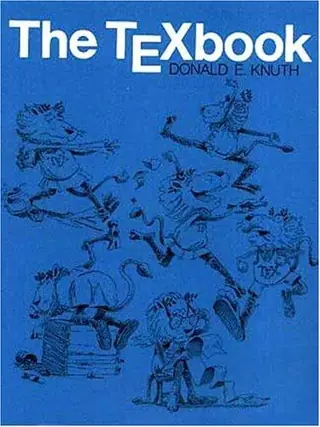
The TeXbook
by Donald Knuth · first published 1970
58% recommend42% neutral
Why HN recommends it
Thorough, carefully written manual for plain TeX that goes under the hood, with many examples, exercises, and humor. Suits readers who want to truly understand TeX, including its error handling and math typesetting.
Summarised by Claude from recommending comments
Affiliate links. As an Amazon Associate I earn from qualifying purchases.
Mentions per year
What Hacker News says
Related books
 2017–2022
A beginner's book of TeX
Raymond Seroul
Recommended by 2 · mentioned by 22 recommend · 2 mention2 recommend · 22 recommend
Mathematical typography
Donald Knuth
Recommended by 3 · mentioned by 53 recommend · 5 mention3 recommend · 53 recommend
Computers and Typesetting
Donald Knuth
Recommended by 6 · mentioned by 146 recommend · 14 mention6 recommend · 146 recommend
 2010–2026
TEX
Donald Knuth
Recommended by 12 · mentioned by 3312 recommend · 33 mention12 recommend · 3312 recommend
 2010–2026
Digital typography
Donald Knuth
Recommended by 6 · mentioned by 176 recommend · 17 mention6 recommend · 176 recommend
 2008–2026
Software tools
Brian W. Kernighan, P. J. Plauger
Recommended by 21 · mentioned by 3021 recommend · 30 mention21 recommend · 3021 recommend
 2010–2026
The Chicago manual of style
University of Chicago Press Editorial Staff
Recommended by 19 · mentioned by 11219 recommend · 112 mention19 recommend · 11219 recommend
 2007–2026
The Elements of Typographic Style
Robert Bringhurst
Recommended by 85 · mentioned by 13585 recommend · 135 mention85 recommend · 13585 recommend
The TeXBook by Knuth is also good if you want to really get to know TeX (and by extension LaTeX). The writing is engaging and well-paced: ISBN: 0201134470
on “Online tutorials for LaTeX” ↗It's a shame that you've never read a good manual. I recommend The TeXbook by Donald Knuth. Being trained in certain things brings so much joy to my life. I would hate it if my life was just a caveman who can only press buttons and see what happens.
on “Windows 9x and Word 9x at 800x600 resolution. Spacious. Comfy” ↗…plain TeX, with a very good feel of what it is doing in its 'guts'. I wrote parsers in compilers in pure TeX (the latter was admittedly a silly academic exercise). It took a very thorough reading of 'The TeXbook' but after that I am constantly amazed at how deliberate and tasteful Knuth's choices were. TeX is simply ... elegant. I am not sure what 'modern' bells and whistles TeX lacks that everyone is so eager…
on “Sile: A Modern Rewrite of TeX” ↗I use TeX. LaTeX also works, but the books are longer and less well written than Knuth's original TeXBook! :-)! I love TeX -- it's one of my favorite and most important tools. I have a Ph.D. in applied math, and IMHO TeX (or LaTeX) is just essential, call that more than ESSENTIAL for my work. E.g., now…
on “Designing a Business Card in LaTeX” ↗The TexBook was a technical documentation for TeX written by Donald Knuth. The book had a lot of jokes, and I enjoyed reading it.
on “Who controls glibc?” ↗A counterpoint would be Knuth's The TeXbook. In that book, Knuth explains every feature of TeX in excruciating detail, without being boring. He could have made the book 1/4 the size, but the book would have been worse for it.
on “Technical Writing: Learning from Kernighan” ↗…a cliche at this point, but I don't think enough writers emulate K&R's style on The C Programming Language. The prose is short, dense, and yet not tedious. Another great "tutorial" to emulate is the TeXbook by Knuth. This one is verbose, but it shows the reader all the little details and pitfalls about the software without becoming boring.
on “Ask HN: Which are the best written tutorials you have seen till now?” ↗…(commonly called the STEM fields) has some really good examples of good technical writing. E.g., for science, see the freshman physics texts by Sears, etc. For technology, see D. Knuth, if only his The TeXBook. For engineering, see, say, D. Luenberger, Optimization by Vector Space Methods. For math, see, say, any of the more respected texts for freshman calculus going back at least 50 years. Also see the texts…
on “Amazon API Gateway – Build and Run Scalable Application Backends” ↗…envelope, please? [drum roll]. And the winner is ["rip"]: Just use just TeX, that is, D. Knuth's TeX with his standard macro collection Plain. If get into trouble, then just get and read his book, The TeXBook -- as software documentation, it is exemplary. I'm guessing that a TeX file sent to people who accept LaTeX will work fine. That was the case the time I published in the Elsevier journal Information…
on “LaTeX Tooling Guide” ↗Sure, if you want to use plain TeX, and not LaTeX. To get a really thorough grounding, you can read Donald Knuth's TexBook. I'm sure there are also briefer guides online.
on “LuaTeX Comes of Age” ↗…default from my experience and one I know all too well myself. It's a lot like makefiles and shell scripts in this way. I can't really comment on what Knuth did right or wrong, but for me reading The TeXBook pretty much made Tex fun where it had previously felt arcane and frustrating. I'm convinced that overall the few hours invested there ended up saving me more hours of frustration on my masters thesis.…
on “Donald Knuth – The Patron Saint of Yak Shaves” ↗…error-handling and error-recovery interfaces of any commandline program — if you use TeX as Knuth intended, that is, if you use plain TeX at the commandline and if you have read the entertaining chapters in The TeXbook on dealing with errors. Just try using plain TeX (not LaTeX) for a few months and you'll find that the behaviour when errors happen is one of its delights, the opposite experience from when you use LaTeX.…
on “Donald Knuth – The Patron Saint of Yak Shaves” ↗…letters to mathematics, and I regard it as fine. For that word processing, that setup is fine, a done deal. I looked at LaTeX, got the basic books, etc. and concluded that (A) Knuth's documentation in The TeXBook is relatively short, well written, and essentially totally free of bugs, and it is easy to write more macros and (B) the LaTeX documentation is much longer, less well written, for the internal logic much…
on “TinyTeX: A lightweight and easy-to-maintain LaTeX distribution” ↗I am a heavy TeX user and great fan of TeX, just Knuth's TeX with just his Plain.tex macro package, just as in his The TeXBook. Great fan. No, I don't use LaTeX -- (a) I would no longer know how to write macros, (b) there is more to learn, (c) there is much more documentation to read, and (d) IMHO the LaTeX documentation is…
on “KaTeX – Fast math typesetting library for the web” ↗If you actually want to do this, then start by reading the TeXBook, by Knuth. I would love to work on this, but definitely can't commit the time.
on “Editing the C Standard” ↗