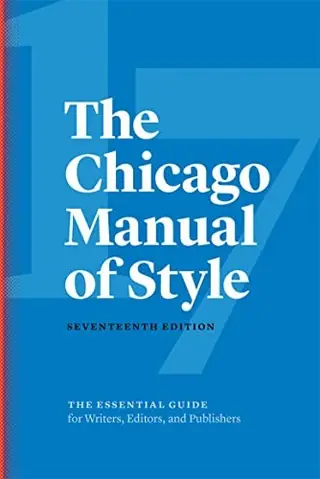
The Chicago manual of style
by University of Chicago Press Editorial Staff · first published 2017
17% recommend82% neutral1% critical
Why HN recommends it
Comprehensive, authoritative reference for American English usage, punctuation, grammar, and citations, aimed at publishing; recommended for writers and editors who want clear answers to tricky style questions.
Summarised by Claude from recommending comments
In the seven years since the previous edition debuted, we have seen an extraordinary evolution in the way we create and share knowledge. This seventeenth edition of The Chicago Manual of Style has been prepared with an eye toward how we find, create, and cite information that readers are as likely to access from their pockets as from a bookshelf. It offers updated guidelines on electronic workflows and publication formats, tools for PDF annotation and citation management, web accessibility standards, and effective use of metadata, abstracts, and keywords. It recognizes the needs of those who a
Affiliate links. As an Amazon Associate I earn from qualifying purchases.
Mentions per year
What Hacker News says
Related books
 2012–2023
The Associated Press Stylebook
Associated Press
Recommended by 2 · mentioned by 42 recommend · 4 mention2 recommend · 42 recommend
 2012–2022
The Art of Plain Talk
Rudolf Flesch
Recommended by 2 · mentioned by 22 recommend · 2 mention2 recommend · 22 recommend
 2012–2024
The New York times manual of style and usage
Allan M. Siegal, William G. Connolly
Recommended by 2 · mentioned by 112 recommend · 11 mention2 recommend · 112 recommend
 2007–2026
The Elements of Style
William Strunk, Jr., E. B. White
Recommended by 131 · mentioned by 231131 recommend · 231 mention131 recommend · 231131 recommend
 2012–2026
Artful Sentences
Virginia Tufte
Recommended by 5 · mentioned by 65 recommend · 6 mention5 recommend · 65 recommend
Practical Typography
Matthew Butterick
Recommended by 98 · mentioned by 11398 recommend · 113 mention98 recommend · 11398 recommend
 2009–2026
Style Guide
The Economist
Recommended by 7 · mentioned by 147 recommend · 14 mention7 recommend · 147 recommend
* Strunk and White * Chicago Manual of Style * NASA Technical Report Writing (Technical Memorandum 105419 (1)) (1) A personal favorite: http://ntrs.nasa.gov/archive/nasa/casi.ntrs.nasa.gov/1993001...
on “Ask HN: Best books/resources on technical writing?” ↗…and Syntax, Constance Hale • Woe Is I, Patricia T. O'Conner More resource-like and grammar-heavy: • Words Into Type, Marjorie E. Skillin (hard-core grammar rules, great section on redundancies) • Chicago Manual of Style (in general, the core style of book and magazine writing) • Associated Press Stylebook (in general, the core style of newspaper writing) • Garner's Modern English Usage, Bryan A. Garner • Merriam-Webster's…
on “Ask HN: Non-technical books for technical people?” ↗Chicago Manual of Style.
on “Ask HN: What would be the single most important book of your field?” ↗…Webster's. For grammar, something used in senior English in high school or freshman English in college. For rhetoric, sure, Strunk and White, The Elements of Style. Not nearly new stuff. For more, The Chicago Manual of Style can provide clear answers to some tricky questions, good answers not easy to find elsewhere. Then you iterate: (1) You write something, a postcard, an e-mail, a birthday card, a blog post, a love letter,…
on “How do you get to write so well in HN?” ↗…better. At the very minimum, Strunk and White is a very contentious entry, and people (like me) will come out of the woodwork to attack it. * Style: Lessons in Clarity and Grace, Joseph Bizup * The Chicago Manual of Style (depending on what kind of writer you are, a different guide may suit you better) * Bird by Bird, Anne Lamott * On Writing, Stephen King
on “There Is No Handbook for Being a Writer” ↗…conversational, weird, etc.). As shocking as this might be around here, the _Microsoft Manual of Style_ is useful as a specifically technical guide, and it's good to have a relative recent edition of the _Chicago Manual of Style_ kicking around as a reference. And, just being familiar with standard grammar and punctuation rules is important. A lot of people aren't. (A lot of people who aren't still think they are.)
on “RethinkDB is shutting down” ↗…https://www.youtube.com/watch?v=Ak-Y56SfkS0 Snark aside, there are plenty of English grammar resources that can be consumed in book form or online without attending an American high school or compromising your privacy. A solid one is the Chicago Manual of Style: https://www.chicagomanualofstyle.org/home.html
on ““Summary of why Grammarly are predatory and you should avoid them”” ↗…to consult this cheat sheet: https://amstp.northwestern.edu/documents/proofreading-marks-... Read about writing. The Elements of Style is dated, but still good. The same goes for Words Into Type. The Chicago Manual of Style is a huge tome, but is a standard for good reason. Every Page is Page One is helpful, especially for writing documentation that winds up on the web. Publications departments generally supplement references…
on “Treating Documentation Like a Product” ↗…by a respected foundation and esteemed board (a la the Creative Commons organization) would be an excellent idea. You are right about the slightly closed nature of style guides. I'm a big fan of the Chicago Manual of Style but it's not free, and nor is the fine AP Stylebook (they even charge $20 or something for their iPhone app..)
on “"Login" is not a verb” ↗If you like this sort of thing you should also check out the Chicago Manual of Style. https://www.chicagomanualofstyle.org/book/ed17/frontmatter/t...
on “The Economist's Style Guide [pdf]” ↗I think at least skimming some edition of the [1] https://en.wikipedia.org/wiki/The_Chicago_Manual_of_Style and some of what is available under [2] https://duckduckgo.com/?q=military+writing+guide would be useful for american english and technical writing.
on “Tortured phrases: A dubious writing style emerging in science” ↗"The Chicago Manual of Style" is a great resource, but it's not free I'm afraid. > What kind of feedback do you all focus on? It depends. I usually help a friend with this, but I do mostly style correction and typos. When I'm pointing…
on “Ask HN: How do you give feedback on your friend's writing/blog posts?” ↗…and Syntax, Constance Hale • Woe Is I, Patricia T. O'Conner More resource-like and grammar-heavy: • Words Into Type, Marjorie E. Skillin (hard-core grammar rules, great section on redundancies) • Chicago Manual of Style (in general, the core style of book and magazine writing) • Associated Press Stylebook (in general, the core style of newspaper writing) • Garner's Modern English Usage, Bryan A. Garner • Merriam-Webster's…
on “Common Bugs in Writing” ↗Get a good grammar textbook (several available to buy) or buy the Chicago Manual of Style. These will help you learn grammar, spelling, and puncuation instead of relying on software.
on “Any descent alternatives to Grammarly premium?” ↗…day. At first I was wondering what routers existed back in 1900, then realized it was not that turn of the century. I think this is the first time I have see 'turn of the century' refer to 1999->2000. Chicago Manual of Style has some good usage suggestions on this... https://www.chicagomanualofstyle.org/qanda/data/faq/topics/U... >A: Instead, write “at the beginning of the twentieth century,” or “at the end of the nineteenth…
on “Cloudflare defeats patent troll Sable at trial” ↗