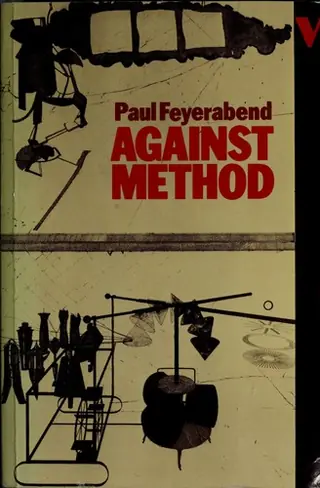
Against Method
Outline of an Anarchistic Theory of Knowledge
by Paul K. Feyerabend · first published 1975
44% recommend50% neutral6% critical
Why HN recommends it
Argues that real science is messier than Popper's idealized method, using Galilean and other historical episodes; read alongside Kuhn and Popper by those wanting to rethink how science works. Fun and provocative.
Common criticism: Some say it cherry-picks and distorts history to support its thesis
Summarised by Claude from recommending comments
Against Method: Outline of an Anarchistic Theory of Knowledge is a 1975 book about the philosophy of science by Paul Feyerabend, in which the author argues that science is an anarchic enterprise, not a nomic (customary) one. In the context of this work, the term anarchy refers to epistemological anarchy.
Affiliate links. As an Amazon Associate I earn from qualifying purchases.
Mentions per year
What Hacker News says
Related books
 2018–2020
The dream of enlightenment
Anthony Gottlieb
Recommended by 2 · mentioned by 22 recommend · 2 mention2 recommend · 22 recommend
 2015–2025
What is this thing called science?
A. F. Chalmers, Chalmers, Alan Chalmers, Alan F. Chalmers
Recommended by 6 · mentioned by 86 recommend · 8 mention6 recommend · 86 recommend
 2007–2024
The Logic of Scientific Discovery
Karl Popper
Recommended by 15 · mentioned by 2615 recommend · 26 mention15 recommend · 2615 recommend
 2018–2020
The Dream of Reason
Anthony Gottlieb
Recommended by 2 · mentioned by 22 recommend · 2 mention2 recommend · 22 recommend
 2015–2022
Philosophy of Science
Samir Okasha
Recommended by 2 · mentioned by 42 recommend · 4 mention2 recommend · 42 recommend
 2007–2026
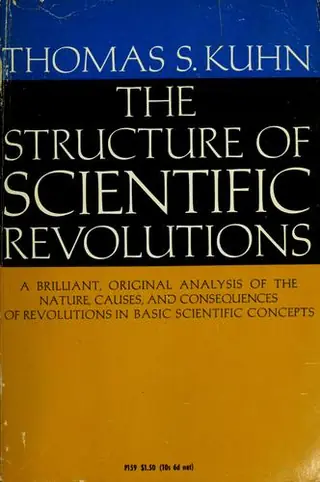
The Structure of Scientific Revolutions
Thomas S. Kuhn, Dennis Holland
Recommended by 96 · mentioned by 21596 recommend · 215 mention96 recommend · 21596 recommend
The Sleepwalkers
Arthur Koestler
Recommended by 9 · mentioned by 139 recommend · 13 mention9 recommend · 139 recommend
 2020–2025
Principia ethica
George Edward Moore
Recommended by 2 · mentioned by 32 recommend · 3 mention2 recommend · 32 recommend
This is basically the thesis of Paul Feyerabend who used it as his main argument against there being a scientific method. His book "Against Method" is one of the best works on Philosophy of Science I've read during my university education.
on “Opposition to Galileo was scientific, not just religious” ↗Anyone who enjoys Kuhn's Structure should go on to read Paul Feyerabend's Against Method, and Farewell to Reason. To summarise: there is only one rule in science, and that is "anything goes!". There are interesting parallels between scientific method and software methods...
on “Thomas Kuhn changed the way the world looked at science (2012)” ↗I love Paul Feyerabend. I believe that the titel "Against Method" was mainly supposed to be provocative. His main point really is to remind us that Popper's view of science is an idealization and that the process of scientific discovery is much more messy in reality.…
on “Against Method” ↗Don't read Popper without also reading 'The Structure of Scientific Revolutions' by Thomas Kuhn and 'Against Method' by Paul Feyerabend. Those critiques of Popper put his philosophy in a much clearer light. Both contain extremely pertinent historical facts about the Galilean, Newtonian and Einsteinian revolutions.
on “Reading list for those who love to learn” ↗I consider Feyerabend's Against Method to be one of the most important books I've ever read. The article primarily addresses beauty as an important feature of science (and it probably is, as Tupolev said, "an ugly plane won't fly") but one…
on “Keep Science Irrational” ↗"Proofs and Refutations" is a fantastic book, I really enjoy that style. If someone is looking for a more lightweight introduction to Lakatos I can highly recommend "For and Against Method" which outlines his "arguments" with Feyerabend. If you're not into science theory (imo) Lakatos is basically Popper++ (I think most people have heard of Popper)
on “Great books about mathematics” ↗I think you can start with "For and Against Method" which gives you Feyerabend and Lakatos. I'd also substitute Ludwik Fleck for Kuhn. But that's personal preference. The list is solid (imo)
on “Philosophy of science books every computer scientist should read” ↗…controversies in the philosophy of science". This goes under Philosophy of Sciences. I demur. Comparing two giants of the Philosophy of Science (nb: not plural) to a relative unknown. I would recommend instead “Against Method” (1975) by Paul Feyerabend or “The Sleepwalkers” (1959) by Arthur Koestler.
on “Eminent Philosophers Name the Most Important Philosophy Books from 1950-2000” ↗…science isn't as rock-solid or immune to the accidents of historical change as you might think. Perhaps if you're feeling really radical and want to challenge your views about science check out Feyerabend's Against Method and Datson and Gallison's Objectivity (D+G's book was instrumental in changing my own views on science, they show, by examining scientific history and the gradual changes that the concept of 'objectivity'…
on “Harvard and the Making of the Unabomber (2000)” ↗> I highly doubt it. Can you quote me some example of these really excellent insights which came from people with irrelevant background? You might be interested in Paul Feyerabend's 'Against Method,' it is a similar topic to this and a pleasant read. > I still don't get it. deductive processes aren't something unique to philosophy. I studied Mathematical logic and induction more extensively…
on “On path to riches, no sign of fluffy majors ” ↗This isn't the full text. Against Method is a full book; it's rather interesting if you're interested in the philosophy of science.
on “Against Method” ↗"For and Against Method" which outlines the discourse between Feyerabend and Lakatos is an excellent book that collects their debates and private correspondence in a well editorialized way. Highly recommended for anyone with…
on “Against Method” ↗…thing that needs to be reimagined is the naive image of science as an infallible way of always getting true answers. Science works, just not in as simple way as one might naively think. Feyerabend's "Against Method" is my favourite place to start :-).
on “Science Isn’t Broken (2015)” ↗Feyerabend explores the difficult process of scientific progress in the classic Against Method. He describes how society finds it difficult to develop new scientific theories to better explain new evidence because of our confirmation bias to conventional theory. For example the earth was once…
on “Why does sorting in computer science mean ordering rather than categorizing?” ↗…reality, not the only lens. This isn't even touching on the fact that the scientific method is riddled with issues and ill equipped to tackle certain problems. Paul Feyerabend explores this nuanced issue in Against Method, which I recommend reading if you ever want to take off the pro-scientific method spectacles [3] [1] https://www.npr.org/sections/health-shots/2018/08/27/6422183... [2] https://www.nature.com/news/1-500-scientists-lift-the-lid-on... [3]…
on “The Impact of Meditating Every Day” ↗