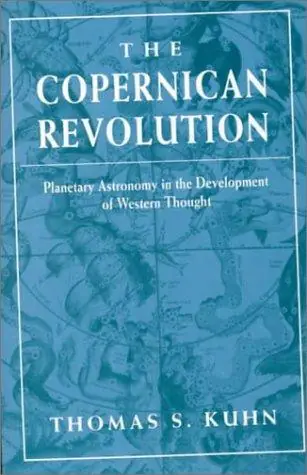
The Copernican revolution
planetary astronomy in the development of western thought
by Thomas S. Kuhn · first published 1957
64% recommend27% neutral9% critical
Why HN recommends it
Clear, well-researched account of how ancient astronomy, cosmology and philosophy were intertwined, showing how deeply held paradigms shape scientific thinking. Suits readers curious about the history of science.
Summarised by Claude from recommending comments
"The author brings to a common focus the considered approach of the historian, the technical understanding of the scientist and the skill and experience of an able teacher. No careful reader of this well-wrought volume can fail to appreciate the nicely balanced interplay of these elements in the full explication of one of the major turning points in the evolution of scientific thought. For those concerned with the teaching of the history of science, this discussion of the issues involved in the Copernican revolution will prove to be indispensable, a superb analysis of the anatomy of revolution
Affiliate links. As an Amazon Associate I earn from qualifying purchases.
Mentions per year
What Hacker News says
Related books
 2016–2025
The invention of science
David Wootton
Recommended by 7 · mentioned by 127 recommend · 12 mention7 recommend · 127 recommend
 2020–2024
On the heavens
Aristotle
0 recommend · 3 mentioned0 recommend · 3 mention0 recommend · 30 recommend
 2007–2023
The world we have lost
Peter Laslett
Recommended by 5 · mentioned by 115 recommend · 11 mention5 recommend · 115 recommend
 2007–2024
The Logic of Scientific Discovery
Karl Popper
Recommended by 15 · mentioned by 2615 recommend · 26 mention15 recommend · 2615 recommend
The Sleepwalkers
Arthur Koestler
Recommended by 9 · mentioned by 139 recommend · 13 mention9 recommend · 139 recommend
 2007–2026
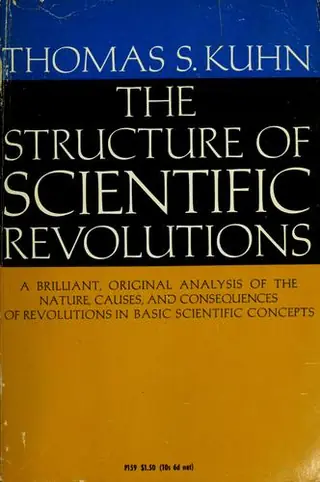
The Structure of Scientific Revolutions
Thomas S. Kuhn, Dennis Holland
Recommended by 96 · mentioned by 21596 recommend · 215 mention96 recommend · 21596 recommend
 2013–2026
Uncle Tungsten
Oliver Sacks
Recommended by 12 · mentioned by 1412 recommend · 14 mention12 recommend · 1412 recommend
Your version of the history and relationships among ideas at the time in physics and astronomy is hopelessly garbled. I respectfully suggest you read Kuhn's The Copernican Revolution. Your comments about people not being stupid, the Church's motivations, etc., if intended as a reply to me, are strawmen.
on “Academics sharing paywalled papers with a codeword on Twitter” ↗…http://www.amazon.com/Lives-Artists-Oxford-Worlds-Classics/d... http://www.amazon.com/Golden-Trade-Moors-Kingdoms-Fourteenth... http://www.amazon.com/Gallic-Wars-Caesars-Account-Conquest/d... http://www.amazon.com/Copernican-Revolution-Planetary-Astron... Note that about half of these are out of print.
on “PG's Rarely Asked Questions” ↗…Constantinople Cipolla, Guns, Sails and Empires Hadas, A History of Rome Oman, The Art of War in the Middle Ages Vasari, Lives of the Artists Bovill, The Golden Trade of the Moors Caesar, Gallic Wars Kuhn, The Copernican Revolution
on “The IPO is dying – Marc Andreessen explains why” ↗Kuhn's really great book is The Copernican Revolution. He was a uniquely insightful historian of science. It's amusing that he took some lessons from the history of science, well known to scholars in that field, simplified and distilled them to the point…
on “Thomas Kuhn changed the way the world looked at science (2012)” ↗A better book by Kuhn about this stuff is The Copernican Revolution. It's original and penetrating history of science without having to read "paradigm" in every paragraph.
on “Academics sharing paywalled papers with a codeword on Twitter” ↗…commonplace notion for historians of science. That’s because the former had no idea how science worked, but the latter were intimate with its actual development. Kuhn was an excellent historian of science: his Copernican Revolution is his real masterpiece.
on “Kuhn's Structure of Scientific Revolutions – outline (2013)” ↗Philosopher here as well. I'd strongly recommend Thomas Kuhn's "The Copernican Revolution". It's a beautiful book that shows how ancient astronomy, cosmology and philosophy were interwoven, with valuable lessons for how science works even today. From the classics I'd also recommend Hume.…
on “Ask HN: Which book can attract anyone towards your field of study?” ↗Could be Thomas Kuhn’s The Copernican Revolution. In any case, it’s a great book.
on “Researchers home in on possible “day zero” for Antikythera mechanism” ↗On Copernicus and Kepler, I recommend the 1957 book The Copernican Revolution by Kuhn. https://en.wikipedia.org/wiki/The_Copernican_Revolution_(boo... Some details might be outdated though.
on “The Daguerreotype’s Famous. Why Not the Calotype?” ↗…models, with his own hybrid model where most of the planets orbit the sun, but the sun orbits the earth. Facts about which model predicted the location of what planets were really important. The book "The Copernican Revolution" by Kuhn is really interesting for anyone curious to know more about this period.
on “Galileo’s telescopes: Seeing is believing (2010)” ↗…though that learning about the history of science is immensely enlightening. In school it seems like these things just fell from the sky fully formed like Athene from Zeus' forehead. Kuhn's book on the Copernican revolution is super interesting. I found it better than the more famous Structure of Scientific Revolutions. The latter is more abstract and tries to build a big theory, while the former mostly just narrates how…
on “If the University of Chicago won't defend the humanities, who will?” ↗…well researched and written. It questions a value that can be so deeply rooted in our paradigms that i got a bit of a "shock" myself. I love to read something so refreshing. http://en.wikipedia.org/wiki/Copernican_Revolution
on “The Problem with Meritocracy” ↗Maybe better is his “The Copernican Revolution”. It’s one of the best popularizations of the history of science I’ve ever read.
on “Ask HN: Any recommendation for a good History of Science book?” ↗…calls "paradigm shifts" -- a low-level shift in assumptions about a certain realm of scientific thought that fundamentally changes the way we approach a particular field. One example Kuhn gives is the Copernican Revolution. Copernicus, as we all know, proposed the heliocentric solar model. Before Copernicus, most people used Ptolemy's epicycles to model the movement of planetary bodies. Initially, it worked, but the cracks…
on “Harry Potter and the Methods of Rationality finished today” ↗…implausible when compared with the new theory. At some point scientific consensus changes and the the new "paradigm" is accepted. You can read more about this at Wikipedia: https://en.wikipedia.org/wiki/Copernican_Revolution https://en.wikipedia.org/wiki/The_Structure_of_Scientific_Re... https://en.wikipedia.org/wiki/Thomas_Kuhn
on “Opposition to Galileo was scientific, not just religious” ↗