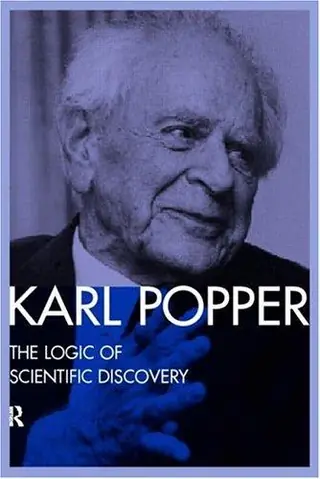
The Logic of Scientific Discovery
by Karl Popper · first published 1935
58% recommend35% neutral8% critical
Why HN recommends it
Popper's case for falsifiability as the dividing line between science and pseudoscience, and a foundation in philosophy of science; suits readers wanting a demanding, rigorous text, some praise its clarity.
Summarised by Claude from recommending comments
When first published in 1959, this book revolutionized contemporary thinking about science and knowledge. It remains the one of the most widely read books about science to come out of the twentieth century.
Affiliate links. As an Amazon Associate I earn from qualifying purchases.
Mentions per year
What Hacker News says
Related books
 2018–2020
Ethical Intuitionism
Michael Huemer
Recommended by 2 · mentioned by 32 recommend · 3 mention2 recommend · 32 recommend
 2011–2022
How to think about the great ideas
Mortimer J. Adler
Recommended by 3 · mentioned by 33 recommend · 3 mention3 recommend · 33 recommend
 2010–2026
A treatise of human nature
David Hume
Recommended by 12 · mentioned by 2512 recommend · 25 mention12 recommend · 2512 recommend
 2015–2025
What is this thing called science?
A. F. Chalmers, Chalmers, Alan Chalmers, Alan F. Chalmers
Recommended by 6 · mentioned by 86 recommend · 8 mention6 recommend · 86 recommend
 2007–2023
Firestar
Michael Flynn
Recommended by 2 · mentioned by 42 recommend · 4 mention2 recommend · 42 recommend
Autobiography
Benjamin Franklin
Recommended by 9 · mentioned by 149 recommend · 14 mention9 recommend · 149 recommend
 2020–2025
Principia ethica
George Edward Moore
Recommended by 2 · mentioned by 32 recommend · 3 mention2 recommend · 32 recommend
…structure, but there was no clear continuation - [BLOG] Philosophy Bro https://www.philosophybro.com/ <- explains concepts clearly - [BOOK] Camus: The Myth of Sisyphus | The Stranger - [BOOK] The Logic of Scientific Discovery, Karl Popper <- loved the clarity - these came into my mind What I didn't enjoy: - [BOOK] I tried reading Schelling's Philosophical Inquiries into the Essence of Human Freedom (got it as a present:…
on “Learning Path for Philosophy?” ↗And also "The Logic of Scientific Discovery", Karl Popper. I read it at young age, and it was an open-mind read.
on “Philosophy of science books every computer scientist should read” ↗…Economy" by Jean-Baptiste Say, "The Man Versus the State" by Herbert Spencer, "The Revolt of the Masses" by José Ortega y Gasset, "Capitalism, Socialism and Democracy" by Joseph Alois Schumpeter, "The Logic of Scientific Discovery" by Karl Popper, "The Machinery of Freedom" by David Friedman, "On Power" Bertrand de Jouvenel, "1984" by George Orwell, "The State" by Anthony de Jasay, "Sketched With the Quill" by Andrzej Bobkowski,…
on “Ask HN: What's one book that changed your life?” ↗…(Diary if have to pick one), All books written by Slavoj Zizek (Welcome to the Desert of the Real: Five Essays on September 11 and Related Dates if have to pick one) Recently read and significant: The Logic of Scientific Discovery, Karl Popper, Market Wizards: Interviews with Top Traders, Jack Schwager
on “Ask YC: favorite books” ↗Fooled by Randomness, The Black Swan - Nassim Nicholas Taleb The (Mis)behavior of Markets - Benoit Mandelbrot The Stuff of Thought - Steven Pinker The Logic of Scientific Discovery - Karl Popper The Four Steps to Epiphany - Steven G. Blank
on “Ask HN: Please name two of your most favorite books.” ↗Right: "The Logic of Scientific Discovery" by Karl Popper Also Gödel's stuff. I still like Gödel, Escher, Bach: An Eternal Golden Braid by Douglas Hofstadter.
on “Philosophy of science books every computer scientist should read” ↗…Eckermann, "The Old Regime and the Revolution" Alexis de Tocqueville, "On Liberty" by John Stuart Mill, "The Man Versus the State" by Herbert Spencer, "The Revolt of the Masses" by José Ortega y Gasset, "The Logic of Scientific Discovery" by Karl Popper, "On Power" Bertrand de Jouvenel, "1984" by George Orwell, "The State" by Anthony de Jasay, "Sketched With the Quill" by Andrzej Bobkowski, "Metaphysical Horror" by Leszek Kolakowski,…
on “Ask HN: Non-tech books that have helped you grow professionally?” ↗> How did we get to the state where the "truth" is such an elusive concept? Look into the fields of epistemology and the philosophy of science, in particular the works of Karl Popper such as The Logic of Scientific Discovery. The "truth" has always been an elusive concept. Outside the realm of mathematics, it's rather difficult to objectively prove most things "true".
on “Google’s first all-hands after 2016 election [video]” ↗The Logic of Scientific Discovery — Karl Popper. It helped me to draw a strong line between Science and Pseudoscience.
on “Ask HN: What books changed the way you think about almost everything?” ↗TLDR: Read hard books and keep increasing the level. I agree 100%. The hardest general books are probably in the area of philosophy. My recent fav: The Logic of Scientific Discovery by Karl Popper.
on “Ask HN: Mind bending books to read and never be the same as before?” ↗…Enquiry Concerning Human Understanding 5) Nietchze, The gay science (meaning "the joyful science") 6) Ludwig Wittgenstein, Philosophical Investigations 7) Existentialism Is a Humanism, Sartre 8) The Logic of Scientific Discovery, Karl Popper 9) Against Method, Paul Feyerabend
on “Ask HN: Learning about philosophy” ↗…of the key scientific critics to logical positivism was Karl Popper -- best known for formalizing the ideas of falsifiability -- eschewed the idea of induction altogether. I highly recommend his "The Logic of Scientific Discovery" (which is not to say that I agree with Popper, but he is an important figure in the philosophy of science). Thomas Kuhn's "The Structure of Scientific Revolutions" calls into question the very idea…
on “Harry Potter and the Methods of Rationality finished today” ↗I'm aware of Kuhn, but I think Popper's Logic of Scientific Discovery is more germane to this discussion, particularly his distinction between logic of proof and logic of discovery. Going back to your opinion poll example, there is no opinion about mixed marriages which…
on “Social Justice Bullies: The Authoritarianism of Millennial Social Justice” ↗…got a Nobel in Economics . . . I learned a lot about my grandfather from him . . . And indirectly a lot from Popper, whose Das Logik Der Vorschung (translated into English with the strange title of The Logic of Scientific Discovery) was for years my Bible. I'd first heard of his Flow concept on a public radio interview I caught whilst on a road-trip through a remote rural high plateau, in the 1990s. Highly memorable and mildly…
on “Mihály Csíkszentmihályi has died” ↗I would rather suggest to read Popper's Logic of Scientific Discovery or works of Lakatos before reading Feyerabend's Against Method. Feyerabend was a former assistant of Popper and mainly criticised his methodological views.
on “Thomas Kuhn changed the way the world looked at science (2012)” ↗