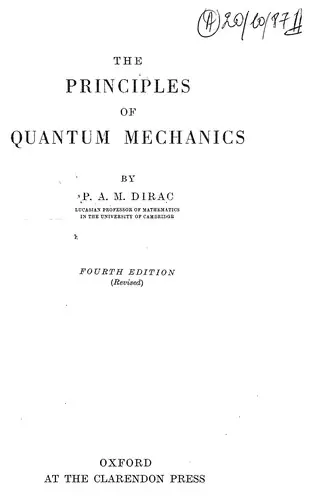
The Principles of Quantum Mechanics
by Paul Adrian Maurice Dirac · first published 1930
71% recommend29% neutral
Why HN recommends it
Derivation-first treatment of quantum mechanics from basic principles, with the mathematics built up carefully. Suited to readers who already know the Schrödinger equation and classical mechanics.
Summarised by Claude from recommending comments
This is one of the most clear presentations of Quantum Mechanics (QM). Starting with a simple motivation for the need of a theory beyond classical physics, Dirac describes a number of features required in the new theory (QM), and proceeds to delineate properties which physical states (quantum states) have to obey in order to make sense in the observable world.<br/><br/>The text proceeds to develop the standard QM terminology (state vector, operator, observable, equation of motion) and delves then into idealized and real physical systems (harmonic oscillator, free particle, hydrogen atom). The
Affiliate links. As an Amazon Associate I earn from qualifying purchases.
Mentions per year
What Hacker News says
Related books
 2013–2024
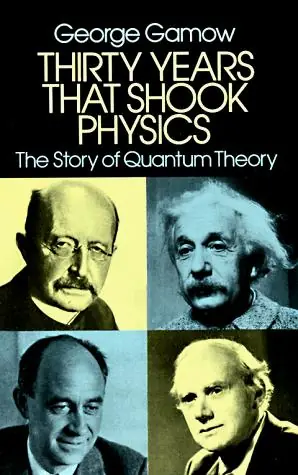
Thirty years that shook physics
George Gamow
Recommended by 5 · mentioned by 55 recommend · 5 mention5 recommend · 55 recommend
 2011–2025
Introduction to Quantum Mechanics (2nd Edition) by David J. Griffiths
David Jeffrey Griffiths, Darrell F. Schroeter
Recommended by 12 · mentioned by 1812 recommend · 18 mention12 recommend · 1812 recommend
 2010–2026
Introduction to electrodynamics
David Jeffrey Griffiths
Recommended by 14 · mentioned by 2814 recommend · 28 mention14 recommend · 2814 recommend
 2007–2026
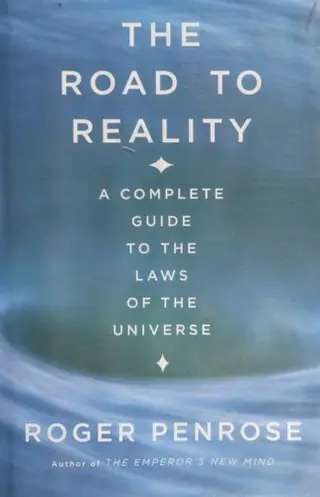
The Road to Reality
Roger Penrose
Recommended by 67 · mentioned by 12867 recommend · 128 mention67 recommend · 12867 recommend
 2008–2026
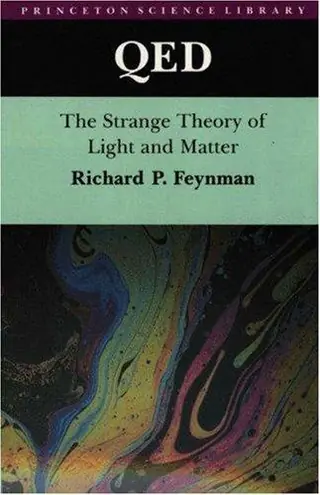
QED
Richard Phillips Feynman, A. Zee
Recommended by 60 · mentioned by 7760 recommend · 77 mention60 recommend · 7760 recommend
 2007–2026
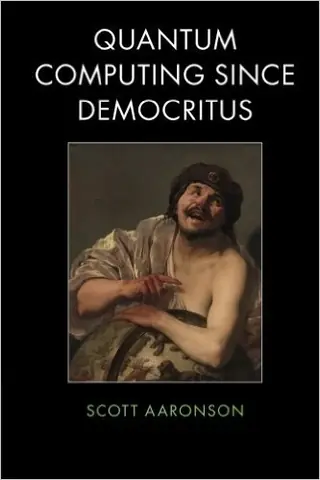
Quantum Computing Since Democritus
Scott Aaronson
Recommended by 73 · mentioned by 9273 recommend · 92 mention73 recommend · 9273 recommend
 2008–2026
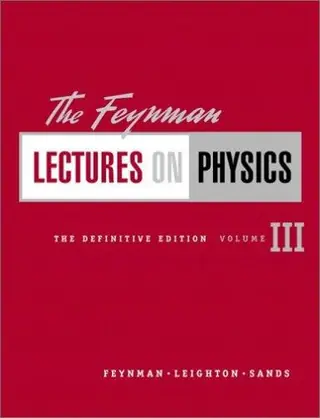
The Feynman Lectures on Physics
Richard Phillips Feynman
Recommended by 69 · mentioned by 12669 recommend · 126 mention69 recommend · 12669 recommend
Check out Dirac's classic 'The Principles of Quantum Mechanics': http://www.amazon.com/Principles-Quantum-Mechanics-Internati... I was shocked how much clearer (and more useful) the exposition is compared to textbooks.
on “IAmA theoretical physicist. Ask me anything (via reddit)” ↗…feels that they want to know more. See the Schroedinger equation. Learn how to calculate energy levels for the harmonic oscillator and for the hydrogen atom. Read first six chapter's of Paul Dirac's "The principles of quantum mechanics". The time spent reading about interpretations and philosophical implications of QM is wasted. People who do research in theoretical physics devote very little time to such considerations, or no at all.
on “Quantum Suicide” ↗…I wouldn't recommend anyone to read this. Instead, there's this awesome gem, which I have read multiple times. Don't believe anyone who says it's outdated and you shouldn't read it. P.A.M. Dirac: The Principles of Quantum Mechanics http://www.amazon.com/Principles-Quantum-Mechanics-Internati...
on “Paul Dirac's handwritten notes for his PhD, the first ever on quantum mechanics” ↗…a little algebraic field theory for motivation on why AB - BA is not necessarily 0. * Eigenstates --> these are special wavefunctions. Eigenvalues and Eigenvectors I recommend Paul Dirac's original Principles of Quantum Mechanics for a baptism by fire. He's the primary source for a lot of this stuff. He simplified a lot of the methods in QM with his Bracket notation. Sorry if I missed something.
on “Quantum mechanics as a generalization of probability (2007)” ↗…From that you can get into Hamiltonian mechanics and from there you can start to really grapple with quantum mechanics. After dealing with the more technical side, you should read Paul Dirac’s book “the principles of quantum mechanics”
on “Ask HN: How to self-study physics?” ↗Dirac derives quantum physics from first principles, including the relevant thought experiments, in one of his books. that was good enough for me. made a lot of sense. "Principles of Quantum Mechanics"
on “Why do many math books have so much detail and so little enlightenment? (2010)” ↗…to Taylor's Classical Mechanics, and Griffith's Introduction to Electrodynamics. You can also learn QM from the graduate texts. No need to read Griffith's QM book first. I'm working through Shankar's Principles of Quantum Mechanics and it is definitely doable. He introduces all the math you need for the rest of the book in the first chapter, so if you can make it through that (it is mostly linear algebra) you will be ready for the…
on “So You Want to Learn Physics (2016)” ↗…Classical Mechanics by Goldstein. 8. Introduction to Electrodynamics by Griffiths. More advanced E&M than Purcell. If you want to go further, then there's always Classical Electrodynamics by Jackson. 9. Principles of Quantum Mechanics by Shankar. This spends more time on the mathematical foundations of QM than Griffiths does and goes into the path integral formalism and touches on relativistic QM towards the end of the book. 10.…
on “Ask HN: How to self-study physics?” ↗…most beautiful and useful artifacts ever made. Think "Philosophiae Naturalis Principia Mathematica", "On The Origin of Species by Means of Natural Selection", "The Nature of the Chemical Bond", and "The Principles of Quantum Mechanics". Unfortunately, most people are too dumb and lazy to appreciate them. Picture Francis Crick, putting down his pen after writing, "It has not escaped the attention of the authors that this structure…
on “Why are scientists satisfied with studying existing artifacts rather than creating their own?” ↗A) math refresher: Basic Training in Mathematics - Shankar B) undergrad A-level text: Principles of Quantum Mechanics - Shankar Happened to like his approach given that he's trying to convey information with serviceable clarity given the subject matter without trying to impress you with his divine intellect, like some…
on “A university IT guy plans to bid in two government airwave auctions” ↗Principles of Quantum Mechanics by Shankar is my favorite upper-undergrad book on the subject.
on “The Golden Age of Quantum Physics” ↗…learning. I can ask so dumb question that I never had the courage to ask nor were they entertained where I was educated. It has been a boon to finally ask. For example I am following Dirac's book "The Principles of quantum mechanics" to study QM. Pre-AI wouldn't have been able to do so, I am just that dumb. Even with AI its tough. but the thing is I can keep asking questions until I get that concept drilled in. Now I am doing it…
on “Is AI ruining our skills? Early results are in – and they're not good” ↗Ok, thank you. What is a good starting place? Dirac's Principles of Quantum Mechanics? Or, asking Claude to tell me about quantum mechanics? </facepalm>
on “Why Quantum Engineering Is Emerging as a Distinct Industrial Sector” ↗> For example I am following Dirac's book "The Principles of quantum mechanics" to study QM. Pre-AI wouldn't have been able to do so, I am just that dumb Why exactly wouldn’t you be able to learn pre-AI?
on “Is AI ruining our skills? Early results are in – and they're not good” ↗…and Hamiltonian mechanics, celestial mechanics, etc. 2. Electromagnetism: Papers on electricity, magnetism, electromagnetic waves, and Maxwell's equations. 3. Quantum Mechanics: Papers exploring the principles of quantum mechanics, wave-particle duality, Schrödinger equation, and quantum states. 4. Relativity: Papers covering the theory of special and general relativity proposed by Albert Einstein. 5. Thermodynamics and Statistical…
on “Can you tell me the list of all physics papers I should read?” ↗