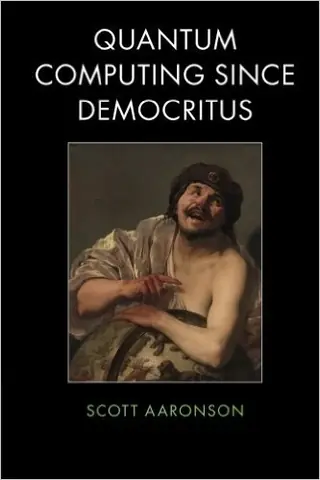
Quantum Computing Since Democritus
by Scott Aaronson · first published 2013
78% recommend20% neutral1% critical
Why HN recommends it
Witty, well-written tour of complexity theory, computability, quantum mechanics and philosophy (free will, Penrose, anthropic reasoning), showing how a top theorist thinks; suits curious readers with some math maturity.
Summarised by Claude from recommending comments
Written by noted quantum computing theorist Scott Aaronson, this book takes readers on a tour through some of the deepest ideas of maths, computer science and physics. Full of insights, arguments and philosophical perspectives, the book covers an amazing array of topics. Beginning in antiquity with Democritus, it progresses through logic and set theory, computability and complexity theory, quantum computing, cryptography, the information content of quantum states and the interpretation of quantum mechanics. There are also extended discussions about time travel, Newcomb's Paradox, the anthropic
Affiliate links. As an Amazon Associate I earn from qualifying purchases.
Mentions per year
What Hacker News says
Related books
 2013–2026
Quantum computation and quantum information
Michael A. Nielsen, Isaac L. Chuang, CAMBRIDGE INDIA
Recommended by 30 · mentioned by 4030 recommend · 40 mention30 recommend · 4030 recommend
 2015–2025
Quantum Computer Science
N. David Mermin
Recommended by 11 · mentioned by 1111 recommend · 11 mention11 recommend · 1111 recommend
Quantum computing for computer scientists
Noson S. Yanofsky
Recommended by 10 · mentioned by 1310 recommend · 13 mention10 recommend · 1310 recommend
 2014–2025
The nature of computation
Cristopher Moore
Recommended by 10 · mentioned by 1410 recommend · 14 mention10 recommend · 1410 recommend
 2010–2022
A modern approach to quantum mechanics
John S. Townsend
Recommended by 3 · mentioned by 43 recommend · 4 mention3 recommend · 43 recommend
 2018–2020
The symmetries of things
John Horton Conway, Heidi Burgiel, Chaim Goodman-Strauss
Recommended by 2 · mentioned by 32 recommend · 3 mention2 recommend · 32 recommend
 2008–2024
Computational complexity
Christos H. Papadimitriou
Recommended by 7 · mentioned by 97 recommend · 9 mention7 recommend · 97 recommend
 2009–2023
1776
David McCullough
Recommended by 3 · mentioned by 43 recommend · 4 mention3 recommend · 43 recommend
One of the points of Scott Aaronson's excellent "Quantum Computing since Democritus" is that if you can quickly solve NP problems, you basically have super powers. Forget about SAT or Travelling Salesman, you can now do fast automated theorem provers and the like. Depending on how it…
on “A Polynomial Time Bounded-Error Quantum Algorithm for Boolean Satisfiability” ↗…in math can read through in one pass (unlike most textbooks) but nonetheless have real math in them? (And has fun exercises!) I can start with some. Feynman's Lectures on Computing. Scott Aaronson's Quantum Computing Since Democritus (though it assumes some background knowledge of quantum computing). I think Colin Adam's "The Knot Book" (on knot theory in topology) as well.
on “Ask HN: What kind of math do you study in your free time?” ↗…NP-completeness, well, of course he doesn't... he understands the mathematical proof that it doesn't, so that's hardly surprising. Edit edit: A positive followup to this negative message: Consider reading Quantum Computing Since Democritus [1], or if you don't want to spend the dough, read through the class notes that turned into that book [2]. [1]: http://www.amazon.com/Quantum-Computing-since-Democritus-Aar... [2]: http://www.scottaaronson.com/democritus/…
on “Breaking np-complete with memcomputing. Is it real?” ↗…small analog computers (nothing scalable, nothing solving general problems) can be constructed before noise becomes an issue. Three good references: Book on quantum and classical computing: Aaronson's "Quantum Computing since Democritus" for gentle-for-newbies but rigorous discussion Very old paper on classical computing (analog vs digital): Von Neumann's "Probabilistic logics and the synthesis of reliable organisms from unreliable…
on “Quantum Computing Explained” ↗…possibly the best technical author around these days. If you haven't already, his new book[1] is absolutely worth checking out, especially if you're unfamiliar with quantum. --- [1] : http://www.amazon.com/Quantum-Computing-since-Democritus-Aar...
on “D-Wave: Truth finally starts to emerge” ↗…Physics, vol. 21, Nos. 6/7, 1982. Shor, Peter W. "Polynomial-Time Algorithms for Prime Factorization and Discrete Logarithms on a Quantum Computer." 1994. I'm also nearly done with Scott Aaronson's Quantum Computing Since Democritus, which is a popularizing treatment derived from graduate-level lectures. It is demanding but super fun. So one risk to quantum computing I wonder about is the error correction. There are lots of attempts…
on “We're Entering a Golden Era of Quantum Computing Research” ↗Quantum Computing Since Democritus, by Scott Aaronson. It covers an astounding amount of stuff -- including complexity theory, the nature of randomness and information, and quantum information theory -- into less than 400 pages.
on “Ask HN: Books with a high signal to noise ratio?” ↗http://www.amazon.com/Quantum-Computing-since-Democritus-ebo... also free online
on “Google, D-Wave, and the case of the factor-10^8 speedup” ↗Quantum Computing Since Democritus by Scott Aaronson. A brilliant MIT professor's reflections on the intersection between computer science, physics and philosophy. Here are the lecture notes and book: http://www.scottaaronson.com/democritus/…
on “Ask HN: What's the best computer science book you've read recently?” ↗Aaronson wrote a great book "Quantum Computing since Democritus" discussing not just quantum mechanics and computing, but also such topics as algorithmic complexity and anthropic principle. It is located somewhere between science and pop-science: it contains quite…
on “PHYS771 Lecture 9: Quantum (2007)” ↗Are you thinking perhaps of Scott Aaronson's Quantum Computing since Democritus? Even if not, that's a great book, free online.
on “Far From 'Infinitesimal': A Mathematical Paradox's Role In History” ↗"Quantum Computing since Democritus" by Scott Aaronson. This book makes me wish I was cool enough to understand everything in it. But still, it does a very good job at connecting the high level bits, and letting you skip over proof sketches…
on “Ask HN: Which book are you reading these days?” ↗I'm just going to answer with the books that rearranged my understanding of the world the most. In no particular order. "Thinking Fast and Slow" by Daniel Kahneman. "Quantum Computing since Democritus" by Scott Aaronson. "The Strategy of Conflict" by Thomas Schelling. "Guns, Germs, and Steel" and "The World until Yesterday" by Jared Diamond. "The Retreat To Commitment" by W. W. Bartley. "The Myth…
on “Ask HN: What is the most mind blowing book you've ever read?” ↗If you are specifically interested in building up the mathematical intuition, check out "Quantum Computing since Democritus" by Aaronson - it excels at presenting the intuition. For less comp-sci and more physics look at the standard references: Nielsen and Chuang's book and Preskill's lecture notes.
on “The Case Against Quantum Computing” ↗Since we're looking at Scott Aaronson, you might want to check out "Quantum Computing Since Democritus". It gives a good explanation of the math behind qubits and how they can be used. Best intro I know of.
on “Scott’s Supreme Quantum Supremacy FAQ” ↗