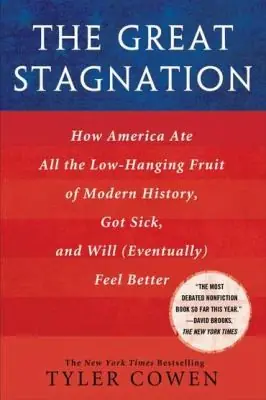
The Great Stagnation
by Tyler Cowen · first published 2011
15% recommend82% neutral3% critical
Why HN recommends it
An economist argues that innovation and productivity gains have slowed since the early 1970s, giving a clear big-picture view of prosperity and growth. A good read for anyone interested in economics and technology.
Summarised by Claude from recommending comments
" ... the eSpecial heard round the world that ignited a firestorm of debate and redefined the nature of our economic malaise is now--at last--a book. America has been through the biggest financial crisis since the Great Depression, unemployment numbers are frightening, median wages have been flat since the 1970s, and it is common to expect that things will get worse before they get better. Certainly, the multidecade stagnation is not yet over. How will we get out of this mess? One political party tries to increase government spending even when we have no good plan for paying for ballooning pro
Affiliate links. As an Amazon Associate I earn from qualifying purchases.
Mentions per year
What Hacker News says
Related books
 2013–2026
Average is Over
Tyler Cowen
Recommended by 13 · mentioned by 3013 recommend · 30 mention13 recommend · 3013 recommend
 2012–2026
Abundance
Peter H. Diamandis, Steven Kotler
Recommended by 11 · mentioned by 1511 recommend · 15 mention11 recommend · 1511 recommend
 2011–2019
The Lights in the Tunnel
Martin Ford
Recommended by 10 · mentioned by 1610 recommend · 16 mention10 recommend · 1610 recommend
 2013–2026
Technological Revolutions and Financial Capital
Carlota Perez
Recommended by 11 · mentioned by 1611 recommend · 16 mention11 recommend · 1611 recommend
 2010–2024
This time is different
Carmen M. Reinhart
Recommended by 13 · mentioned by 2013 recommend · 20 mention13 recommend · 2013 recommend
Rent Is Too Damn High
Matthew Yglesias
Recommended by 8 · mentioned by 118 recommend · 11 mention8 recommend · 118 recommend
 2008–2026
Player Piano
Kurt Vonnegut, Christian Rummel
Recommended by 64 · mentioned by 12864 recommend · 128 mention64 recommend · 12864 recommend
 2014–2026
Zero to One
Peter A. Thiel, Blake Masters
Recommended by 166 · mentioned by 413166 recommend · 413 mention166 recommend · 413166 recommend
…discriminatory children-of-alumni admissions? While I don't want to look a gift horse in the mouth, I've been involved in post-secondary education for too long, and read too many books on it (Tyler Cowen's The Great Stagnation is recommended, as is his book The Complacent Class), to think that "more money, same system" is the answer. We need comprehensive, systemic reform, starting with the accreditation bodies, before we pour…
on “Why I’m Giving $1.8B for College Financial Aid” ↗…to the point that housing is extremely expensive. If you move from Seattle to, say, Houston or Dallas, you'll probably see your effective rent shrink by 35 – 50%. Secondly: see Tyler Cowen's books The Great Stagnation and Average is Over. Those books are too sophisticated and deep (though they're quite readable) to summarize here, but the shortish version is that Western economies are undergoing a lot of profound shifts…
on “Ask HN: What is really wrong with the US economy, really?” ↗Tyler Cowen discusses precisely these issues in The Great Stagnation: http://www.amazon.com/Great-Stagnation-America-Low-Hanging-E..., which was published in 2010 or 2011 but is still excellent.
on “The stuff we need is getting more expensive, other stuff is getting cheaper” ↗"The Great Stagnation" from Tyler Cowen of Marginal Revolution, is a long essay that address this issues from an economist point of view. A wonderful read. http://marginalrevolution.com/marginalrevolution/2011/01/the...
on “We’re not going to have a jobless recovery. We’re going to have a jobless future” ↗Two essay with opposite views on the relationship between innovation, employment and prosperity, Race Against The Machine [1], and The Great Stagnation [2]. [1] Race Against The Machine: How the Digital Revolution is Accelerating Innovation, Driving Productivity, and Irreversibly Transforming Employment and the Economy In "Race Against the Machine",…
on “Ask HN: Summer reading” ↗I'm rather surprised this hasn't already been mentioned, but if you want to read more on this thread of thought written by an economist, check out the ebook, "The Great Stagnation" by Tyler Cowen. Alternatively, watch his Tedx talk.
on “What happened to innovation?” ↗…making for several years. I just read Zero to One and found it good, but not great. Cowen's book, Average is Over [1], covers much of the same ideas and is better reasoned. (Cowen's earlier book, The Great Stagnation, is also quite good). [1]: http://www.amazon.com/gp/product/B00C1N5WOI?btkr=1
on “Why Is Peter Thiel Pessimistic About Technological Innovation?” ↗…Baumol's Cost Disease. Stuff is cheaper because of efficiency but services (teaching, doctoring) is very expensive because it isn't. Tyler Cowen discusses extensively the hard-to-automate areas in The Great Stagnation, which is worth reading.
on “The Software Revolution” ↗…industrial revolution, farmers could move to the city and get a job in the factory. In the (first) information revolution, factory workers could become telephone operators. But as Tyler Cowen notes in "The Great Stagnation," jobs in the software industry are relatively few compared to the number of jobs that are being eliminated in other fields. It's unclear what new class of jobs would fully compensate for the loss of,…
on “We’re not going to have a jobless recovery. We’re going to have a jobless future” ↗There are some interesting comparisons between (what the economist Tyler Cowen refers to as) The Great Stagnation Of 1973-now, and The Really Great Stagnation of 1650-1740. Restraining the comparison to the English speaking nations, we can say: 1.) Both episodes begin with a cultural revolution that has no precedent…
on “The General Crisis of the 17th Century” ↗…number of extremely talented entrepreneurs not unlike our own HN community), whereas other major industries have stagnated or declined (housing, finance, manufacturing). I believe Tyler Cowen and his "Great Stagnation" sums it up nicely in that the net loss in those industries has been larger and more relevant macroeconomically than the relatively concentrated gains in Silicon Valley. tl;dr: computation is fueling…
on “Why the Internet is creating more value than jobs” ↗…industries and our ways of living and communicating, especially those of us active on HN. But, the impact in the macro statistics is still.. meh. See also Peter Thiel's laments and Tyler Cowen on 'the great stagnation'. Personally, I suspect there's been a lot of qualitative improvement that doesn't show up in the time-series statistics. (For example, we're taking a lot of the benefit of the Internet in economically-unmetered…
on “Paul Krugman (1998): By 2005 Internet will have no more economic impact than fax” ↗The world economy slowed in 1973. No one really knows why. Some books focus on the effects in the USA, some focus elsewhere. In the West this has been "The Great Stagnation" whereas in several countries in Asia this has been "The Great Bounce Back" as formerly wealthy civilizations, such as China, recovered some of the ground they lost in the 1800s. Sad to say, I'm not…
on “Revealed: the 30-year economic betrayal dragging down Generation Y’s income” ↗…incentive for doing this, but the amount of self-promotion was enough to annoy me and make me stop reading. Years later, I attended a presentation that Cowen gave that was ostensibly on his book the Great Stagnation, but in reality it turned out to be a demonstration of some online learning venture he was bankrolling at the time. He's a smart and productive guy, no doubt, but my (anecdotal) experiences make me wonder…
on “Tyler Cowen is a curator of talent” ↗I haven't read "Average is Over" but I think that Cowen's "The Great Stagnation" covered a lot of the same ground. It was informative and reasonably persuasive, even if one doesn't share his prescriptions for fixing things. It presents the idea of a slowdown in innovation and educational…
on “Peter Thiel's Zero to One Might Be the Best Business Book I've Read” ↗