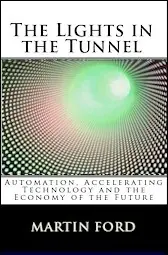
The Lights in the Tunnel
Automation, Accelerating Technology and the Economy of the Future
by Martin Ford · first published 2009
63% recommend38% neutral
Why HN recommends it
Argues that cheap computerized automation is displacing human labor and reshaping corporate profits and employment; a thought-provoking, forward-looking introduction for readers new to automation and work.
Summarised by Claude from recommending comments
A computer engineer from Silicon Valley employs a powerful thought experiment to explore the economy of the future. An imaginary "tunnel of lights" is used to visualize the economic implications of the new technologies that are likely to appear in the coming years and decades. Challenged are nearly all conventional views of the future and the danger that lies ahead if we do not plan for the impact of rapidly advancing technology is illuminated. It also offers unique insights into how technology will intertwine with globalization to shape the remainder of the 21st century, and explores ways in
Affiliate links. As an Amazon Associate I earn from qualifying purchases.
Mentions per year
What Hacker News says
Related books
 2011–2019
Race Against The Machine
Erik Brynjolfsson
Recommended by 12 · mentioned by 2112 recommend · 21 mention12 recommend · 2112 recommend
 2014–2025
The Second Machine Age
Erik Brynjolfsson, Andrew McAfee
Recommended by 9 · mentioned by 209 recommend · 20 mention9 recommend · 209 recommend
 2011–2026
The Great Stagnation
Tyler Cowen
Recommended by 5 · mentioned by 345 recommend · 34 mention5 recommend · 345 recommend
 2008–2026
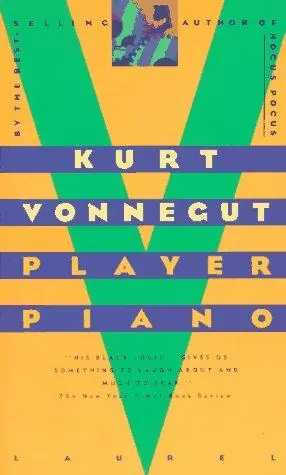
Player Piano
Kurt Vonnegut, Christian Rummel
Recommended by 64 · mentioned by 12864 recommend · 128 mention64 recommend · 12864 recommend
Explanation and analysis of the idea of a 'post-employment economy', i.e. increasing corporate profits and decreasing employment, is given in 'The Lights in the Tunnel' by Martin Ford (which I found to be a good read, although a little verbose). The main argument is that cheap computerized automation is displacing human workers, and corporate incentives are such that…
on “Surviving the post-employment economy” ↗1. Race Against the Machine by Brynjolfsson and McAfee 2. The Second Machine Age by Brynjolfsson and McAfee 3. The Lights in the Tunnel by Martin Ford 4. Rise of the Robots by Martin Ford 5. Average is Over by Tyler Cowen -specifically, the parts about labor market bifurcation and man-machine pairs Brynjolfsson and McAfee are MIT…
on “Ask HN: Any good books on the economic impact of automation?” ↗Maybe 'The Lights in the Tunnel: Automation, Accelerating Technology and the Economy of the Future' by Martin Ford? I haven't finished the whole thing yet, but so far it has been a good read about some of the problems with increased…
on “Help find a bright object on Mars” ↗…stems from the current focus on knowledge work tasks rather than repetitious, small problem-space labor. IBM's watson will price out radiologists and their pattern finding ilk. I found Martin Ford's [lights in the tunnel](http://www.thelightsinthetunnel.com/) enlightening and concerning. He too suggests a basic income.
on “It Is Time For Basic Income” ↗…non-developers unaware of the potential for technology to displace jobs over the next 20 years. If you're interested in related material I recommend a book by Martin Ford that's freely available online, The Lights In The Tunnel: http://www.thelightsinthetunnel.com
on “Bill Gates: People Don't Realize How Many Jobs Will Soon Be Replaced by Software” ↗…interested in exploring the topic of human labor becoming increasingly unnecessary in more depth, there was a very forward thinking (published in 2009) book written about this by a computer scientist called "Lights in the Tunnel". The author goes as far as to propose new societal structures to maintain order as this process unfolds. Highly recommended. http://smile.amazon.com/gp/product/1448659817
on “The Software Revolution” ↗The Lights in the Tunnel by Martin Ford Race Against The Machine by Erik Brynjolfsson and Andrew McAfee The War on Normal People by Andrew Yang
on “Ask HN: Best books you read in the past decade?” ↗Read "lights in the tunnel" by Martin Ford.
on “We’re not going to have a jobless recovery. We’re going to have a jobless future” ↗Relevant reading: Race Against the Machine (http://amzn.com/B005WTR4ZI) The Lights in the Tunnel (http://amzn.com/B002S0NITU)
on “Making It in America” ↗His first book "The lights in the tunnel" is a great book too.
on “Rise of the Machines: The Future Has Lots of Robots, Few Jobs for Humans” ↗…(unskilled manual work) and a software developer (skilled knowledge work) that made automating the former inevitable. As a rebuttal, I would point to some passages from Martin Ford's book on automation, The Lights in the Tunnel: >A common misconception about automation is the idea that it will primarily impact low paying jobs that require few skills or training. To illustrate that this is not necessarily the case, consider…
on “Not the autoworkers of our generation” ↗…next 30 years. This clearly isn't a sustainable or desirable (for most) outcome and it seems as though we need a fundamental socioeconomic restructuring in order to avoid total collapse. Martin Ford's "Lights in the Tunnel" addresses this issue, but there seems to be hardly any other discussion of this topic. Is the technology just a long way off? Do most economists just think that the economy will always have a use for…
on “Ask HN: Socioeconomic implications of automation?” ↗…means by possessing things, its a mixed blessing.Plenty of free or low cost content, though large staple goods like houses or cars are climbing up there. Also, Martin Ford mentions something called the lights in the tunnel problem. Imagine a tunnel full of lights that represent the wealth of people. In the modern world, a handful of lights shine intensely bright, while increasingly more are dark, dim, or low-intensity.…
on “The rise of the corporate colossus is a giant problem” ↗Thanks! Very interesting. From the WP article: "Martin Ford author of The Lights in the Tunnel: Automation, Accelerating Technology and the Economy of the Future [6] makes the case that the risk posed by accelerating technology may be primarily economic in nature. Ford argues that before technology…
on “Bill Joy: Why the future doesn't need us (2004)” ↗There aren't enough rich people who need services to give people jobs. Martin Ford's "The Lights in the Tunnel" makes this point.
on “Trade school, not 4-year college, is a better bet to solve the US income gap” ↗