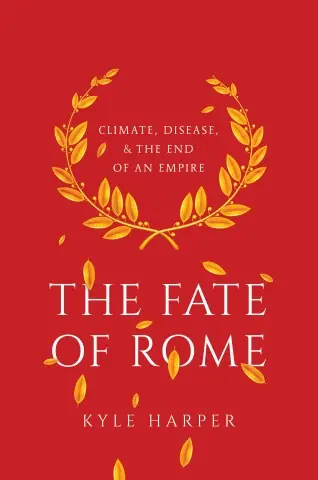
The Fate of Rome
by Kyle Harper · first published 2017
67% recommend33% neutral
This book is a sweeping new history of how climate change and disease helped bring down the Roman Empire. Here is the monumental retelling of one of the most consequential chapters of human history: the fall of the Roman Empire. The Fate of Rome is the first book to examine the catastrophic role that climate change and infectious diseases played in the collapse of Rome's power -- a story of nature's triumph over human ambition. Interweaving a grand historical narrative with cutting-edge climate science and genetic discoveries, Kyle Harper traces how the fate of Rome was decided not just by emp
Affiliate links. As an Amazon Associate I earn from qualifying purchases.
Mentions per year
What Hacker News says
Related books
 2008–2026
The Confidence Man
Herman Melville
Recommended by 3 · mentioned by 73 recommend · 7 mention3 recommend · 73 recommend
 2016–2025
Ecology and the politics of scarcity
William Ophuls
Recommended by 1 · mentioned by 21 recommend · 2 mention1 recommend · 21 recommend
 2008–2025
A Farewell to Alms
Gregory Clark
Recommended by 16 · mentioned by 3316 recommend · 33 mention16 recommend · 3316 recommend
 2008–2026
Future shock
Alvin Toffler
Recommended by 19 · mentioned by 6219 recommend · 62 mention19 recommend · 6219 recommend
 2007–2026
The Wealth of Nations
Adam Smith
Recommended by 92 · mentioned by 40592 recommend · 405 mention92 recommend · 40592 recommend
If you're interested in the topic, I strongly recommend Kyle Harper's The Fate of Rome, discussing co-evolution of urbanisation, extended trade and commerce networks, and epidemic disease.
…though not necessarily comprehensively), John Stuart Mill, William Stanley Jevons (esp. Coal & Money), Daniel Yergin (Prize), Richard Heinberg, Henry Adams (Education), Leslie White, Kyle Harper (esp, The Fate of Rome), Gregory Clark (Alms & Son), Karl Polanyi (Transformation), Elisabeth Eisenstein (Printing Press), Michael & Joyce Heusemann, William Foster Lloyd (esp. "Value"), Jeffrey S. Dukes ("Sunshine"), Jared…
on “Sanitation conquered disease long before vaccines or antibiotics” ↗…manipulation attacks, harrassment, and the usual laundry list of Trust & Safety issues. The notion of co-evolving threats comes from biology generally, though I'd strongly recommend Kyle Harper's The Fate of Rome which postulates that civilisations (themselves social networks) and their plagues co-evolve alongside one another. I've just learned that the Santa Fe Institute crowd are fans of Harpers (Geoffrey West…
on “Facebook says it was wrong to ban Canadian MP’s Christmas message” ↗This is more or less how more recent scholarship looks at complicated, long-term multi-modal sort of events and changes. Fate of Rome is a fairly recent book that examines things like disease and climate change, for instance: https://press.princeton.edu/books/hardcover/9780691166834/th...
on “Lead poisoning probably did not cause the downfall of the Roman Empire” ↗…hygiene, lack of a theory of disease, and widespread and distant commerce. Ancient civilisations, from Rome onward (and before) co-evolved with their major epidemics. I cannot recommend Kyle Harper's The Fate of Rome highly enough in this regard.
on “1966 children about the future [video]” ↗…See: http://www.fraser-courtman.co.uk/list_of_famines_&_pestilenc... Keep in mind that without cities and trade, few infectious diseases could spread much beyond a localised tribe. Kyle Harper's The Fate of Rome makes a strong argument that the plagues and pestilences which afflicted the empire co-evolved with it. https://press.princeton.edu/books/hardcover/9780691166834/th...
on “The comfortable life is killing us” ↗The two regions often responded very dissimilarly. nKyle Harper'sbThe Fate of Rome looks at this in depth. TL:DR; civilisation's patterns (cities, trade, travel) co-evolve diseases. Populations tend to evolve resistance to local endemic disease, but are susceptible to novel agents,…
on “Factors associated with Covid-19 deaths in records of 17M adult NHS patients” ↗Let me recommend the book - The Fate of Rome by Kyle Harper (2020)- about how climate change and pandemies slowly sapped strength of Roman Empire.. From Antonine Plague to Plague of Justinian and from Roman Climate Optimum to Late Antiquity Ice…
on “Societal Collapse” ↗If you’re interested in knowing more about how this event and other ecological factors influenced the decline and fall of the Roman Empire (to coin a phrase...), “The Fate of Rome” by Kyle Harper is a great read or listen, if you prefer audiobooks (ignoring every time the narrator mistook causal for casual...)
on “Skies went dark: Historians pinpoint the 'worst year' ever to be alive” ↗…contamination and increased resistance), antibiotics (resistance), various medications (thalidomide comes to mind), advertising, shipping (invasive species), just off the top of my head. Kyle Harper's The Fate of Rome argues compellingly that civilisations co-evolve with their plagues, which raises some interesting implications. I've been suggesting in conversations elsewhere that we're living in an era of consequences.
on “Could, should, might, shouldn’t – A taxonomy of futurists” ↗…that point, not only do already-extant issues become intolerable (or more specifically: unsurvivable), but new harms co-evolve with the cities themselves to emerge within them. (See Kyle Harper's The Fate of Rome for a wonderful exploration of this concept.) For online UCG platforms, this presents as various forms of activity that directly attack trust and safety of the platform itself. Ultimately, growth of…
on “You either die an MVP or live long enough to build content moderation” ↗Pretty much that. For further parallels with Rome, I strongly advise Kyle Harper's The Fate of Rome, which develops the idea that empires and diseases co-evolve with one another. Another lesson from history which seems increasingly significant now.
on “Train burglaries in LA” ↗A fascinating insight for me came via Kyle Harper's book The Fate of Rome: plagues co-evolve to match civilisations. <https://press.princeton.edu/books/hardcover/9780691166834/th...> That is, the Antonine, and other plauges of Rome relied on the dense urbanisation, highly-developed…
on “A ‘plague’ comes before the fall: lessons from Roman history” ↗…occurrence, or a co-symbiant of human activities and behaviours, co-emerging with them. My view leans toward the latter, based on both evolutionary arguments and historical evidence --- see Kyle Harper's The Fate of Rome for an excellent argument that civilisations and their diseases co-evolve.[4] ________________________________ Notes: 1. Almost certainly a generalisable proposition of any networked system. As Tilly…
on “SF MUNI expects to lose the majority of its bus lines permanently” ↗…emerged in Herman Melville's novel of the same name. The elements of distant communications, and speedy entry and exit, create the space required for fraud. A different tack is taken by Kyle Harper's The Fate of Rome, looking at the co-emergence of disease, epidemics, and plague with both urban density and high-volume (for the time) trade, commerce, and travel. Though he doesn't touch on fraud. The whole question…
on “Google Search is routinely gamed by private blog networks” ↗