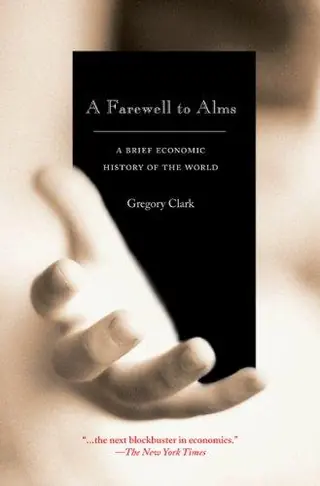
A Farewell to Alms
by Gregory Clark · first published 2007
48% recommend52% neutral
Why HN recommends it
Data-heavy economic history of why growth took off in Europe but not elsewhere, set against Guns, Germs, and Steel. Suits readers curious about the Industrial Revolution, Malthusian limits and long-run social mobility.
Summarised by Claude from recommending comments
Affiliate links. As an Amazon Associate I earn from qualifying purchases.
Mentions per year
What Hacker News says
Related books
 2019–2022
The Gifts of Athena
Joel Mokyr
Recommended by 2 · mentioned by 32 recommend · 3 mention2 recommend · 32 recommend
 2014–2026
Science and civilisation in China
Joseph Needham
Recommended by 3 · mentioned by 63 recommend · 6 mention3 recommend · 63 recommend
 2011–2025
A Study of History
Arnold J. Toynbee, D.C Somervell
Recommended by 1 · mentioned by 91 recommend · 9 mention1 recommend · 91 recommend
 2014–2025
The Son Also Rises
Gregory Clark
Recommended by 3 · mentioned by 173 recommend · 17 mention3 recommend · 173 recommend
 2009–2025
The lever of riches
Joel Mokyr
Recommended by 7 · mentioned by 97 recommend · 9 mention7 recommend · 97 recommend
 2016–2026
Rise and Fall of American Growth
Robert J. Gordon
Recommended by 24 · mentioned by 3724 recommend · 37 mention24 recommend · 3724 recommend
 2017–2026
Energy and Civilization
Vaclav Smil
Recommended by 23 · mentioned by 3223 recommend · 32 mention23 recommend · 3223 recommend
Nothing much (in percentage terms) got invented until the industrial revolution. The question is why the industrial revolution took so long. If you are interested in this topic I highly recommend A Farewell to Alms [0] - warning controversial hypothesis, but it raises lots of interesting topics to think about. 0. https://en.m.wikipedia.org/wiki/A_Farewell_to_Alms
on “Why things might have taken so long” ↗…Mokyr's been studying the concept for rather longer, and has been editing a rather attractive series through Princeton University Press on the subject, including books by himself, Gregory Clark (UC Davis, A Farewell to Alms), Robert J. Gordon (Northwestern, The Rise and Fall of American Growth), and others. Recommended. I've been looking at the dynamics of technological mechanism, and am settling on roughly nine: 1. Fuels,…
on “Why the Industrial Revolution Didn’t Happen in China” ↗…numbers, from memory) then this isn't a small effect. If this sounds interesting you should read Gregory Clark: http://www.nytimes.com/2007/08/07/science/07indu.html https://en.wikipedia.org/wiki/A_Farewell_to_Alms
on “You’re Descended from Royalty and So Is Everybody Else” ↗…If you are familiar with scientific literature, with economic history, with population genetics etc, the Malthusian model is pretty much the consensus view these days. See, for example Gregory Clark’s “Farewell to Alms” or Shennan’s “First Farmers of Europe”. The biggest fail of Malthus was that he made his argument at exactly the worst possible time, when the growth in productive capacity has for the first time in…
on “The Global Population Crisis That Never Was” ↗…for intelligence. It can’t have been strong because otherwise we’d all be Von Neumanns. Gregory Clark's work on social mobility is fascinating if you find this topic interesting. Start with either A Farewell to Alms or The Son Also Rises.
on “Klotho – There May Be a Drug to Turbocharge Your Brain. Who Should Get It?” ↗…(http://en.wikipedia.org/wiki/Albion%27s_Seed) which details how cultural differences in four areas of England manifested themselves in colonial America, with cultural consequences to this day; and "A Farewell to Alms" (http://www.amazon.com/Farewell-Alms-Economic-History-Princet...) which attempts to explain why England was the first country to escape the "Malthusian Trap", enabling the industrial revolution.
on “The Tel Aviv Cluster” ↗1. The Lever of Riches, by Joel Mokyr 2. Guns Germs and Steel, by Jared Diamond 3. A Farewell to Alms, by Gregory Clark 4. Power and Prosperity, by Mancur Olsen 5. Carnage and Culture, Victor Davis Hanson 6. Capital Ideas, by Peter Bernstein 7. The Geodesic Network, by Peter Huber
on “Ask HN: What history of economics and technology book would you recommend?” ↗One of the more interesting books I've read recently - A Farewell to Alms - http://www.amazon.com/Farewell-Alms-Brief-Economic-History/d... has the basic argument that as a direct result of modern technology, there are people living on the planet now (in sub-saharan Africa),…
on “Aerial footage of uncontacted Amazon tribe” ↗…used to be almost your entire life was taken up simply in an effort to survive; now most of us work 40 hours per week and it takes care of all of our needs." That's not really true. I suggest reading "A Farewell to Alms" (http://www.amazon.com/Farewell-Alms-Brief-Economic-History/d...) A more accurate description would be something like "After several thousands of years where civilization has made life more difficult…
on “In Defense of Old Grumpy Guy: Get Off My Lawn” ↗Some ideas from scanning Amazon and looking through HN: - A Farewell to Alms: A Brief Economic History of the World - This Time Is Different: Eight Centuries of Financial Folly - Why Nations Fail: The Origins of Power, Prosperity, and Poverty - Global Economic History: A Very…
on “Ask PG and HN: What is your recommended reading list for economic history?” ↗One more follow-up: I've just read the first chapter of Gregory Clark's Farewell to Alms (available online) which looks at the three questions of the Industrial Revolution, Demographic Transition, and Great Divergence. I suspect you might enjoy that as well.
on “Late Capitalism and the Ends of Sleep” ↗I don't have a specific text offhand that addresses this directly, but Gregory Clark's A Farewell to Alms addresses this general point. It's part of a series of related works, edited by Joel Mokyr, including last year's The Rise and Fall of American Growth, by Robert Gordon. https://www.worldcat.org/title/farewell-to-alms-a-brief-econ...…
on “The health care toll today’s work culture exacts on employees” ↗A Farewell to Alms by Gregory Clark. It changed my mind about the nature of industrial civilization. Surely You're Joking, Mr. Feynman! and the sequel, What Do You Care What Other People Think? Mindstorms by Seymour Papert
on “Ask HN: What books changed the way you think about almost everything?” ↗…evidence that it's more intelligent and richer people who enjoyed better reproductive success in pre-modern times, for example from the dying wills of medieval and pre-modern Englishmen. See Gregory Clark's "Farewell to Alms" for references, it's a great book by the way. Also, the fact that IQ was on the rise was probably due the Flynn effect, which is confounding the issue. There are two effects going on: one is the Flynn…
on “IQ rates are dropping in many developed countries” ↗…economists, biophysical economics, and numerous others. Among texts I'd recommend: Mancur Olson, The Rise and Decline of Nations. Lloyd Jeffrey Dumans, The Overburdened Econommy. Gregory Clark, A Farewell to Alms. (The series this is part of contains numerous other explorations of economic history.) Karl Polanyi, The Great Transformation Arnold Toynbee, Lectures on the Industrial Revolution.
on “The Mighty Fallen: Argentina and the Great Depression” ↗