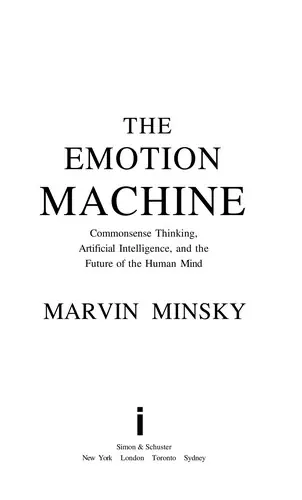
The emotion machine
by Marvin Minsky, Mercedes García Garmilla · first published 2006
52% recommend48% neutral
Why HN recommends it
Wide-ranging computational account of mind, covering intelligence, consciousness, emotion and common sense. Suits readers who want a materialist, AI-oriented theory of mind; best read after Society of Mind.
Summarised by Claude from recommending comments
Affiliate links. As an Amazon Associate I earn from qualifying purchases.
Mentions per year
What Hacker News says
Related books
 2008–2026
The society of mind
Marvin Minsky
Recommended by 60 · mentioned by 15360 recommend · 153 mention60 recommend · 15360 recommend
 2013–2025
Artificial general intelligence
Ben Goertzel, Cassio Pennachin
Recommended by 1 · mentioned by 41 recommend · 4 mention1 recommend · 41 recommend
 2016–2021
Words and rules
Steven Pinker
Recommended by 1 · mentioned by 41 recommend · 4 mention1 recommend · 41 recommend
 2014–2026
Programming Game AI by Example
Mat Buckland
Recommended by 7 · mentioned by 87 recommend · 8 mention7 recommend · 87 recommend
 2009–2023
The Media Lab
Stewart Brand
Recommended by 3 · mentioned by 93 recommend · 9 mention3 recommend · 93 recommend
 2015–2026
Cybernetics, or control and communication in the animal and the machine
Norbert Wiener, Doug Hill, Sanjoy Mitter
Recommended by 4 · mentioned by 104 recommend · 10 mention4 recommend · 104 recommend
 2007–2025
How the Mind Works
Steven Pinker
Recommended by 23 · mentioned by 3123 recommend · 31 mention23 recommend · 3123 recommend
 2016–2026
The Turing option
Harry Harrison
Recommended by 4 · mentioned by 84 recommend · 8 mention4 recommend · 84 recommend
I think Marvin Minsky had it right in his book The Emotion Machine (2006): From Chapter III. From Pain to Suffering >Why does the sensation called pain sometimes lead to what we call suffering? How could such a simple event distort all your other thoughts so much?…
on “'Mindful people' feel less pain” ↗…partly from his personality). You might get some perspective from looking at his last book "Mind and Nature". And, in many ways, much more powerful looks at "mind" are Minsky's "Society of Mind" and "The Emotion Machine". There is also Kahneman's "Thinking: Fast and Slow" more recently ...
on “Alan Kay's reading list” ↗…? What kind of stuff influenced you ? I would be curious to know how much you read about psychology, behaviorism, neuroscience etc. before writing the paper. Read minsky's books. Society of Mind and Emotion Machine. These are the most comprehensive overview to AI/computational psychology. EM's got a lot of stuff about 'consciousness' and what it means to be relatively conscious. I like that you don't slip into metaphysical…
on “My Naive Attempt at Making an Artificial Being” ↗…how intellectual structures grow out of one another and about how, in the process, they acquire both logical and emotional form." It is also worth reading Papert's colleague Marvin Minsky's book, The Emotion Machine. It makes quite a more interesting study of emotion as the foundation of understanding[1]. [0] http://llk.media.mit.edu/courses/readings/gears-v1.pdf [1] http://en.wikipedia.org/wiki/The_Emotion_Machine
on “Reinventing Explanation” ↗…https://www.amazon.com/Unified-Theories-Cognition-William-Le... https://www.amazon.com/Master-Algorithm-Ultimate-Learning-Ma... https://www.amazon.com/Singularity-Near-Humans-Transcend-Bio... https://www.amazon.com/Emotion-Machine-Commonsense-Artificia... https://www.amazon.com/Physical-Universe-Oxford-Cognitive-Ar... See also, the work on various "Cognitive Architectures", including SOAR, ACT-R, CLARION, etc, https://en.wikipedia.org/wiki/Cognitive_architecture…
on “Ask HN: How close are we, really, to general AI?” ↗…you're interested in sophisticated explanations of conscious experience and semantics from a materialist's perspective, Hofstadter and Sander's 'Surfaces and Essences' and Minsky's 'Society of Mind' and 'Emotion Machine' are great. Dennett's 'Intentional Stance' is also relevant - discussing how we can sensibly talk about material systems as having intention. Bear in mind that dualism is the more 'natural thought' in…
on “MIT professor Marvin Minsky wins $540,000 award” ↗Fascinating! I found that reading Marvin Minsky's The Emotion Machine, explained a lot about how might a brain be built to produce such results. And there is an entire chapter about what scientists in this article are calling analogical machines. Minsky calls them difference…
on “Crow Intelligence Study Shows Birds Can Solve Puzzles Inspired by Aesop's Fables” ↗...bonus points if you mention "Society of Mind" or "The Emotion Machine" by Minsky.
on “I feel therefore I am” ↗I'd spend my money on these two: - The Emotion Machine by Minsky - Superintelligence: Paths, Dangers, Strategies by Nick Bostrom
on “Ask HN: Best books on AI?” ↗You might like Minsky’s “The Emotion Machine.” Emotion is, as you say, essentially a higher order function of the nervous system—-some complex way of amplifying and dampening certain systems in order to adapt to circumstances. We understand emotion…
on “The Western Elite from a Chinese Perspective” ↗Minsky's subsequent book called "the emotion machine" probably has some of the most complete treatments of topics like intelligence, understanding and consciousness.
on “The Society of Mind (2011)” ↗Also look at his later book, "The Emotion Machine". When I took Minsky's "Society of Mind" class, he was working on the later book, and many lectures were him talking about what he had been working on earlier that day.
on “Ask HN: What is the relevance today of Minsky's “Society of Mind” concept?” ↗The best books I would recommend are; — The Master Algorithm by Pedro Domingos — The Book of Why by Judea Pearl — What Computers Still Can't Do by Hubert L. Dreyfus — Society of Mind & The Emotion Machine by Marvin Minsky — The Feeling Of What Happens by Antonio Damasio — Language & Mind by Noam Chomsky — A great mooc is also, the "Learning From Data" Telecourse from Caltech https://work.caltech.edu/telecourse
on “Ask HN: What's a promising area to work on in 2024 -ideally not crowded already?” ↗…https://www.newyorker.com/magazine/2017/03/27/daniel-dennett... Regarding the multiple layers: the most interesting thoughts I read about theories of a mind, are the books by Marvin Minsky, namely: The Society of Mind and The Emotion Machine which should be more widely known. More on Minsky's ideas on “Matter, Mind, and Models” are mentioned in https://www.newyorker.com/magazine/1981/12/14/a-i
on “A Model of a Mind” ↗Regarding Minsky: the most interesting thoughts I read about theories of a mind, are his books, namely: The Society of Mind and The Emotion Machine which should be more widely known. More of Minsky's ideas on “Matter, Mind, and Models” are mentioned here: https://www.newyorker.com/magazine/1981/12/14/a-i And let's not forget Daniel Dennett: In…
on “Darwin Machines” ↗