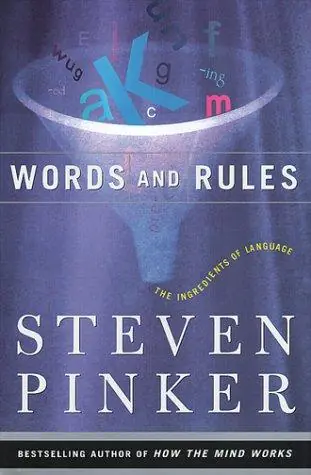
Words and rules
the ingredients of language
by Steven Pinker · first published 1999
7mentions
1recommended by
4HN commenters
2016–2021first – last mentioned
25% recommend75% neutral
How does language work, and how do we learn to speak? Why do languages change over time, and why do they have so many quirks and irregularities? In this book, the profound mysteries of language are explored.
Affiliate links. As an Amazon Associate I earn from qualifying purchases.
Mentions per year
What Hacker News says
Related books
 2020–2023
Soar Cognitive Architecture
John E. Laird, Robert E. Wray III, Yongjia Wang, Nate Derbinsky
Recommended by 1 · mentioned by 31 recommend · 3 mention1 recommend · 31 recommend
 2008–2026
The emotion machine
Marvin Minsky, Mercedes García Garmilla
Recommended by 16 · mentioned by 3116 recommend · 31 mention16 recommend · 3116 recommend
…language tend to be the ones that get used all the time - be, do, go etc - because for anything more obscure the brain just forgets the special case and applies the general rule. Steven Pinker's book Words and Rules is a great layman-oriented read if this sort of thing interests you.
on “Researchers: It takes 1.5 MB of data to store language information” ↗If you find this sort of thing interesting, I can highly recommend Steven Pinker's Words and Rules.
on “Initial Stress-Derived Noun” ↗…but it's suggestive that AlphaGo combines a classical AI search with neural nets. Another example: Steven Pinker's theory that human language uses a combo of neural-net-style and logic-style processing (Words and Rules). This isn't to say that Skynet will run part of itself on Prolog -- more like, to get the best performance over the broadest range of domains will need multiple techniques. One advantage of logic +…
on “Douglas Lenat's Cyc is now being commercialized” ↗…Pylyshyn 40. Neuro-Dynamic Programming - Dimitri P. Bertsekas & John Tsitsiklis 41. The Language Instinct - Steven Pinker 42. How The Mind Works - Steven Pinker 43. Images and Words - Steven Pinker 44. Words and Rules - Steven Pinker 45. The Blank Slate - Steven Pinker 46. Consciousness Explained - Daniel Dennett 47. How to Build a Brain: A Neural Architecture for Biological Cognition - Chris Eliasmith 48. Introduction…
on “Ask HN: What projects are you working on now?” ↗…lot of reading and background research. So I just finished reading Laird's SOAR book[1], and the second volume of Goertzel's Engineering General Intelligence[2]. Now I'm working on finishing Pinker's Words and Rules[3]. On the more hands-on front, all I really did was download the source for the various components of OpenCog[4], build them, and get all of that stuff installed. The plan for the next little while…
on “Ask HN: What did you build this week?” ↗…deep-diving into various bits of "stuff" related to AI. I just finished reading a The SOAR Cognitive Architecture by John Laird, and Engineering General Intelligence Part 2 by Ben Goertzel, as well as Words and Rules by Stephen Pinker. Also spent some time building and installing all of OpenCog, and installing SOAR. The goal is to start messing around with both, and start actually implementing some simple agents.…
on “Ask HN: What you up to? (Who doesn't want to be hired?)” ↗…the field — for hybrid systems, modular systems that combined associative networks (forerunners of today’s deep learning) with classical symbolic systems. This was the central thesis of Pinker’s book Words and Rules and the work that was at the core of my 1993 dissertation. Dozens of academics bitterly contested our claims, arguing that single, undifferentiated neural networks would suffice. Two of the leading advocates…
on “AI is transforming Google search – the rest of the web is next” ↗