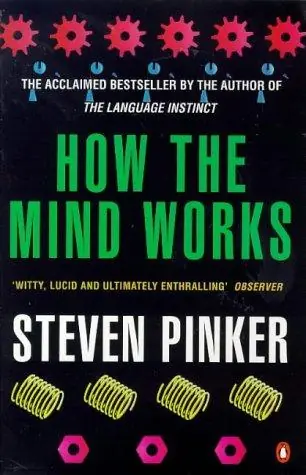
How the Mind Works
by Steven Pinker · first published 1997
74% recommend23% neutral3% critical
Why HN recommends it
Accessible popular-science overview of cognitive science and evolutionary psychology, with clear sections on natural selection, vision and brain structure. Suits curious laypeople and programmers.
Summarised by Claude from recommending comments
"Presented with extraordinary lucidity, cogency and panache...Powerful and gripping...To have read [the book] is to have consulted a first draft of the structural plan of the human psyche...a glittering tour de force" - Spectator "Why do memories fade? Why do we lose our tempers? Why do fools fall in love? Pinker's objective in this erudite account is to explore the nature and history of the human mind...He explores computations and evolutions, and then considers how the mind lets us "see, think, feel, interact, and pursue higher callings like art, religion and philosophy"" - Sunday Times
Affiliate links. As an Amazon Associate I earn from qualifying purchases.
Mentions per year
What Hacker News says
Related books
 2012–2021
The Hidden Pattern
Ben Goertzel
Recommended by 1 · mentioned by 21 recommend · 2 mention1 recommend · 21 recommend
No Bad Parts
Richard Schwartz
Recommended by 5 · mentioned by 55 recommend · 5 mention5 recommend · 55 recommend
How Can the Human Mind Occur in the Physical Universe?
John Robert Anderson
Recommended by 2 · mentioned by 42 recommend · 4 mention2 recommend · 42 recommend
 2009–2019
The power of less
Leo Babauta
Recommended by 4 · mentioned by 64 recommend · 6 mention4 recommend · 64 recommend
 2007–2026
The Language Instinct
Steven Pinker
Recommended by 44 · mentioned by 8344 recommend · 83 mention44 recommend · 8344 recommend
 2009–2022
The Time Traveler's Wife
Audrey Niffenegger
Recommended by 2 · mentioned by 82 recommend · 8 mention2 recommend · 82 recommend
 2010–2026
Revolutionary road
Richard Yates
Recommended by 7 · mentioned by 107 recommend · 10 mention7 recommend · 107 recommend
I always had your knee-jerk reaction to gossip, but after reading "How the mind works" by Steven Pinker I had to rethink my stance. I think I've been too influenced by sayings such as "Great minds discuss ideas; average minds discuss events; small minds discuss people". What Pinker argues…
on “A Small Town in the Philippines Banned Gossip” ↗…turns out the Eskimos use modifiers, too. The Language Instinct is a great read. Pinker's got a real talent for popular science writing that's accessible but not dumbed down. Check out his first hit, How the Mind Works, if you're interested in general cognitive science.
on “The reason why Blub programmers have such a hard time picking up more powerful languages.” ↗"How the Mind Works" by Steven Pinker has some very well-reasoned arguments to support your intuition that it's in our DNA. [It's basically a popsci introduction to evolutionary psychology and cognitive science.]
on “Abbreviated Parody of Paul Graham's "Boss"” ↗How the Mind Works by Steven Pinker The Selfish Gene by Richard Dawkins On Intelligence by Jeff Hawkins The Undercover Economist by Tim Hartford
on “Ask HN: Books That Gratify One's Intellectual Curiosity?” ↗…monkey brain while it makes a maneuvre to reach some object. The path is clearly visible in the brain of the monkey before it gets executed. For much interesting reading on this subject try Steven Pinker, How the mind works.
on “Ask HN: Hypothetically reverse-engineer programming solutions from the brain?” ↗…Gene by Richard Dawkins. It's surprisingly accessible (I've never taken a biology class), and talks a lot about evolutionary game theory which I found fascinating. Some other books I read last year: How the Mind Works by Steven Pinker. It was a great book, Pinker's writing is accessible and entertaining. Much more so than On Intelligence by Jeff Hawkins. More with Less: Paul MacCready and the Dream of Efficient Flight…
on “Ask HN: Great books you read in 2009?” ↗…of trade-offs, they are actually pretty damn good at what they do. Human vision alone is incredibly complex. Anyone interested in how difficult it is to replicate the brain should read Steven Pinker's "How the Mind works".
on “When Will We Be Able to Build Brains Like Ours?” ↗…anesthetic to a brain, consciousness is lost, while removing it restores consciousness. There is no continuity under anesthetic, the time is just 'skipped'. A simple book that will help you get it, is "How the Mind Works" by Steven Pinker. Science assumes that consciousness depends on the brain, since that assumption explains the observations. What's more, we take assumptions for facts once we have enough consistent observations…
on “Ten Things Everyone Should Know About Time” ↗It's always healthy to be versed with the opposing viewpoint, so I'd suggest reading How the Mind Works by Steven Pinker for a well articulated and evidenced materialistic thesis.
on “MIT discovers the location of memories: Individual neurons” ↗…refer to the Mating Mind here. It's borderline-crank material, and not regarded as serious by the vast majority in the field. Referring people to almost any book by Steven Pinker is much better. E.g. "How the Mind Works."
…information. - "Where Wizards Stay Up Late" by Katie Hafner, which chronicles the creation of the internet, but revels in some of the engineering details and technical challenges the team encountered. - "How The Mind Works" by Steven Pinker (tangentially related to CS, but valid), which is a psychology book, but actually delves into the computational theory of mind and even discusses how our brain's tricks have been used…
on “Ask HN: Can you recommend any good computer science audiobooks or podcasts?” ↗…terms of non-fiction: Real-World Reasoning: Toward Scalable, Uncertain Spatiotemporal, Contextual and Causal Inference by Ben Goertzel, Nil Geisweiller, and Lucio Coelho is the stand-out of the lot. How the Mind Works by Steven Pinker and How Can the Human Mind Occur in the Physical Universe? by John R Anderson are also worthy of a mention.
on “Ask HN: What are some of the best books you have read in 2022?” ↗How about... How the mind works (Pinker) Zen and the art of motorcycle maintenance (Pirsig) Sophie's World (Gaarder)
on “Ask YC: favorite books” ↗I've read a lot of Steven Pinker's books, and they were all enjoyable. The ones I've read include: The Language Instinct How the Mind Works The Blank Slate The Stuff of Thought
on “Roger Ebert's bleak assessment of the next 100 years” ↗There's lots of research that shows that the structure of the brain IS very important in how it works and how we use it. For a good overview see Steven Pinker's How the Mind Works. Many of these studies include individuals that had isolated damage to one small part of the brain and how that affects them. They show that specific parts of the brain are involved in highly specialized…
on “Nature v nurture? Please don't ask” ↗