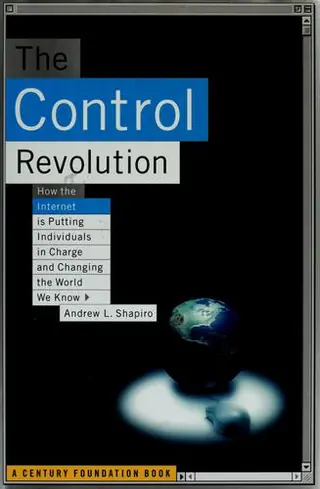
The control revolution
by Andrew L. Shapiro · first published 1999
100% recommend
In this exploration of the meaning of the Internet, journalist and legal scholar Andrew Shapiro weaves a narrative through events that are occurring all around us. Dissidents use the Net to evade censorship to get their messages out. Musicans bypass record companies and put their songs on the world wide web for fans to download directly. "Day traders" roil the stock market, buying securities online with the click of a mouse and then selling minutes later when the price jumps. Shapiro argues that there is a common thread underlying these developments. It is not just a change in how we compute
Affiliate links. As an Amazon Associate I earn from qualifying purchases.
Mentions per year
What Hacker News says
Related books
 2010–2026
The control revolution
James R. Beniger
Recommended by 3 · mentioned by 53 recommend · 5 mention3 recommend · 53 recommend
 2021–2022
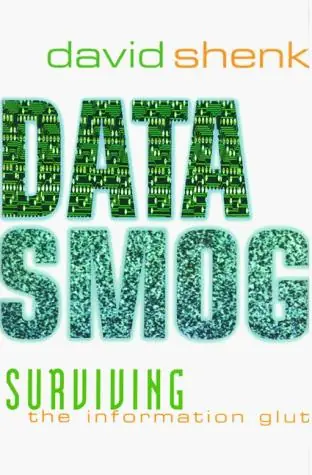
Data Smog
David Shenk
Recommended by 2 · mentioned by 22 recommend · 2 mention2 recommend · 22 recommend
 2013–2026
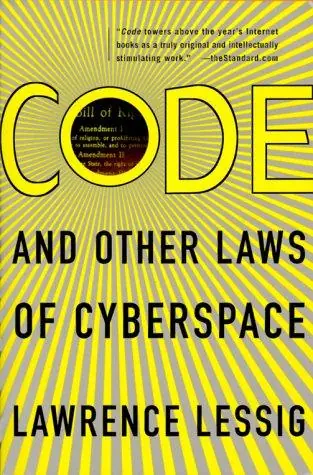
Code
Lawrence Lessig
Recommended by 2 · mentioned by 162 recommend · 16 mention2 recommend · 162 recommend
 2011–2022
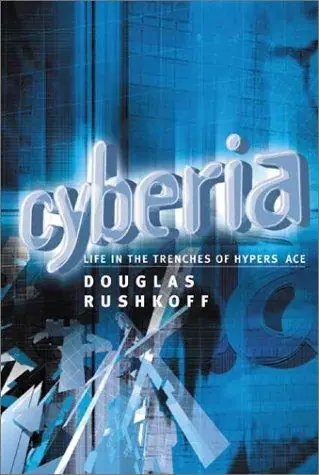
Cyberia
Douglas Rushkoff
Recommended by 4 · mentioned by 94 recommend · 9 mention4 recommend · 94 recommend
 2010–2025
The printing press as an agent of change
Elizabeth L. Eisenstein
Recommended by 5 · mentioned by 75 recommend · 7 mention5 recommend · 75 recommend
 2008–2026
Future shock
Alvin Toffler
Recommended by 19 · mentioned by 6219 recommend · 62 mention19 recommend · 6219 recommend
…a very long time, as with IBM and AT&T. Two of today's FAANG date from the 1970s, another two from the 1990s. Dominance can be long-lived. There were some who saw this coming. Andrew Shapiro's The Control Revolution (1999) kinda-mostly saw this coming, and certainly called out the major aspects. Shoshana Zuboff recognised at least some of the potential in the 1970s and 1980s. The crowd still believes the lie, for…
on “How Big Tech got so big: hundreds of acquisitions” ↗…Much of what's freely-available is low-quality at best, propaganda (or worse) in the worst case. Curation itself has value, and yet is constrained. This is in fact a major theme of Andrew Shapiro's The Control Revolution, and one of the tired arguments still encountered frequently today which was entirely anticipated over two decades ago.
on “Technorealism (1998)” ↗…Chicken Farm Jenny Oddell How to Do Nothing: Resisting the Attention Economy Wendy Liu Abolish SIlicon Valley Jonathan Taplin Move Fast and Break Things Andrew L. Shapiro The Control Revolution Lawrence Lessig Code and Other Laws of Cyberspace David Shenk Data Smog Douglas Rushkoff Cyberia Paulina Borsook Cyberselfish.
on “Are smartphones serving as adult pacifiers?” ↗…general): <https://archive.ph/8ceqI>, discussed at the time on HN: <https://news.ycombinator.com/item?id=24771470> I'd also very strongly recommend Andrew J. Shapiro's exceedingly prescient 1999 book, The Control Revolution, which covers the prospects, and risks, of online media, amongst numerous other topics: <https://www.worldcat.org/title/41076267> <https://archive.org/details/controlrevolutio0000shap> <http://libgen.rs/book/index.php?md5=9CCE57E117DD4213F395FE07...>
on “Please stop calling it the ‘newsletter economy’” ↗…with extreme frequency in many of them. Whether it's good or bad, this is undeniably big. ________________________________ Notes: 1. An exception to the poor predictions is Andrew L. Shapiro's The Control Revolution (1999), which I'd read for the first time a year or two ago. It seems to me to have done a quite good job of exploring both the upsides and downsides of the Web, and remains worth reading, though as…
on “Ask HN: Has HN become too skewed towards AI/LLM?” ↗…the game. It's instructive to revisit much of the early writing of the Internet. Much of that was strongly hagiographic and deludedly optimistic, but there were exceptions. Andrew J. Shapiro's The Control Revolution (1999) got far more right than wrong. <https://www.worldcat.org/title/41076267> <https://archive.org/details/controlrevolutio0000shap> <http://libgen.vg/book/index.php?md5=9CCE57E117DD4213F395FE07...>
on “The 'papers, please' era of the internet will decimate your privacy” ↗…the cautionary takes have worn better. A partial bibliography here: <https://toot.cat/@dredmorbius/105074933053020193> I'd add to that Lessig's Code and Other Laws of Cyberspace and Andrew Shapiro's Control Revolution, both published in 1999. <https://archive.org/details/codeotherlawsofc0000less> <https://archive.org/details/controlrevolutio00andr> Alvin Toffler's Future Shock addresses this specific issue only…
on “Why Twitter is such a big deal (2009)” ↗…1997, "Real News": http://www.canonical.org/~kragen/real-news.html A book that explores some of these concepts (in terms of the Net's impact on traditional news media) is Andrew L. Shapiro's book The Control Revolution (1999).[2] What numerous prognosticators (yourself, Epic, Shapiro, and more) got right was that the traditional print media would be profoundly disrupted. What seems to have been broadly missed was…
on “Over 200 newspapers now involved in lawsuits vs. Google, Facebook” ↗…trends. Among them are Alvin Toffler's Future Shock, which turned 50 last year, read for the first time, Lawrence Lessig's Code and Other Laws of Cyberspace (22 years), a re-read, and Andrew Shapiro's The Control Revolution, also for the first time. All have hits and misses. Some of them are more slanted one way than the other. Toffler has aged surprisingly well, in my view, despite some weaknesses. Lessig, at least…
on “The Evolution of Hacker News (2013)” ↗…O'Reilly heads, Howard Rheingold, Stewart Brand, Esther Dyson, Declan McCullough, I recall or suspect, were among the boosters. I'm reading some late-1990s sources (Lawrence Lessig's Code, Andrew Shapiro's Control Revolution) which cover some of this ground. I was there for it myself, though memory is a faulty guide.. Online search is difficult as later writings cloud the results.
on “Why we’re removing comments on most of Inquirer.com” ↗One of the authors (Andrew L. Shapiro) wrote the 1999 book The Control Revolution. It's something of a sibling to Lawrence Lessig's Code and Other Laws of Cyberspace (Shapiro was a student of Lessig's), though its focus is somewhat different. The first part reads (intentionally)…
on “Technorealism (1998)” ↗…looking at the history of technology and information technology in particular. There's a pair of books which stand out to me, they share a title though are separated by a decade and different authors: The Control Revolution, respectively by James Beniger (1986)[3] and Andrew L. Shapiro (1999)[4]. Beniger's book looks backwards at the development of largely commercial and corporate communications over the course of the Industrial…
on “A quick and sobering guide to cloning yourself” ↗…(as with large-scale print or broadcast media), or negative side-effects of "personalised" media. John Seeley Brown's The Social Life of Information (2000) addresses the first, Andrew J. Shapiro's The Control Revolution (1999) the second. More recently it's been noted that personalised targeting (of both advertising and "content") means that it's often difficult to assess what kinds of things others in your immediate…
on “A philosopher's one-word theory to explain why the world feels so weird” ↗