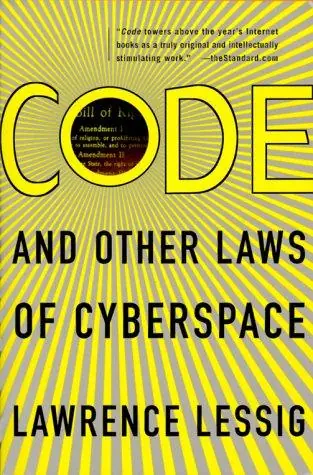
Code
and other laws of cyberspace
by Lawrence Lessig · first published 1999
13% recommend88% neutral
Although the book is named Code and Other Laws of Cyberspace, Lessig uses this theme sparingly. It is a fairly simple concept: since cyberspace is entirely human-made, there are no natural laws to determine its architecture. While we tend to assume that what is in cyberspace is a given, in fact everything there is a construction based on decisions made by people. What we can and can't do there is governed by the underlying code of all of the programs that make up the Internet, which both permit and restrict. So while the libertarians among us rail against the idea of government, our freedoms
Affiliate links. As an Amazon Associate I earn from qualifying purchases.
…affect human behavior and "eyes on the street" safety. I also liked the point that new ideas require old buildings (for cheap rents). This article and your comment makes me think of Lawrence Lessig's "Code 2.0" book where he writes that (at least) four things can shape human behavior: * rules * norms * prices * architecture All are important -- but they influence people in different ways…
on “Designing Cities for Families” ↗…selected (very specialized, very dedicated) few will dedicate their lives to the production of culture. This will bring quality up in the long run. Lawrence Lessig has written about this wonderfully (Code and Other Laws of Cyberspace, Free Culture, etc). I get the need for private property and goods, but I see no reason why digital images and texts (which can be copied without physical limits), including…
on “Ghostty's AI Policy” ↗…Currency by David LEE Kuo Chuen Blockchain Technology Explained by Alan T. Norman Cryptoassets by Chris Burniske Attack of the 50 Foot Blockchain by David Gerard Bitcoin Billionaires by Ben Mezrich Code by Lawrence Lessig Blockchain and the Law by Primavera De Filippi Bitcoin by Dominic Frisby Blockchain by Mark Gates The Age of Cryptocurrency by Paul Vigna Bitcoin For Dummies by Prypto The Truth…
on “Top 57 Cryptocurrency Books” ↗…Currency by David LEE Kuo Chuen Blockchain Technology Explained by Alan T. Norman Cryptoassets by Chris Burniske Attack of the 50 Foot Blockchain by David Gerard Blockchain Basics by Daniel Drescher Code by Lawrence Lessig Blockchain and the Law by Primavera De Filippi Blockchain by Mark Gates Bitcoin by Dominic Frisby The Starfish and the Spider by Ori Brafman The Age of Cryptocurrency by Paul Vigna…
on “Show HN: I've compiled a list of books on cryptocurrencies” ↗…by reading the book myself and writing down a summary sentence / keywords per every page read. This way it took me a day (from early morning to late night) to read a 400 pages long Lawrence Lessig's "Code 2" and write a review. Next day I managed to get highest score at the relevant exam. It kind of makes sense that reading + writing + listening allows one to deeply absorb content and probably is the best…
on “Springer Textbooks More Than 10 Years Old Available for Free Legal Download” ↗…envisioned and was recently complaining that it gets increasingly lost? https://www.theguardian.com/technology/2017/nov/15/tim-berne... Lawrence Lessig: About the legal implications in respect to his book Code is Law. https://medium.com/wordsthatmatter/the-neutrality-network-e5...
on “OpenBazaar 2.0, powered by IPFS” ↗> Sure, but what oppressive law is at work here? "Code is law" -Lawrence Lessig But if you're looking for a government law, how about any of the ones that allow people who create alternate app stores via jailbreaks to be prosecuted.
on “Parler Tricks: Making Software Disappear” ↗…Nothing: Resisting the Attention Economy Wendy Liu Abolish SIlicon Valley Jonathan Taplin Move Fast and Break Things Andrew L. Shapiro The Control Revolution Lawrence Lessig Code and Other Laws of Cyberspace David Shenk Data Smog Douglas Rushkoff Cyberia Paulina Borsook Cyberselfish.
on “Are smartphones serving as adult pacifiers?” ↗…want to read her book. That said, I disagree with a lot of her conclusions. Contra her assertions, I believe that technological change is the principal cause of historical change. Lawrence Lessig wrote Code is Law, which highlights how specific software system decisions constrained the available legal regimes that could apply. The same thing happens for all technology: the invention of containerized shipping…
on “Silicon Valley misreads science fiction and undermines democracy” ↗…specifically associated with vast trails of other nominally unassociated online information (search history, logins to other sites, analytics on other sites, etc.). This is in the sense of Lawrence Lessig's Code and Other Laws of Cyberspace. The architectures of Facebook, Google, and other social networks, advertising networks, mobile phone systems, phone apps, PC-based snooping (inclusive of Microsoft Windows,…
on “NSA tracking cellphone locations worldwide, Snowden documents show” ↗…and smooth the path for introductions with the established party. Essentially, the matchmaker stakes _their_ reputation by speaking for another. Lawrence Lessig describes a similar concept in his book Code and Other Laws of Cypberspace, in a passage describing a physical messaging system, the Yale Wall. This was a board onto which messages could be posted, with the proviso that that they be signed. Unsigned…
on “The Hostile Email Landscape” ↗…Shirkey, various O'Reilly heads, Howard Rheingold, Stewart Brand, Esther Dyson, Declan McCullough, I recall or suspect, were among the boosters. I'm reading some late-1990s sources (Lawrence Lessig's Code, Andrew Shapiro's Control Revolution) which cover some of this ground. I was there for it myself, though memory is a faulty guide.. Online search is difficult as later writings cloud the results.
on “Why we’re removing comments on most of Inquirer.com” ↗One of the authors (Andrew L. Shapiro) wrote the 1999 book The Control Revolution. It's something of a sibling to Lawrence Lessig's Code and Other Laws of Cyberspace (Shapiro was a student of Lessig's), though its focus is somewhat different. The first part reads (intentionally) archingly technophillic. That's balanced by the following…
on “Technorealism (1998)” ↗…changes after it is set, and minting more editions would be professional suicide, and the network of institutions would never allow or recognize it even if an artist tried it. Lawrence Lessig's book Code developed the argument that any combination of social norms, legal structures/enforcement, and code or infrastructure can function as law, and sanction or foster certain behaviour and markets. "Code is…
on “Why Web3?” ↗…software and aims to use BitTorrent in the Browser (WebTorrent, once WebtorrentDesktop is fixed) to popularize public domain torrenting for the Enlightenment of the masses. Lawrence Lessig writes that "code is like architecture." What that means is it gives us our mode of approaching the world and the ideologies around us. In Ancient Athens, the architecture of the public square facilitated the birth of…
on “Propagate.info: Public Domain Torrent Indexer” ↗