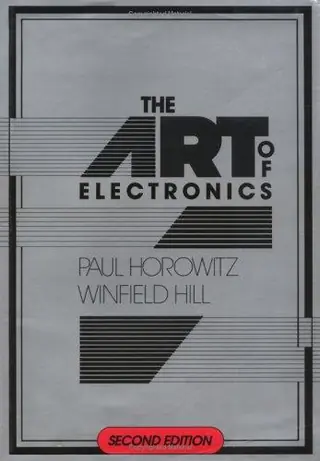
The art of electronics
by Paul Horowitz, Winfield Hill · first published 1980
67% recommend26% neutral8% critical
Why HN recommends it
Practical, in-depth reference for learning circuits by building, with a student manual and lab exercises that defer math until needed; suits software people and hobbyists who are serious about hardware.
Common criticism: Some say it is too hard or poorly suited for true beginners
Summarised by Claude from recommending comments
This is the thoroughly revised and updated second edition of the hugely successful The Art of Electronics. Widely accepted as the authoritative text and reference on electronic circuit design, both analog and digital, this book revolutionized the teaching of electronics by emphasizing the methods actually used by circuit designers -- a combination of some basic laws, rules of thumb, and a large bag of tricks. The result is a largely nonmathematical treatment that encourages circuit intuition, brainstorming, and simplified calculations of circuit values and performance. The new Art of Electroni
Affiliate links. As an Amazon Associate I earn from qualifying purchases.
Mentions per year
What Hacker News says
Related books
 2009–2026
Practical Electronics for Inventors
Paul Scherz
Recommended by 51 · mentioned by 6451 recommend · 64 mention51 recommend · 6451 recommend
 2009–2025
Make
Charles Platt
Recommended by 15 · mentioned by 1615 recommend · 16 mention15 recommend · 1615 recommend
 2008–2026
Getting started in electronics
Forrest M. Mims
Recommended by 28 · mentioned by 3828 recommend · 38 mention28 recommend · 3828 recommend
Lessons in Electric Circuits
Tony R. Kuphaldt
Recommended by 15 · mentioned by 1615 recommend · 16 mention15 recommend · 1615 recommend
 2016–2025
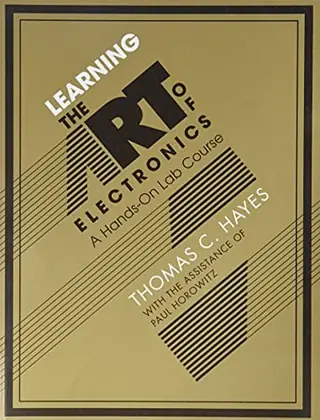
Learning the art of electronics
Thomas C. Hayes
Recommended by 14 · mentioned by 1914 recommend · 19 mention14 recommend · 1914 recommend
 2009–2026
Electronic principles
Albert Paul Malvino
Recommended by 3 · mentioned by 43 recommend · 4 mention3 recommend · 43 recommend
 2011–2026
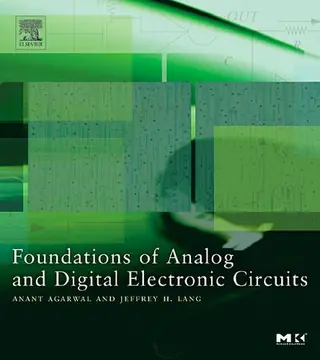
Foundations of analog & digital electronic circuits
Anant Agarwal
Recommended by 5 · mentioned by 95 recommend · 9 mention5 recommend · 95 recommend
 2010–2023
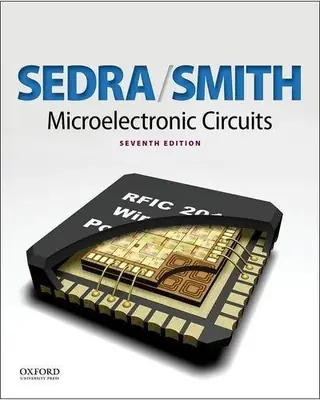
Microelectronic circuits
Adel S. Sedra, Kenneth C. Smith
Recommended by 9 · mentioned by 119 recommend · 11 mention9 recommend · 119 recommend
…pick up. I would love to see what's on your summer reading lists. My recent favourites: Bayesian Data Analysis, 3rd ed, by Gelman et al Designing Data-Intensive Applications, by Martin Kleppmann The Art of Electronics, by Horowitz & Hill
on “Ask HN: Technical Summer Reading List” ↗…opinion electrical engineering, being a subject where fast feedback is generally possible, is very well suited to project-first learning. I would recommend grabbing a few textbooks (Horowitz and Hill's Art of Electronics holding pole position for a practically-oriented learner, in my opinion), reading their introductory material (table of contents, preface, etc.; enough that you know what each book has in it), and then…
on “My self-study plan for electrical engineering” ↗I really like the 3rd edition of The Art of Electronics. The text is a fun read, and the student manual is a great extension of the main text, with a bunch of practical insight and discussion that puts it beyond mere exercises. Caveat: I'm a software guy.…
on “Ask HN: How to self-learn electronics?” ↗…have real requirements, and so they force you to iterate on the design until you hit all your requirements: power supply logistics, signal purity, enclosure, ... Get a good textbook like Horowitz The Art of Electronics. Learn how to use a CAD-based circuit simulator program like LTSpice. Build the circuits you read about in the simulator, and run them: apply signals, and look at how the voltages behave at various nodes…
on “Ask HN: How to self-learn electronics?” ↗"The Art of Electronics", by Horowitz and Hill, is a respected textbook for this. The ARRL Handbook has many explained schematics for radio. For modern commercial products, mostly you'll have some big special purpose ICs plus…
on “How to Read a Schematic” ↗…bypass capacitors and ferrite beads in the right places, and protection circuitry in case something fails. (MOSFETs tend to fail into the ON state.) If you really want to learn this stuff, get "The Art of Electronics", by Horowitz and Hill. [1] https://raw.githubusercontent.com/John-Nagle/ttyloopdriver/m... [2] https://github.com/John-Nagle/ttyloopdriver/blob/master/READ...
on “How to Read a Schematic” ↗The Art of Electronics, by Paul Horowitz and Winfield Hill is the way to go. It’s over 1000 pages and has an additional exercise book, but at the end one has some basic understanding what’s really going on.
on “A Summary of Electronics” ↗…microcontroller will be filled in. This exercise isn't strictly necessary, but I don't know anybody who has done it that wasn't better off for it. My final note is to buy or "acquire" Horowitz and Hill's The Art of Electronics. Embedded development is inseparable from electrical engineering, so even if you don't read it front to back, there are some sections that you will definitely be visiting if your background isn't in electronics.
on “My Business Card Runs Linux” ↗I recommend The Art of Electronics, by Horowitz and Hill. I'm an electrical engineer and in my experience most EE courses are very math heavy. This is because the theory behind electronics is very math heavy. Many people don't enjoy doing…
on “Show HN: Learn how to build electronics with monthly kits” ↗Not sure about blogs, but I can recommend the book The Art of Electronics (Horowitz and Hill). It's very expensive, but worth every penny.
on “Examining a vintage RAM chip, I find a counterfeit with a different die inside” ↗For general circuit design, I would recommend The Art of Electronics, 3rd Ed. by Horowitz and Hill. Of course it’s a book and not a web tutorial, but the content matters more than the format I would think.
on “Ask HN: What are hardware development learning web tutorials?” ↗Honestly, just pick up the Art of Electronics - Horowitz and Hill. Spend some time working through that book. By the end of it, you'll have a better grasp of electronics than 90% of the engineers I've worked with, all who are EE bachelors/majors.…
on “Project Patchouli: Open-source electromagnetic drawing tablet hardware” ↗The. Art. Of. Electronics. I bought this as a sophomore in high school and was completely blown away by it. The chapter on PLLs alone is worth the price of the book.
on “The Best Textbooks on Every Subject” ↗a little more on the analog design end, but I like: The Art of Electronics by Horowitz & Hill Integrated Electronics by Millman and Halkias (There was allegedly a newer edition published in 2001) Electrical Engineering 101: Everything You Should Have Learned in School... but…
on “Y Combinator + Upverter Hardware Hackathon” ↗The Art of Electronics - Horowitz and Hill I'm a software guy, with a bunch of firmware experience, but I sometimes do data-center wrangling when I'm not slinging C++ and PHP around. It's really good to have a grounding in…
on “Ask HN: What is HN reading?” ↗