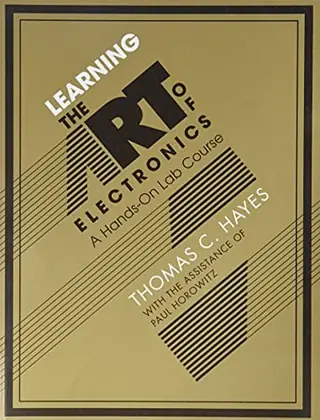
Learning the art of electronics
by Thomas C. Hayes · first published 2016
74% recommend26% neutral
Why HN recommends it
Hands-on lab course with one project per chapter, written as a practical companion to The Art of Electronics. Suits newcomers who find the main text dense and want to build circuits on a breadboard.
Summarised by Claude from recommending comments
Affiliate links. As an Amazon Associate I earn from qualifying purchases.
Mentions per year
What Hacker News says
Related books
Practical Electronics for Inventors, Fourth Edition
Paul Scherz, Simon Monk
Recommended by 6 · mentioned by 66 recommend · 6 mention6 recommend · 66 recommend
 2011–2026
Foundations of analog & digital electronic circuits
Anant Agarwal
Recommended by 5 · mentioned by 95 recommend · 9 mention5 recommend · 95 recommend
 2009–2026
Electronic principles
Albert Paul Malvino
Recommended by 3 · mentioned by 43 recommend · 4 mention3 recommend · 43 recommend
 2009–2026
Practical Electronics for Inventors
Paul Scherz
Recommended by 51 · mentioned by 6451 recommend · 64 mention51 recommend · 6451 recommend
 2008–2026
The art of electronics
Paul Horowitz, Winfield Hill
Recommended by 153 · mentioned by 230153 recommend · 230 mention153 recommend · 230153 recommend
 2009–2025
Make
Charles Platt
Recommended by 15 · mentioned by 1615 recommend · 16 mention15 recommend · 1615 recommend
Introduction to Embedded Systems
Edward A. Lee, Sanjit A. Seshia
Recommended by 3 · mentioned by 43 recommend · 4 mention3 recommend · 43 recommend
 2013–2025
Patterns for Time-Triggered Embedded Systems
Michael J. Pont
Recommended by 3 · mentioned by 43 recommend · 4 mention3 recommend · 43 recommend
I recommend you get the Thomas C. Hayes "Learning the Art of electronics - a hands-on lab course" book and doing the work. Source components of ebay from China, stuff is dirt cheap. Get a $400 Rigdol scope and your set.
on “Show HN: Learn how to build electronics with monthly kits” ↗I'm not sure there is a best, but different styles that appeal to different people. One prominent candidate is Horowitz's Art of Electronics. Learning the Art of Electronics is a hands on lab oriented course with one project per chapter.
on “Ask HN: What are some books where the reader learns by building projects?” ↗Forest Mims "Getting Started in Electronics" Horowitz and Hill "Art of Electronics" Horowitz and Hayes "Learning the Art of Electronics" plus get a breadboard and a bunch of basic components, and a multimeter.
on “Ask HN: How / where to learn practical electrical / electronics?” ↗…recommend The Art of Electronics highly enough - it's way more intuitive and informative than any other resource on the subject I've found. It's exceptionally great when paired with the self-paced lab manual Learning the Art of Electronics[0]. [0] https://www.digikey.com/en/resources/edu/harvard-lab-kit
on “My self-study plan for electrical engineering” ↗You need a solid background in digital electronics to start. 1. Nand2Tetris 2. Books: The Art of Electronics, especially the last half. Learning the Art of Electronics. Also especially the last half. 3. You should have a good understanding of programming in C.
on “FPGA Advent Calendar” ↗…needs to be a course guide that spans the entire material with independent guidance. A good modern example of this is The Art of Electronics which is a textbook format. There is a companion book which is Learning the Art of Electronics which contains exactly the structure I want to see, which is your lectures, tutorials and labs in a structured format on paper. You can complete these with guidance, without guidance, with or without…
on “Laptops Are Great, But Not During a Lecture or a Meeting” ↗That is in there. See p79/80 in 3e for example of impedance relationships. Also lots of practical examples in the companion book "Learning the Art of Electronics" I've had all editions of this including the first and it's definitely in there!
on “Ask HN: Where did you learn modular electronics?” ↗And the associated learning the art of electronics text. The first edition student manual was what taught me.
on “Design electronics like it is 70s at CERN” ↗…is a wonderful book and you can certainly learn from it. I don't think it's useful as a reference, but it is a little opaque to someone new. But, now there is https://learningtheartofelectronics.com/ Learning the Art of Electronics, which is a practical course with labs to complete, etc. It is very, very good. I am using subsets of it (with scaffolding/additional practice) to teach smart middle schoolers to design transistor circuits…
on “Electronics Lab Bench Setup Guide” ↗I have TAoE (but probably 2nd Ed, as I’ve had it for some years) and it is both educational and very dense. That said, I bought “Learning the Art of Electronics: A Hands-On Lab Course” and really like it. There’s a good bit of practical, accessible knowledge there. Imho worth checking out for anyone who likes the idea of TAoE but finds it just a bit deep. FWIW,…
on “Ultimate Electronics” ↗The books Make: Electronics and Learning The Art of Electronics are pretty good hands on resources.
on “Learn the basics of digital electronics with the hands-on Logic Lab kit” ↗I took a class where we used Learning the Art of Electronics (with AoE as a reference), and that book was also excellent. Class was taught by a former student of Horowitz and Hill, and one week the OG did the guest lecture! Unforgettable.
on “The Art of Electronics (2015)” ↗Try pairing it with the companion "Learning the Art of Electronics." It's a hands-on lab workbook that complements the main book. It's very practical.
on “Learn electricity and electronics fundamentals without taking a formal course” ↗Or better yet, the "Learning the Learning the Art of Electronics" which breaks down the companion book.
on “Learn electricity and electronics fundamentals without taking a formal course” ↗Would it pay off to get the lab book Learning The Art of Electronics too? https://www.amazon.com/Learning-Art-Electronics-Hands-Course...
on “Show HN: Learn how to build electronics with monthly kits” ↗