Successful Lisp
by David B. Lamkins · first published 2004
75% recommend25% neutral
Why HN recommends it
Free, well-organized tour of Common Lisp with a nutshell introduction in chapter 3 and a suggested reading order; suited to beginners to intermediate programmers, often paired with Practical Common Lisp.
Summarised by Claude from recommending comments
According to the author's website this book: * Provides an overview of Common Lisp for the working programmer. * Introduces key concepts in an easy-to-read format. * Describes format, typical use, and possible drawbacks of all important Lisp constructs. * Provides practical advice for the construction of Common Lisp programs. * Shows examples of how Common Lisp is best used. * Illustrates and compares features of the most popular Common Lisp systems on desktop computers. * Includes discussion and examples of advanced constructs for iteration, error hand
Affiliate links. As an Amazon Associate I earn from qualifying purchases.
Mentions per year
What Hacker News says
Related books
 2007–2025
ANSI Common Lisp
Paul Graham
Recommended by 67 · mentioned by 13167 recommend · 131 mention67 recommend · 13167 recommend
 2007–2026
Practical Common Lisp
Peter Seibel
Recommended by 218 · mentioned by 294218 recommend · 294 mention218 recommend · 294218 recommend
 2015–2024
Common Lisp Recipes
Edmund Weitz
Recommended by 20 · mentioned by 2620 recommend · 26 mention20 recommend · 2620 recommend
 2008–2025
The little LISPer
Daniel P. Friedman
Recommended by 28 · mentioned by 4328 recommend · 43 mention28 recommend · 4328 recommend
 2008–2026
Let Over Lambda
Doug Hoyte
Recommended by 66 · mentioned by 9866 recommend · 98 mention66 recommend · 9866 recommend
 2007–2026
The seasoned schemer
Daniel P. Friedman
Recommended by 33 · mentioned by 4733 recommend · 47 mention33 recommend · 4733 recommend
 2007–2026
On LISP
Paul Graham
Recommended by 192 · mentioned by 355192 recommend · 355 mention192 recommend · 355192 recommend
 2007–2026
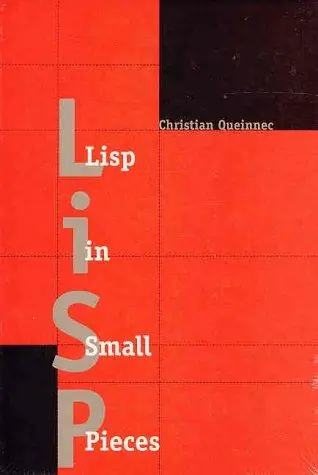
Lisp in Small Pieces
Christian Queinnec
Recommended by 101 · mentioned by 141101 recommend · 141 mention101 recommend · 141101 recommend
Don't forget 'Successful Lisp' by David Lamkins (http://psg.com/~dlamkins/sl/) - in printed-book or HTML versions. Chapter 3 is an excellent 'nutshell' introduction to Common Lisp. The rest of the book, aside from covering various…
on “A Common Lisp Bookshelf” ↗Definitely this book. I would recommend keeping Graham's books for later. Practical Common Lisp + Land of Lisp + Common Lisp recipes + the Lisp Hyperspec = Profit! Additional readings: Successful Lisp (Lamkins - very underrated), Paul Graham's books, and Hoyte's Let Over Lambda (advanced).
on “Practical Common Lisp (2005)” ↗…omitted from IEEE, but most Schemes have it) at the REPL to import definitions from a file (or there's always good ol' copy+paste). If you want to learn Common Lisp rather than Scheme, you can check out "Successful Lisp" by David Lamkins and/or "Practical Common Lisp" by Peter Seibel, both of which are freely readable on the Web. You'll also want to keep the ANSI Common Lisp HyperSpec by Kent Pitman handy as a reference…
on “Why Lisp is now an acceptable scripting language” ↗Successful Lisp David B. Lamkins
on “SBCL 2.2.8” ↗I approached it by following my guru's advice, after having fun with Python, OCaml, Erlang; learing Lisp was pain first and then fun. Paul's book explained a lot, as well as Successful Lisp. And yes, browing HyperSpec a lot makes sense!
on “Ask news.YC: For the lisp experts - tell me how you learned the language.” ↗…comments of pchristensen's blog recommended the book 'Common Lisp: A Gentle Introduction to Symbolic Computation'. I flicked through the first few chapters and for what it's worth it seems pretty good. Also 'Successful Lisp' is pretty good too. Common Lisp: A Gentle Introduction to Symbolic Computation: http://www.cs.cmu.edu/~dst/LispBook/ Successful Lisp: http://psg.com/~dlamkins/Site/sl.html
on “How To Learn Lisp” ↗…also important to find where the contemporary work and discussion happens, what the current best practices are, and so on. For books for the beginner to intermediate programmer, I would go with PCL and Successful Lisp in tandem; for cross-platform implementations SBCL and Clozure (formerly OpenMCL). And of course, this: http://abhishek.geek.nz/docs/lisp-answers/.
on “Starting with Lisp: A collection of beginner pointers” ↗In [Successful Lisp, how to understand and use CL](http://www.communitypicks.com/r/lisp/s/17592186045679-succes...) there is a chapter on debugging. Book's site, free dl: https://successful-lisp.blogspot.com Also, it may…
on “A new version of Common-Lisp.net has been launched” ↗…update-instance-for-redefined-class method. (Methods aren't owned by classes, unlike other OOP languages, which I think eliminates a lot of the OOP design problems associated with those other languages.) I like the book Successful Lisp as a tour of Common Lisp, it's got a suggested reading order in ch 2 for different skill levels: https://dept-info.labri.fr/~strandh/Teaching/MTP/Common/Davi... It's dated in parts as far as tooling goes…
on “Lisp from Nothing, Second Edition” ↗I bought Graham's "Ansi Common Lisp" book and read it briefly, and tried to write some code as well. I also read "Successful Lisp" briefly. Hoping to give constructive feedback and not to start a flame, here are some opinions/impressions. Please note that : 1. These are mostly impressions, not complete opinions. 2. I am only…
on “Why didn't Common Lisp fix the world?” ↗…http://www.scheme.com/tspl4/ "Concrete Abstractions." http://gustavus.edu/+max/concrete-abstractions.html Lisp: "Common Lisp the language, 2nd edition." http://www.cs.cmu.edu/Groups/AI/html/cltl/cltl2.html "Successful Lisp." http://www.psg.com/~dlamkins/sl/ "Common Lisp: an interactive approach". http://www.cse.buffalo.edu/~shapiro/Commonlisp/ Ocaml: http://www.seas.upenn.edu/~cis500/cis500-f02/resources/ocaml... (draft)…
on “Ask HN: Free Programming eBooks” ↗…the UB in C that you mentioned. Until seeing that post, I wasn't really aware of that potential issue with literals, so I think it's good to point these things out. Recently, I saw it was mentioned in "Successful Lisp"; it might be mentioned in other books I've read, but maybe I just didn't pick up on it.
on “Spur – RISC IV: The Lisp Multiprocessor Workstation” ↗