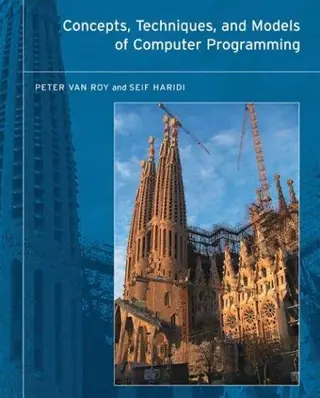
Concepts, techniques, and models of computer programming
by Peter Van Roy, Seif Haridi · first published 2004
75% recommend25% neutral
Why HN recommends it
Builds different programming paradigms (functional, logic, object-oriented, dataflow, concurrent) from a small core model, mostly using Oz. Suits programmers who want to understand ideas over languages and frameworks.
Summarised by Claude from recommending comments
Affiliate links. As an Amazon Associate I earn from qualifying purchases.
Mentions per year
What Hacker News says
Related books
 2007–2026
How to Design Programs
Matthias Felleisen
Recommended by 277 · mentioned by 440277 recommend · 440 mention277 recommend · 440277 recommend
 2009–2026
Design concepts in programming languages
Franklyn A. Turbak, David Gifford, Mark A. Sheldon
Recommended by 7 · mentioned by 87 recommend · 8 mention7 recommend · 87 recommend
 2008–2025
Advanced compiler design and implementation
Steven S. Muchnick
Recommended by 13 · mentioned by 2213 recommend · 22 mention13 recommend · 2213 recommend
 2008–2026
Essentials of programming languages
Daniel P. Friedman
Recommended by 43 · mentioned by 4843 recommend · 48 mention43 recommend · 4843 recommend
 2008–2026
Types and Programming Languages
Benjamin C. Pierce
Recommended by 132 · mentioned by 226132 recommend · 226 mention132 recommend · 226132 recommend
 2007–2026
Structure and Interpretation of Computer Programs
Harold Abelson, Gerald Jay Sussman, Julie Sussman
Recommended by 347 · mentioned by 602347 recommend · 602 mention347 recommend · 602347 recommend
…finite domain constraint programming, constraint logic programming, logic programming, relational programming Static functional programming - ml, haskell A good modern introduction to programming is Concepts, Techniques, and Models of Computer Programming, by Peter Van Roy and Saif Haridi. It's far superior to the commonly mentioned lisp book Structure and Interpretation of Computer Programs.
on “On Lisp” ↗One fantastic multi-paradigm-from-the-start language that often gets missed out is Mozart/Oz - http://mozart2.org . This language is used in the awesome book "Concepts, Techniques, and Models of Computer Programming" by Peter van Roy and Seif Haridi - https://www.info.ucl.ac.be/~pvr/book.html
on “Multi-Paradigm Languages” ↗…be there, too. Any "top X books for field Y" list is going to be a bit arbitrary, probably telling you as much about the people who wrote the list as the field itself. That said, I'd also suggest: * Concepts, Techniques, and Models of Computer Programming by Peter Van-Roy and Seif Haridi ("CTM"), which covers several different programming approaches. Not about different languages, but their underlying models, and ways in which they can be combined. *…
on “Books that will Substitute for a Computer Science Degree” ↗…masses" was being developed. If you want a detailed systematic account of programming paradigms, (without detailed study of what applications they are good and bad for I'm afraid) I would highly recommend Concepts, Techniques, and Models of Computer Programming by Roy and Haridi (this book leans towards dataflow oriented paradigms, explaining a few other paradigms using the idea).
on “The paradigms of programming” ↗…come in handy. What other math books should I be reading? You should make time for Structure and Interpretation of Computer Programs (http://mitpress.mit.edu/sicp/). Other good theory books: Concepts, Techniques, and Models of Computer Programming by Peter van Roy, and Types and Programming Languages by Benjamin Pierce. As for math - it's good to know some set theory and mathematical logic, but I wasn't a math major so I don't have good recs in…
on “Ask HN: How should I go about learning CS?” ↗Another book taking this kind of horizontal approach explains different programming paradigms rather than concrete languages: "Concepts, Techniques, and Models of Computer Programming" by Peter Van Roy and Seif Haridi (http://www.info.ucl.ac.be/~pvr/book.html). It is IMHO a deeply illuminating book.
on “Seven Languages: A Pragmatic Guide to Learning Programming Languages” ↗If I had to recommend just one book overall, it'd be Peter Van Roy and Seif Haridi's _Concepts, Techniques, and Models of Computer Programming_ (http://www.info.ucl.ac.be/~pvr/book.html). It's an extremely lucid overview of the different underlying models on which most programming languages are built, and how they interact when combined. It…
on “Ask HN: going back to school, what books before CS?” ↗Oz is an interesting language. I only learned it because I was reading Peter Van Roys excellent Concepts, Techniques and Models of Computer Programming, but I'm glad I did. Having said that, I've never actually used it for anything substantial.
on “What Does Haskell Have to Do with C++?” ↗The modularity advantage of shared state's "spooky action at a distance" when properly employed is not a fresh insight. It's even addressed in good textbooks on programming such as van Roy and Haridi's Concepts, Techniques and Models of Computer Programming. Here's an old related LtU post by van Roy: http://lambda-the-ultimate.org/classic/message9361.html. Another dramatic example (which is one of the book's exercises) is revocable capabilities.
on “Functional Programming Doesn't Work (and what to do about it)” ↗I admire the combination of theoretical audacity and sweeping pragmatism taken by the authors of that paper. They mention Oz a few times. I am big fan of "Concepts, Techniques, and Models of Computer Programming" by Van Roy and Haridi, which shows the reader how different computing paradigms can be constructed from a kernel language in Oz. That makes the text something of a kindred spirit to the paper, insofar…
on “Data first, not code first” ↗A few recommendations on this, since at where I work a talk is organized on this very topic today. 1. A great book that covers multiple paradigms of programming is Roy and Haridi's "Concepts, Techniques and Models of Computer Programming" https://mitpress.mit.edu/books/concepts-techniques-and-model... . This stands hand in hand with the better known SICP. 2. Folks in the CS and programming world seem to ignore bleeding edge work being…
on “Being confidently programming language agnostic” ↗As a first-class language feature this goes back at least to 1985 and Linda https://en.wikipedia.org/wiki/Linda_(coordination_language) and tuplespaces. (You'd know about Linda already if you'd read Concepts, Techniques, and Models of Computer Programming. Don't delay, read CTM today: https://www.info.ucl.ac.be/~pvr/paradigms.html ) And here's a Martin Fowler talk about the practise of implementing it informally as a pattern or framework: https://www.youtube.com/watch?v=STKCRSUsyP0
on “Message-Oriented Programming (2017)” ↗'Concepts, Techniques and Models of Computer Programming' by Peter Van Roy and Hadidi may be a better book than this and even SCP, since it presents a well organized "science" of computer programming..
on “How to Design Programs (2014)” ↗You might find the following two books helpful; 1. Programming Language Pragmatics by Michael Scott. 2. Concepts, Techniques and Models of Computer Programming by Peter Van Roy, Seif Haridi.
on “Ask HN: How to study programming language theory as a non CS student?” ↗The author doesn't mention it but Concepts, Techniques and Models of Computer Programming by Haridi & Van Roy teaches concurrent logic programming (as part of a tour through a wide variety of programming models, including logic programming, stateful concurrency, and constraint programming).…
on “The joy of concurrent logic programming” ↗