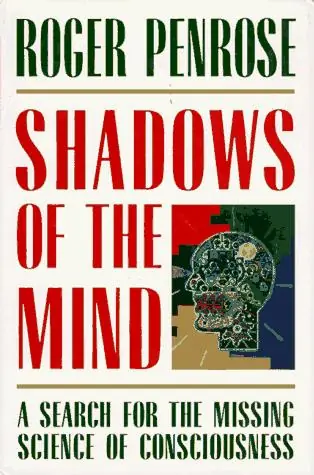
Shadows of the mind
by Roger Penrose · first published 1994
42% recommend52% neutral6% critical
Why HN recommends it
Penrose argues that consciousness and intelligence are not purely algorithmic, citing Gödel's theorems and quantum effects in the brain. Suits readers wanting a detailed case against strong AI, even if they disagree.
Summarised by Claude from recommending comments
A New York Times bestseller when it appeared in 1989, Roger Penrose's The Emperor's New Mind was universally hailed as a marvelous survey of modern physics as well as a brilliant reflection on the human mind, offering a new perspective on the scientific landscape and a visionary glimpse of the possible future of science. Now, in Shadows of the Mind, Penrose offers another exhilarating look at modern science as he mounts an even more powerful attack on artificial intelligence. But perhaps more important, in this volume he points the way to a new science, one that may eventually explain the phy
Affiliate links. As an Amazon Associate I earn from qualifying purchases.
Mentions per year
What Hacker News says
Related books
Emperor's New Mind
Roger Penrose
Recommended by 37 · mentioned by 11237 recommend · 112 mention37 recommend · 11237 recommend
 2007–2026
I Am a Strange Loop
Douglas R. Hofstadter
Recommended by 101 · mentioned by 204101 recommend · 204 mention101 recommend · 204101 recommend
 2008–2026
Gödel's proof
Ernest Nagel, James Roy Newman
Recommended by 30 · mentioned by 3930 recommend · 39 mention30 recommend · 3930 recommend
 2008–2024
Black holes and time warps
Kip S. Thorne
Recommended by 16 · mentioned by 1816 recommend · 18 mention16 recommend · 1816 recommend
Permutation City
Greg Egan
Recommended by 256 · mentioned by 354256 recommend · 354 mention256 recommend · 354256 recommend
 2007–2026
Gödel, Escher, Bach
Douglas R. Hofstadter
Recommended by 505 · mentioned by 1,055505 recommend · 1,055 mention505 recommend · 1,055505 recommend
 2007–2026
The Road to Reality
Roger Penrose
Recommended by 67 · mentioned by 12867 recommend · 128 mention67 recommend · 12867 recommend
 2008–2026
Anathem
Neal Stephenson
Recommended by 207 · mentioned by 393207 recommend · 393 mention207 recommend · 393207 recommend
To add to this: The Emperor's New Mind, by Roger Penrose. Really cool book. The Road to Reality: A Complete Guide to the Laws of the Universe, by Penrose again. Shadows of the Mind: A Search for the Missing Science of Consciousness, Penrose.
on “5 Great Science Books to Expand Your Mind” ↗I recommend reading "Shadows of the Mind" by Roger Penrose. In that book he argues that strong artificial intelligence isn't achievable on classical computers, since the human brain seems to have the ability to do quantum computing in certain…
on “Stephen Hawking: AI, Potentially the Worst Thing to Happen to Humanity” ↗If you look up Shadows of the Mind by Roger Penrose you will find a significant bibliography of non-mystic thought on the subject.
on “Ask HN: Does anyone doubt artificial consciousness is possible?” ↗…probably the most interesting thinkers on this problem, and I lead towards his conclusions -- that consciousness is a byproduct of biology -- not intelligence or computation. Highly recommend his book Shadows of the Mind -- it's on my list. In summary he believes that consciousness isn't a by-product of computation done by neurons (the traditional view), but rather quantum level effects created by MAP proteins within…
on “Can AI Become Conscious?” ↗+1, a really enjoyable but provocative read. With respect to Godel, Roger Penrose's "Shadows of the Mind" gives a pretty good insight into the implications of Godels theorems.
on “Gödel and the limits of logic” ↗I feel a better explanation of them was given in "Shadows of the mind" by Roger Penrose where he explains how they play a vital role in Quantum Theory which impacts real-life behavior.
on “What are the complex numbers, really?” ↗- Zen and the Art of Motorcycle Maintenance (Pirsig) - Gödel, Escher, Bach: an Eternal Golden Braid (Hofstadter) - Shadows of the Mind: A Search for the Missing Science of Consciousness (Penrose) - Zen Mind, Beginner's Mind (Suzuki) - Demian (Hesse) - The Stranger (Camus) - Slaughterhouse-Five (Vonnegut) - Another Roadside Attraction…
on “Ask HN: What are the best books you've ever read?” ↗If you genuinely want the strongest statement of it, read The Emperor's New Mind followed by Shadows of the Mind, both by Roger Penrose. These books often get shallowly dismissed in terms that imply he made some elementary error in his reasoning, but that's not the case. The dispute is more about the assumptions…
on “You are the scariest monster in the woods” ↗…capture it, and I'm not going to try to summarise(*). The books are well worth a read regardless of whether you agree with Penrose. (The Emperor's New Mind is a lovely, wide-ranging book on many topics, but Shadows of the Mind is only worth it if you want to go into extreme detail on the AI argument and its counterarguments.) * I will mention though that "some" should be "all" in 2, but that doesn't make it a correct statement…
on “You are the scariest monster in the woods” ↗Scott Aaronson mentions Penrose's "The Emperor's New Mind", but I feel "Shadows of the Mind" is putting forward a much clearer view of Penrose's thesis. At the current stage of my life I'm quite comfortably in Camp C. "Intelligence" and "consciousness" are not algorithmic.[1] A lot of materialists…
on “LLMs and self-referentiality” ↗All books are suitable for casually reading on trams, apart from really old and delicate or oversized ones. I loved 'The Emperors's New Mind' and 'Shadows of the Mind', and did read some of those two while on train journeys, if that helps at all.
on “Roger Penrose Says Physics Is Wrong, From String Theory to Quantum Mechanics” ↗I don't agree with you. Read "Shadows of the Mind", your opinions on him might change. I don't think being a Polymath means you have to know mutually exclusive stuff. I don't that's possible in the sciences anyway.
on “Hunt for Modern Polymaths: 20 Living Examples” ↗There are tons of written books and journals on this topic. My favorite: https://global.oup.com/academic/product/shadows-of-the-mind-...
on “Is artificial consciousness achievable? Lessons from the human brain” ↗No, Penrose is not dumb. He gives a very good argument in his books on limitations of AI, which is almost always misrepresented including in most of this thread. It is worth reading "Shadows of the Mind".
on “Gödel's theorem debunks the most important AI myth – Roger Penrose [video]” ↗…probably the best I can find right now which talks about almost all viewpoints. http://plato.stanford.edu/entries/consciousness/ There is an extremely good and entertaining argument in Penrose's book Shadows of the Mind against consciousness being computational (but the book has quite a good number of flaws in its other arguments). From a reductionist and materialistic physical standpoint we only have fundamental particles…
on “MIT discovers the location of memories: Individual neurons” ↗