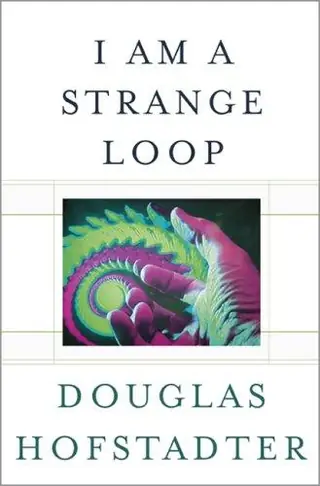
I Am a Strange Loop
by Douglas R. Hofstadter · first published 2007
49% recommend44% neutral7% critical
Why HN recommends it
Argues that consciousness and the self emerge from a recursive feedback loop in the brain. It restates the central ideas of GEB in a more focused, personal, accessible way, suiting readers curious about mind and AI.
Summarised by Claude from recommending comments
Hofstadter's long-awaited return to the themes of Gödel, Escher, Bach--an original and controversial view of the nature of consciousness and identity. What do we mean when we say "I"? Can a self, a soul, a consciousness, an "I" arise out of mere matter? If it cannot, then how can you or I be here? This book argues that the key to understanding selves and consciousness is a special kind of abstract feedback loop inhabiting our brains. Deep down, a human brain is a chaotic soup of particles, on a higher level it is a jungle of neurons, and on a yet higher level it is a network of abstractions th
Affiliate links. As an Amazon Associate I earn from qualifying purchases.
Mentions per year
What Hacker News says
Related books
 2007–2026
Gödel, Escher, Bach
Douglas R. Hofstadter
Recommended by 505 · mentioned by 1,055505 recommend · 1,055 mention505 recommend · 1,055505 recommend
 2008–2026
Fluid Concepts and Creative Analogies
Douglas R. Hofstadter, Fluid Analogies Research Group
Recommended by 17 · mentioned by 3117 recommend · 31 mention17 recommend · 3117 recommend
 2008–2026
Gödel's proof
Ernest Nagel, James Roy Newman
Recommended by 30 · mentioned by 3930 recommend · 39 mention30 recommend · 3930 recommend
 2009–2026
Le Ton beau de Marot
Douglas R. Hofstadter
Recommended by 27 · mentioned by 5227 recommend · 52 mention27 recommend · 5227 recommend
 2007–2026
Metamagical Themas
Douglas R. Hofstadter
Recommended by 45 · mentioned by 8445 recommend · 84 mention45 recommend · 8445 recommend
 2007–2026
The Mind's I
Douglas R. Hofstadter, Daniel C. Dennett
Recommended by 36 · mentioned by 5736 recommend · 57 mention36 recommend · 5736 recommend
 2013–2026
Surfaces and Essences
Emmanuel Sander
Recommended by 14 · mentioned by 1814 recommend · 18 mention14 recommend · 1814 recommend
 2008–2026
Shadows of the mind
Roger Penrose
Recommended by 13 · mentioned by 3113 recommend · 31 mention13 recommend · 3113 recommend
I'd owned this book for many years and had a similar experience to OP. But one day someone gave me `I am a Strange Loop`, which I started reading and enjoyed way more. After getting in a little bit Hofstadter makes some apologies for GEB saying it was the sum of work of a very young person. I think he was 24? I think it's…
on “Why I Don't Love Gödel, Escher, Bach” ↗…think about it etc...) of the information (the world, no matter how it works) needs to be explained. Imho Douglas Hofstadter comes closest to trying to explain it without all that kind of pitfalls in "I Am a Strange Loop". Not that it actually truly explains it, but at least it acknowledges those things that make me normally dismiss theories that could explain consciousness.
on “Is Consciousness an Illusion?” ↗hofstadter has a pretty decent defintion worked out in 'godel, escher, bach" and "i am a strange loop": consciousness arises when systems in the brain model the external world, and then begin modeling their modelling of the external world, and then begin modelling their modelling of their modelling...
on “A Neuroscientist’s Theory of How Networks Become Conscious (2013)” ↗…west, at least) is cobbled together from various religions, spiritualities, and extremely, extremely dense philosophers read by few and understood by fewer. You might find Richard Hofstadter's Book "I Am A Strange Loop" illuminating if you find my explanation meager.
on “Non-Computability of Consciousness (2007)” ↗You might be interested in reading Douglas Hofstadter's book I Am A Strange Loop.
on “Consciousness Isn’t a Mystery, It’s Matter” ↗In no particular order ... I Am a Strange Loop by Douglas Hofstadter - strongly influenced my beliefs about how consciousness works Godel, Escher, Bach by Douglas Hofstadter - made me think more deeply about so many topics Animal Liberation by Peter…
on “Ask HN: What books have made the biggest impact on your mental models?” ↗I Am A Strange Loop by Hofstadter. The book he wrote many years before, GEB, is well-known. However, he was frustrated that so many people didn't get what he was trying to convey, so he took the central point and distilled…
on “Ask HN: What are the best unknown books you have read?” ↗…interviewer doesn't know Hofstadter from a hole in the ground. Such a shame a great mind like Hofstadter is subjected to these awful questions. Here's an idea. If you haven't read Hofstadter's GEB and I Am a Strange Loop, don't try to interview him about it. Especially don't open with a question that reveals this in the first breath Hofstadter responds with. I love Bill Moyers, don't get me wrong here, but this reminds…
on “An Interview with Douglas R. Hofstadter” ↗Addition to my last post: my feelings on this particular issue (the mind-body problem, the soul, experience, or however you want to cast it) are pretty close to Hofstadter's as outlined in I Am A Strange Loop, which is a great read no matter what your stance on the issue (he doesn't take a strong stance either way, but pretty clearly indicates that he thinks it's the computation that's important, not the substrate).…
on “Science and the Demise of Philosophy” ↗The enumeration at the top of your comment is the best thing I've read yet today. Douglas Hofstadter expands on similar ideas in I Am a Strange Loop.
on “My fellow geeks, we need to have a talk.” ↗You might like Douglas Hofstadter's book I Am a Strange Loop. He examines consciousness as a recursive feedback loop. The book has some hokey tangents, but I think it's a good presentation. btw, this book is much more accessible that Hofstadter's GEB. :) https://en.wikipedia.org/wiki/I_Am_a_Strange_Loop
on “MIT discovers the location of memories: Individual neurons” ↗I'm reminded of I Am a Strange Loop and Gödel, Escher, Bach by Douglas Hofstadter. About recursiveness being at the heart of consciousness.
on “Mise en abyme” ↗It seems like the essays they want would be similar in spirit to Douglas Hofstadter's books: "Gödel, Escher, Bach" and "I Am a Strange Loop" https://en.wikipedia.org/wiki/I_Am_a_Strange_Loop
on “How can mindless mathematical laws give rise to aims and intention?” ↗Mind And Nature - A Necessary Unity, by Gregory Bateson, and I Am A Strange Loop, by Douglas Hofstadter. They're a great combination, as they're both attempts to define the concept of "mind" through patterns. Bateson is one of the early thinkers in the field of Cybernetics, which…
on “Ask HN: What books are you reading?” ↗Theres an interesting book about this “I am a Strange Loop” written by Douglas Hofstadter
on “Controlling electric signals in the body could help it heal” ↗