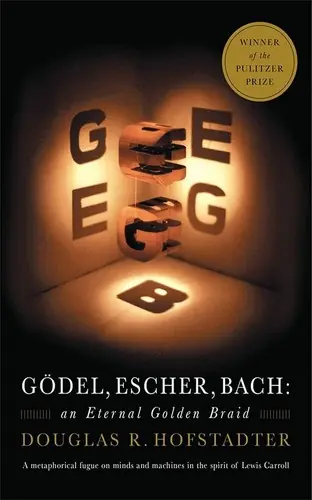
Gödel, Escher, Bach
an Eternal Golden Braid
by Douglas R. Hofstadter · first published 1979
48% recommend44% neutral8% critical
Why HN recommends it
Playful, wide-ranging tour of logic, Gödel's incompleteness trick, mind, music and art, enjoyed as a fun, exhilarating read; suits curious programmers and math fans who want ideas about thought and computation.
Summarised by Claude from recommending comments
Winner of the Pulitzer Prize A metaphorical fugue on minds and machines in the spirit of Lewis Carroll Douglas Hofstadter's book is concerned directly with the nature of "maps" or links between formal systems. However, according to Hofstadter, the formal system that underlies all mental activity transcends the system that supports it. If life can grow out of the formal chemical substrate of the cell, if consciousness can emerge out of a formal system of firing neurons, then so too will computers attain human intelligence. Gödel, Escher, Bach is a wonderful exploration of fascinating idea
Affiliate links. As an Amazon Associate I earn from qualifying purchases.
Mentions per year
What Hacker News says
Related books
 2007–2026
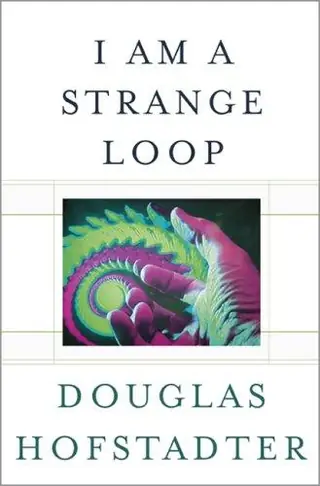
I Am a Strange Loop
Douglas R. Hofstadter
Recommended by 101 · mentioned by 204101 recommend · 204 mention101 recommend · 204101 recommend
 2007–2026
Metamagical Themas
Douglas R. Hofstadter
Recommended by 45 · mentioned by 8445 recommend · 84 mention45 recommend · 8445 recommend
 2009–2026
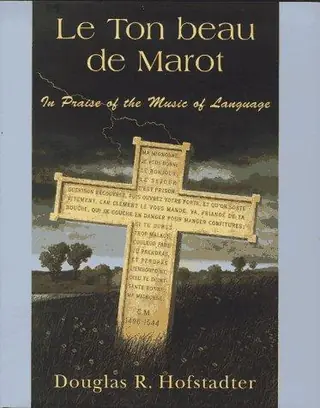
Le Ton beau de Marot
Douglas R. Hofstadter
Recommended by 27 · mentioned by 5227 recommend · 52 mention27 recommend · 5227 recommend
 2008–2026
Gödel's proof
Ernest Nagel, James Roy Newman
Recommended by 30 · mentioned by 3930 recommend · 39 mention30 recommend · 3930 recommend
 2007–2026
The Selfish Gene
Richard Dawkins
Recommended by 220 · mentioned by 431220 recommend · 431 mention220 recommend · 431220 recommend
 2007–2026
The Mind's I
Douglas R. Hofstadter, Daniel C. Dennett
Recommended by 36 · mentioned by 5736 recommend · 57 mention36 recommend · 5736 recommend
 2007–2026
Zen and the Art of Motorcycle Maintenance
Robert M. Pirsig
Recommended by 302 · mentioned by 508302 recommend · 508 mention302 recommend · 508302 recommend
 2013–2026
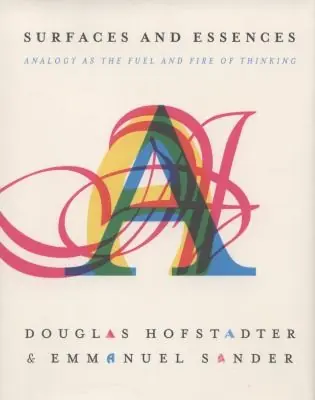
Surfaces and Essences
Emmanuel Sander
Recommended by 14 · mentioned by 1814 recommend · 18 mention14 recommend · 1814 recommend
Looking for good books to read. Any recommendations? I liked these: Everything and More, David Foster Wallace Gödel, Escher, Bach, Douglas Hofstadter Collected Fictions, Jorge Luis Borges In Praise of Idleness, Bertrand Russell Antifragile, Nassim Taleb The Long Way, Bernard Moitessier Deceit, Desire, and the Novel, Rene Girard The Wu-Tang Manual, RZA Meditations, Marcus Aurelius Essays,
on “Ask HN: What are some good books?” ↗Although not directly development related. The most impressive book I've had the pleasure of reading is "Gödel Escher Bach: An eternal golden braid" (also known as GEB) from Douglas Hofstadter. It's hard to explain what it is about exactly, but it contains ideas and concepts from mathematics, computer science, philosophy and conscience. All of it is explained in very clear and interesting way. I
on “The most mentioned books on Stack Overflow” ↗Gödel, Escher, Bach: an Eternal Golden Braid Introduced me to the beauty of logic and its limits. Also gave me solid mathematical thinking foundations. Pro tip: Try listening to Bach while you read about Bach.
on “Ask HN: What book changed your life?” ↗…FreeBSD Operating System - McKusick, Bostic, Karels, Quarterman The Design of the Unix Operating System - Bach The Unix Programming Environment - Kernighan, Pike The Art of Unix Programming - Raymond Godel, Escher, Bach - Hofstadter Metamagical Themas - Hofstadter Joel on Software - Spolsky Code Complete - McConneli The Mythical Man-Month - Brooks No Silver Bullet - Brooks The Long Tail - Anderson The Art of the…
on “ASK HN: Hacker Bibles” ↗…possibility of spiritual experience within a naturalistic world view. A lot of atheism that is public today misses empathy with religious experience. -Martin Gardner's articles -Douglas Hofstadter - Godel, Escher, Bach & Le Ton Beau De Marot - for those that enjoy spending all day thinking about logic & languages (hello programmers) these two books are romantic pulp - you know you shouldn't be reading them, they are…
on “Neil DeGrasse Tyson’s Eight Books Everyone Should Read” ↗Mandatory recommendation for Gödel, Escher, Bach: An Eternal Golden Braid [1] by Douglas Hofstadter. Now I know most HNers are no stranger to this book, but if you haven't read it I encourage you to pick up a copy. A lot of people will say that it "changed the way they think about everything" without going into much more detail, so I'll just tell you how it did so for me. I've always been an anal
on “Gödel Without (Too Many) Tears” ↗"Gödel, Escher, Bach" is one of my favorite books, and I have a tremendous amount of respect and admiration for Hofstadter... so I'm really disappointed and saddened to read that he (quoting from the article) "hasn't been to an artificial-intelligence conference in 30 years. 'There's no communication between me and these people,' he says of his AI peers. 'None. Zero. I don't want to talk to collea
on “The Man Who Would Teach Machines to Think” ↗I'm a 3rd year undergraduate student and for various reasons I'm taking the rest of the year out and returning to studying Electronic Engineering next September. I know there are a lot of "Best books of 20xx" posts on HN, but I'm looking for overall recommendations for someone who is intelligent and thinks a lot, but has done almost no reading before (excluding school readings etc.) and wants catc
on “Ask HN: I have no commitments for the next 6 months – what books should I read?” ↗So many, and I wish I could write a long paragraph on each, but I'm unfortunately short on time. I'm posting any in case just one person who hasn't heard of those checks them out and gets value: -Godel, Escher, Bach (Douglas Hosfstadter) -The Mindbody Prescription (John E. Sarno, completely cured my long-term crippling RSI that kept me from using computers and was ruining my life) -Feeling Good (Dr. Burns, cognitive…
on “Ask HN: What books changed the way you think about almost everything?” ↗Gödel, Escher, Bach: An Eternal Golden Braid, and I'm loving it. Some parts are funny, some are dry, and some are truly mind-blowing. As someone who loves wordplay, self-reference, and multiple layers of meaning, this book is like crack. Every chapter surprises me with something new. Its reputation is well-deserved.
on “Ask HN: Which book are you reading these days?” ↗The essentials, looking at my non-CS shelves: * "Alice in Wonderland", Carroll * "Gödel, Escher, Bach: An Eternal Golden Braid", Hofstadter * Either "His Dark Materials", Pullman; or "Illuminatus!", Shea and Wilson * "The Hitchhiker's Guide to the Galaxy", Adams (all of its sequels are also good) * "Zen and the Art of Motorcycle Maintenance" and "Lila", Pirsig * Either "Watchmen", Moore and
on “Ask HN: Which non-programming books are a beneficial read for programmers?” ↗"Gödel, Escher, Bach" by Douglas Hofstadter, which I read when I was 17. I was just getting into serious programming (I would learn C later that year). I had only an inkling about things like recursion, had little appreciation for music outside of Pink Floyd, and lacked any kind of spiritual philosophy that didn't end in simple atheism or nonsense that I stole from science fiction paperbacks. GEB
on “Ask HN: Which non-technology book has influenced you the most and why?” ↗"We can implant entirely false memories"[1] I also remember being really suprised when I first learned the Central Limit Theorem[2] a long time ago. That said, Hofstadter's "Gödel, Escher, Bach"[3] probably had the biggest impact on me. [1] http://www.guardian.co.uk/science/2003/dec/04/science.resear... [2] http://en.wikipedia.org/wiki/Central_limit_theorem [3] http://en.wikipedia.org/wiki/Gö
on “Ask YC: What have you learned that rocked your world?” ↗Douglas Hofstadter used this analogy in his 1979 book, Gödel, Escher, Bach. GEB presents an analogy about how the individual neurons of the brain coordinate to create a unified sense of a coherent mind by comparing it to the social organization displayed in a colony of ants. It's a fascinating book, and well worth the read for the inquiring mind.
on “Ants swarm like brains think” ↗…turned to computer science and was instantly drawn to AI. I read everything I could get my hands on on the subject, with Daniel Dennett and Douglas Hofstadter being favorites of course (I still revisit Godel Escher Bach from time to time). I even experimented with various psychedelics looking for that elusive insight that would explain things. Now I'm in my 40's and of course I still don't have "the answer". I'm not…
on “Why can’t the world’s greatest minds solve the mystery of consciousness?” ↗