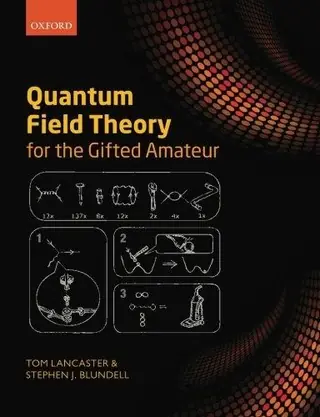
Quantum field theory for the gifted amateur
by Tom Lancaster · first published 2014
100% recommend
Why HN recommends it
Clear, example-rich introduction to quantum field theory that builds ideas step by step in short chapters; suited to readers who know basic quantum mechanics and electromagnetism, including working engineers.
Summarised by Claude from recommending comments
Affiliate links. As an Amazon Associate I earn from qualifying purchases.
Mentions per year
What Hacker News says
Related books
 2022–2025
Quarks and leptons
Francis Halzen
Recommended by 2 · mentioned by 42 recommend · 4 mention2 recommend · 42 recommend
 2015–2022
Student friendly quantum field theory
Robert D. Klauber
Recommended by 2 · mentioned by 32 recommend · 3 mention2 recommend · 32 recommend
 2015–2021
Renormalization methods
W. D. McComb
Recommended by 2 · mentioned by 52 recommend · 5 mention2 recommend · 52 recommend
 2010–2026
Introduction to Elementary Particles
David Jeffrey Griffiths
Recommended by 11 · mentioned by 1611 recommend · 16 mention11 recommend · 1611 recommend
 2008–2026
Lectures on physics
Richard Phillips Feynman
Recommended by 14 · mentioned by 2914 recommend · 29 mention14 recommend · 2914 recommend
 2008–2026
QED
Richard Phillips Feynman, A. Zee
Recommended by 60 · mentioned by 7760 recommend · 77 mention60 recommend · 7760 recommend
 2007–2026
Calculus on manifolds
Michael Spivak
Recommended by 22 · mentioned by 4822 recommend · 48 mention22 recommend · 4822 recommend
 2009–2026
Finite-dimensional vector spaces
Paul R. Halmos
Recommended by 24 · mentioned by 3824 recommend · 38 mention24 recommend · 3824 recommend
Probably the highest point in my physics "career" was when my advisor recommended Quantum Field Theory for the Gifted Amateur [0] to me. It was after I had basically decided to abandon hope at academia and become an engineer, but I was just barely past the threshold of being able to understand the contents. I worked through…
on “What is quantum field theory and why is it incomplete?” ↗Thank you for the recommendations! While I have not seen either of those books before, I have another book by the author of the first one, Stephen Blundell. It's Quantum Field Theory for the Gifted Amateur, and I think you might like it. Not as a standalone quantum book, but perhaps as a supplement to a more "serious" treatment. edit: I just saw you recommended this below!
on “Free Math Books” ↗"Quantum Field Theory for the Gifted Amateur" by Stephen Blundell and Tom Lancaster. It might be right for you if you know the basics of Quantum Mechanics and electromagnetism
on “The Deconstructed Standard Model Equation” ↗I would recommend Quantum Field Theory for the Gifted Amateur by Lancaster and Blundell. It has many clear worked examples and builds up lots of the conceptual and technical ideas in a way that felt comfortable. Also the chapters are quite short and are digestible…
on “Structure and Interpretation of Classical Mechanics (2015)” ↗…recommendations you might find useful. The first is QED, a series of lectures by Richard Feynman. This text covers the qualitative nature of the perturbation theory used for quantum electrodynamics. The second is Quantum Field Theory for the Gifted Amateur by Lancaster and Blundell. It's nicely written and accessible at the advanced undergrad level, building up QFT from the basics. Caveat-- I work in astronomy but have a PhD in physics and have taken graduate…
on “Ten years after the Higgs, physicists face the nightmare of finding nothing else” ↗…books (I think Peskin and Schroeder can be horrific unless you have someone to ask stupid questions too, if you're like me [Well read, but not that sharp on the bell curve of academic bragging rights]) Quantum Field Theory for the gifted amateur is also pretty great (And Pretty actually), Zee for the working man or something like that
on “How Feynman Diagrams Revolutionized Physics” ↗Spivaks Physics for Mathematicians is a blessing - even for physicists. and Quantum Field Theory for the gifted amateur is a surprisingly fun read.
on “Ask HN: What, in your opinion, are the greatest and most useful textbooks?” ↗Quantum Field Theory for the gifted amateur (well not quite...) Concepts in thermal physics Not at the same level as L&L but they are absolute masterpieces in pedagogy and the formula should be extended to a 800page tome to cover more material.…
on “Free Math Books” ↗…properly it requires a university education + years of postgrad exposure to the delights of QED / electroweak theory. If anyone here wants a relatively understandable deep dive, my favourite books are Quantum Field Theory for the Gifted Amateur [aka graduate student] by Stephen Blundell [who taught me] and Tom Lancester [his former graduate student], and also Quarks and Leptons by Halzel and Martin. It is not a short road.
on “Why the weak nuclear force is short range” ↗Read Quantum field theory for the gifted amateur
on “Probability (1963)” ↗